View methods side by side.
Choose up to four methods. Add them using the search and share the comparison by copying its link.
| Criterion | 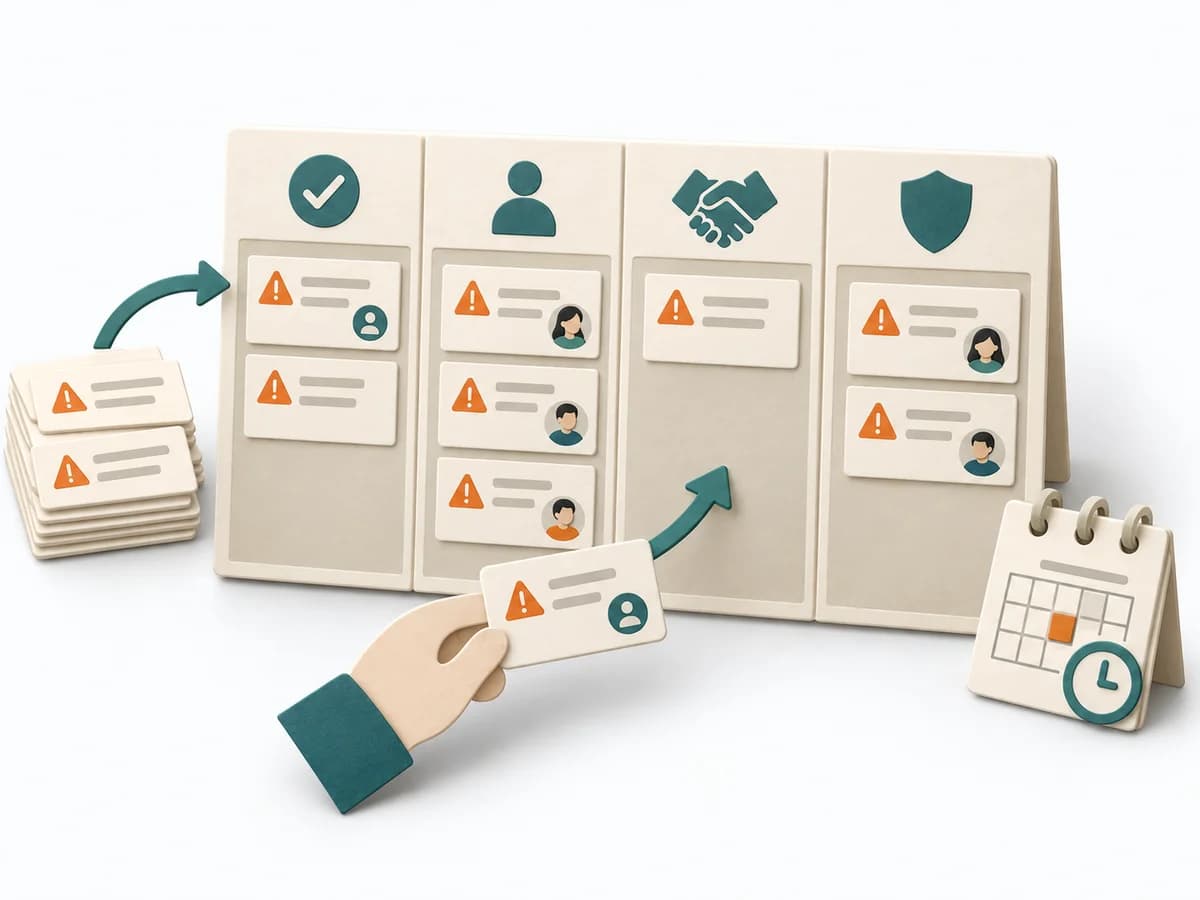 Agile ROAM Board |  Business Strategy GAP Analysis |  Product Strategy Impact Mapping |  UX Research Diary Study |
|---|---|---|---|---|
Purposedifferent | When work needs to move between different states or columns, it makes that movement and its handoffs legible. It sorts work by value, risk, and delivery ability. The result is captured as a ROAM Board and an Owner List. | GAP Analysis compares the current state with a target picture and makes the distance manageable. It becomes useful when, ahead of new initiatives, it must become clear which capabilities, processes, or resources are missing. | When a goal needs to be connected to several possible paths, it shows chains of impact instead of feature lists. It connects business goal, behavior change, and measures. | When experiences build up over days or weeks and a single session cannot capture them, Diary Study records the course of everyday life. Recurring triggers, moods, and habits become visible this way, beyond the sharpness of memory. |
Complexitydifferent | Low | Medium | Medium | Medium |
Timedifferent | 20-40 min initial, dann laufend | 1-3 h | 45-90 min | 1-4 Wochen |
Participantsdifferent | 3-15 | 2-8 | 3-8 | 5-20 |
Formatdifferent | Workshop + async | Workshop + async | Workshop | Async |
Outputdifferent | ROAM Board, Owner List | Gap Matrix, Action Plan, Risk Notes | Impact Map, Outcome Hypotheses, Delivery Options | Diary Entries, Longitudinal Patterns, Experience Timeline |
Tagsno overlap | RiskAgileTrackingAlignment | StrategyAnalysisPlanning | OutcomesStrategyBehaviorPlanning | UX researchTrackingBehavior |