View methods side by side.
Choose up to four methods. Add them using the search and share the comparison by copying its link.
| Criterion | 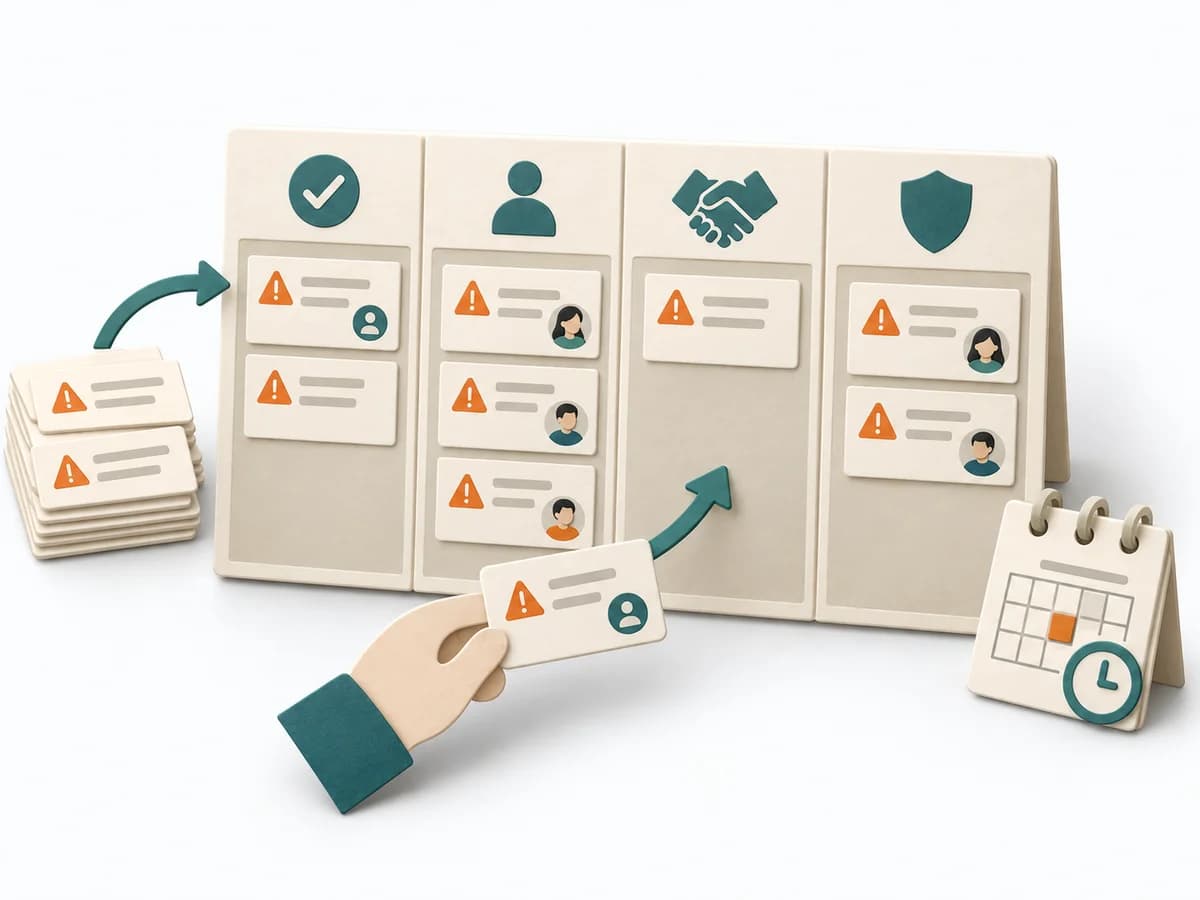 Agile ROAM Board |  Growth Flywheel |  UX Research Diary Study |  Growth Hooked Model |
|---|---|---|---|---|
Purposedifferent | When work needs to move between different states or columns, it makes that movement and its handoffs legible. It sorts work by value, risk, and delivery ability. The result is captured as a ROAM Board and an Owner List. | Growth often breaks down where a reinforcing mechanism builds up too much friction. A Flywheel shows the cycle of value, repetition, and reinforcement meant to sustain growth. | When experiences build up over days or weeks and a single session cannot capture them, Diary Study records the course of everyday life. Recurring triggers, moods, and habits become visible this way, beyond the sharpness of memory. | The Hooked Model helps clarify engagement loops, user behavior, and experiments. It makes repeat behavior measurable and captures the result as a hooked loop, trigger map, and reward design. |
Complexitydifferent | Low | Medium | Medium | Medium |
Timedifferent | 20-40 min initial, dann laufend | 60-120 min | 1-4 Wochen | Multiple workshops over several weeks |
Participantsdifferent | 3-15 | 3-8 | 5-20 | 2-8 |
Formatdifferent | Workshop + async | Workshop | Async | Workshop + async |
Outputdifferent | ROAM Board, Owner List | Flywheel Map, Friction Points, Growth Levers, Experiment Backlog | Diary Entries, Longitudinal Patterns, Experience Timeline | Hooked loop, Trigger map, Reward design, Ethics check |
Tagsno overlap | RiskAgileTrackingAlignment | GrowthRetentionConversion | UX researchTrackingBehavior | GrowthBehaviorRetention |