View methods side by side.
Choose up to four methods. Add them using the search and share the comparison by copying its link.
| Criterion | 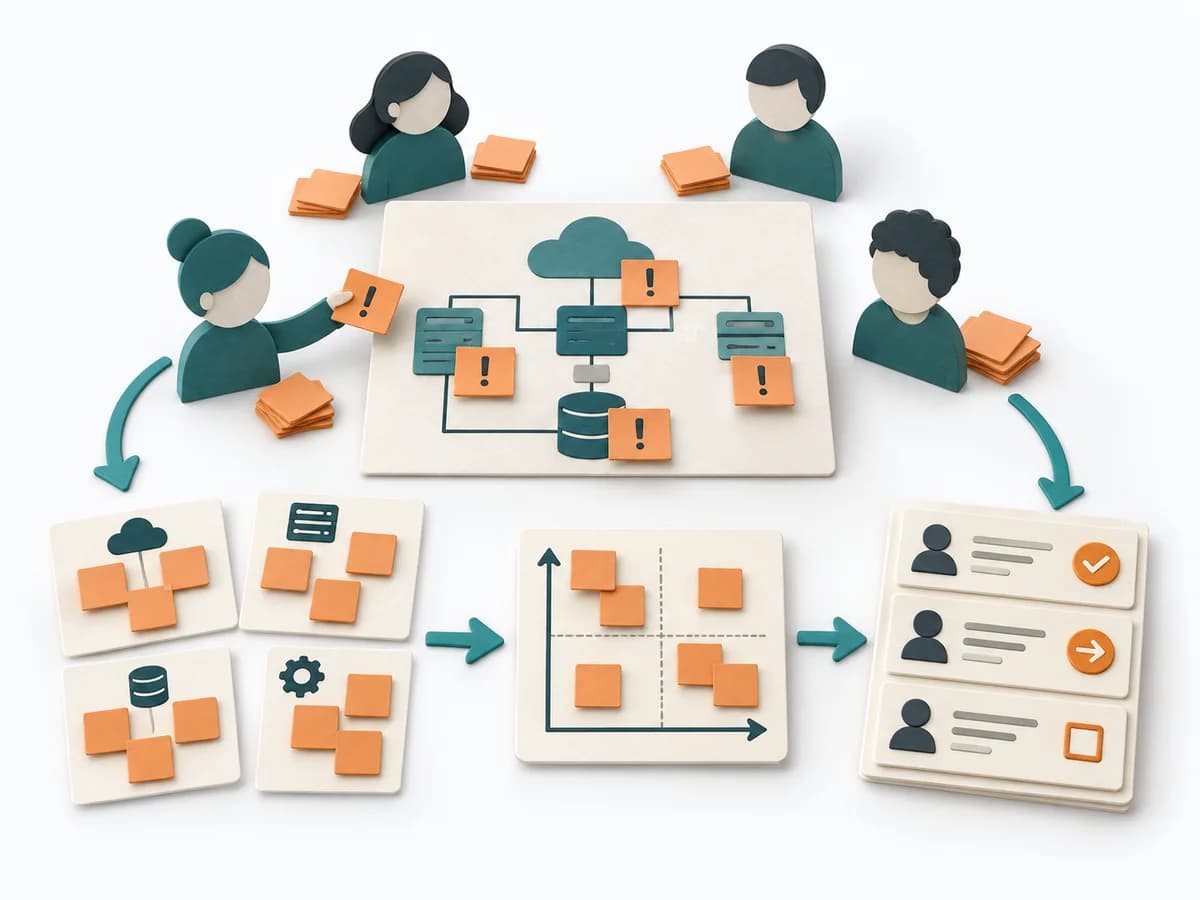 Architecture Risk Storming |  UX Research Usability Testing |  Product Discovery Experiment Canvas |  Product Discovery Test Card |
|---|---|---|---|---|
Purposedifferent | Helps clarify architecture context, options, and consequences in concrete terms. It organizes technical context, alternatives, and consequences. The result is captured as an Annotated Diagram, a Prioritized Risk List, and an Action Backlog. | When a product is built but people get stuck on tasks, usability testing shows the friction at concrete points. Observed use instead of self-report makes visible where orientation, understanding, or interaction breaks down. | When experiments become unreadable after the fact, it arranges hypothesis, signal, and learning goal on a single canvas. It separates problem, assumption, solution, and evidence. The result is captured as a Completed Experiment Canvas and a Success Metric. | The Test Card turns a critical assumption into a testable claim and specifies in advance which result counts as success. |
Complexitydifferent | Low | Medium | Low | Low |
Timedifferent | 60-90 min | 1-2 h je Session | 30-60 min | 20-35 min |
Participantsdifferent | 4-12 | Based on research question | 1-5 | 1-5 |
Formatdifferent | Workshop | Workshop + async | Workshop + async | Workshop + async |
Outputdifferent | Annotated Diagram, Prioritized Risk List, Action Backlog | Usability Issues, Severity List, Recommendations | Completed Experiment Canvas, Success Metric | Test Card with a pre-set threshold |
Tags1 shared | RiskArchitectureWorkshopValidation | ValidationUXPrototype | ExperimentsValidationDiscoveryHypothesis | ExperimentsValidationDiscoveryHypothesis |