View methods side by side.
Choose up to four methods. Add them using the search and share the comparison by copying its link.
| Criterion | 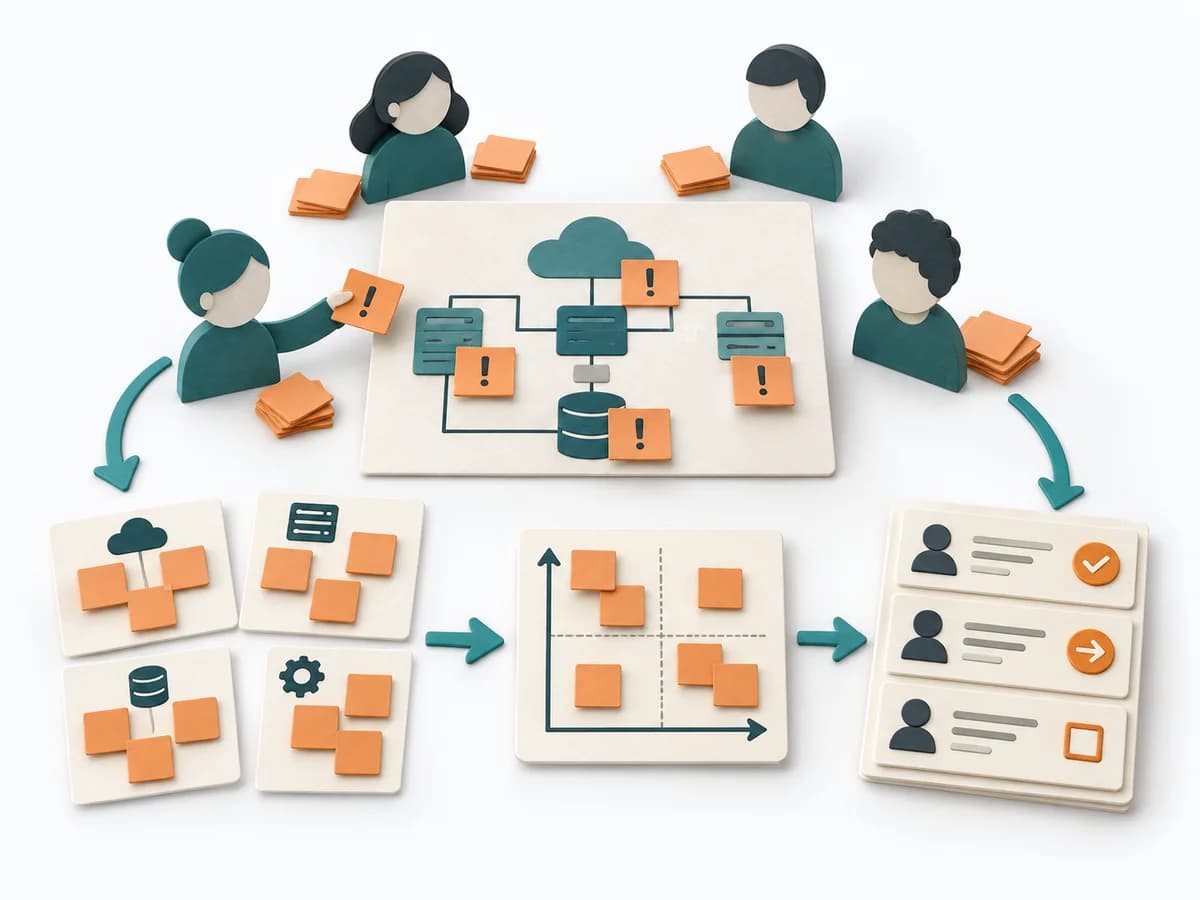 Architecture Risk Storming |  Operations After-Action Review |  Agile Sprint Retrospective |  Product Discovery Assumption Mapping |
|---|---|---|---|---|
Purposedifferent | Helps clarify architecture context, options, and consequences in concrete terms. It organizes technical context, alternatives, and consequences. The result is captured as an Annotated Diagram, a Prioritized Risk List, and an Action Backlog. | After missions or project phases with unclear outcomes, the method makes visible what actually happened and what can be learned from it. It separates course, effect, and causes so experience turns into solid improvement. | When a sprint is over and friction shouldn't simply be carried forward, it opens the view onto collaboration and patterns. It creates space to see causes and changes together. | When assumptions still sit unordered in the room, it weighs uncertainty against leverage. It makes visible which hypotheses should be checked first. |
Complexitydifferent | Low | Low | Low | Medium |
Timedifferent | 60-90 min | 20-45 min | Up to 3 hours for a one-month Sprint; shorter Sprints are usually shorter | 45-60 min |
Participantsdifferent | 4-12 | 3-12 | Scrum Team | 2-8 |
Formatdifferent | Workshop | Workshop + async | Workshop | Workshop + async |
Outputdifferent | Annotated Diagram, Prioritized Risk List, Action Backlog | Lessons learned, Action items, Event summary | Improvement actions, Team agreements | Assumption map, Test backlog, Risk ranking |
Tagsno overlap | RiskArchitectureWorkshopValidation | LearningOperationsImprovement | RetrospectiveImprovementLearning | AssumptionsRiskExperimentsValidation |