View methods side by side.
Choose up to four methods. Add them using the search and share the comparison by copying its link.
| Criterion | 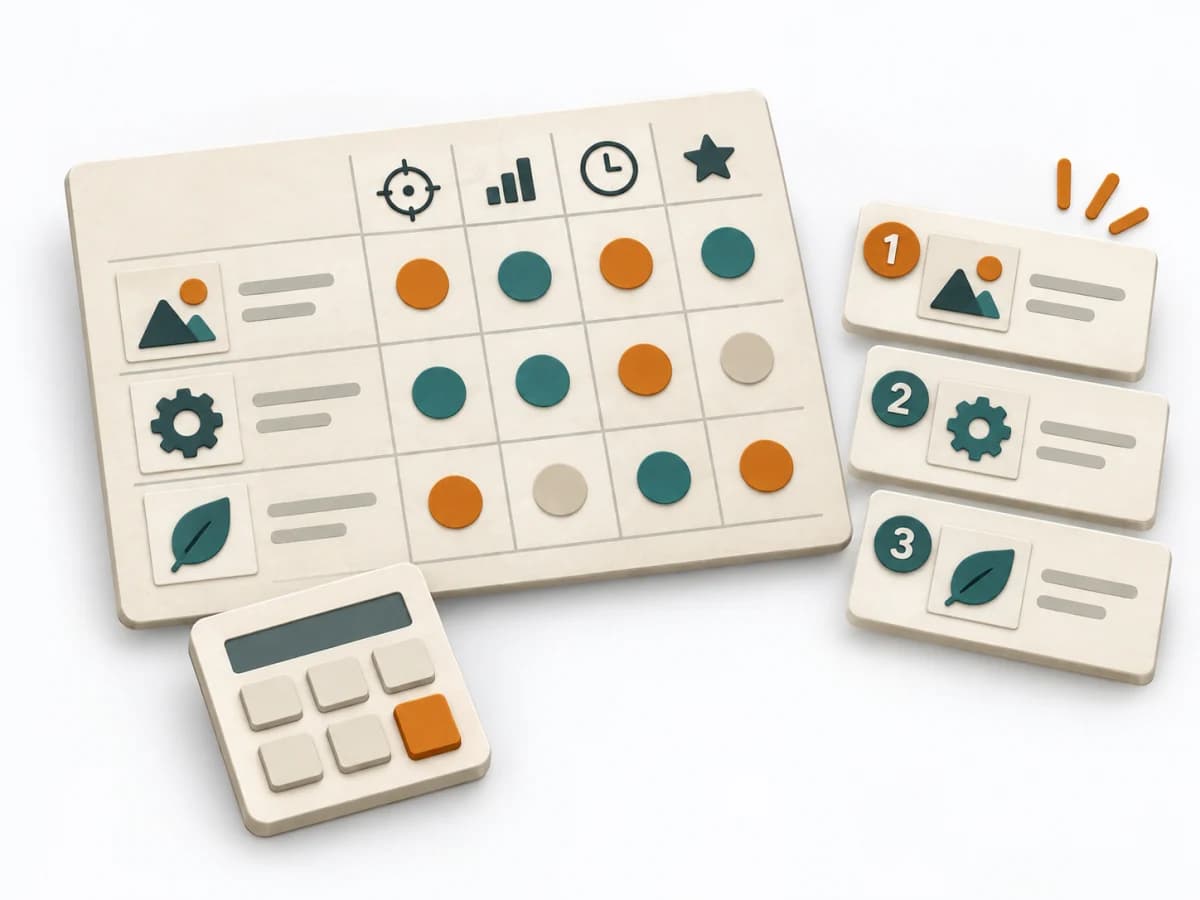 Product Strategy RICE Scoring |  Delivery RAID Log |  Decision Making Trade-off Analysis |  Decision Making Risk Matrix |
|---|---|---|---|---|
Purposedifferent | When many initiatives compete for the same resources, it brings reach, impact, confidence, and effort into one shared ranking. It makes prioritization economically connectable. | Helps clarify scope, sequence, and delivery flow in concrete terms. It makes work, boundaries, and order steerable. The result is captured as a RAID Log and a source for status reporting. | With limited resources, quality, speed, cost, and risk almost always compete with each other. Trade-off Analysis makes these tensions explicit and prevents decisions from producing hidden side effects. | When a project faces many possible disruptions, it quickly becomes unclear which risks deserve attention first. It separates options, evaluation criteria, and open risks. The result is captured as a Risk Matrix and a Top Risk List. |
Complexitydifferent | Medium | Low | Medium | Low |
Timedifferent | 60-90 min | 30 min Setup, dann laufend | 45-120 min | 30-60 min |
Participantsdifferent | 2-10 | 1-3 maintaining, briefing for everyone | 2-8 | 3-10 |
Formatdifferent | Workshop + async | Async | Workshop + async | Workshop + async |
Outputdifferent | RICE Scores, Ranked List, Assumption Log | RAID Log, Status Report Source | Trade-off Matrix, Criteria List, Decision Rationale, Accepted Downsides | Risk Matrix, Top Risk List |
Tagsno overlap | PrioritizationScoringRoadmapTradeoffs | RiskTrackingStakeholdersGovernance | TradeoffsDecisionCriteriaOptions | RiskDecisionPrioritizationAssessment |