View methods side by side.
Choose up to four methods. Add them using the search and share the comparison by copying its link.
| Criterion |  Delivery RAID Log |  UX Research User Interviews | 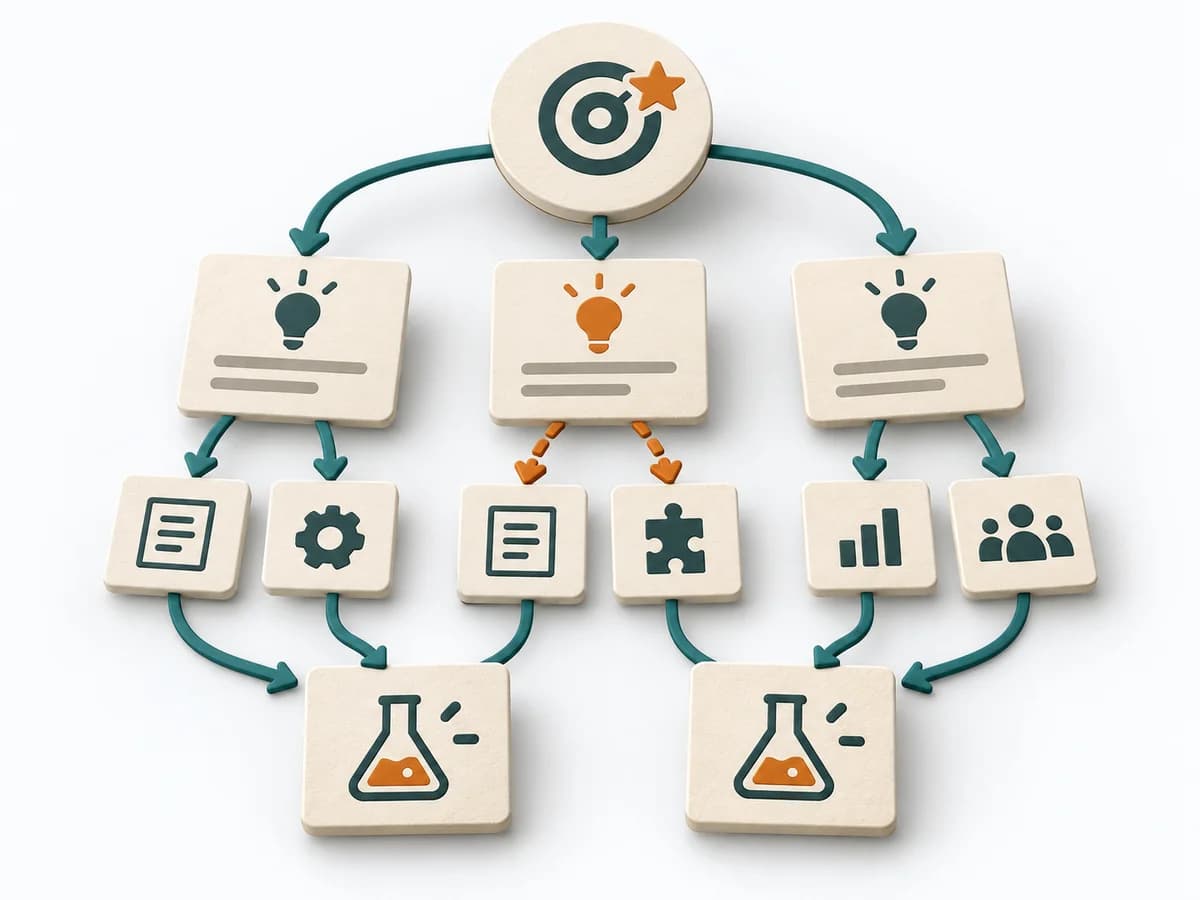 Product Discovery Opportunity Solution Tree |  Product Discovery Assumption Mapping |
|---|---|---|---|---|
Purposedifferent | Helps clarify scope, sequence, and delivery flow in concrete terms. It makes work, boundaries, and order steerable. The result is captured as a RAID Log and a source for status reporting. | When teams derive needs only from assumptions and real motives are missing, user interviews give direct access to behavior and meaning. Conversations from the target group's everyday life make patterns, tensions, and open questions solidly visible. | When discovery keeps swinging between goals, ideas, and learning loops, it creates clear steering logic. It connects the desired outcome, opportunities, and experiments into a legible structure. | When assumptions still sit unordered in the room, it weighs uncertainty against leverage. It makes visible which hypotheses should be checked first. |
Complexitydifferent | Low | Low | Medium | Medium |
Timedifferent | 30 min Setup, dann laufend | 30–60 min per interview | 1-2 h Setup, laufend | 45-60 min |
Participantsdifferent | 1-3 maintaining, briefing for everyone | 1 participant per interview | 2-6 | 2-8 |
Formatdifferent | Async | Workshop + async | Workshop + async | Workshop + async |
Outputdifferent | RAID Log, Status Report Source | Interview Notes, Themes, Insight Summary | Opportunity Solution Tree, Experiment Backlog, Learning Log | Assumption map, Test backlog, Risk ranking |
Tagsno overlap | RiskTrackingStakeholdersGovernance | QualitativeResearchCustomerDiscovery | DiscoveryOutcomesExperimentsOpportunity | AssumptionsRiskExperimentsValidation |