View methods side by side.
Choose up to four methods. Add them using the search and share the comparison by copying its link.
| Criterion | 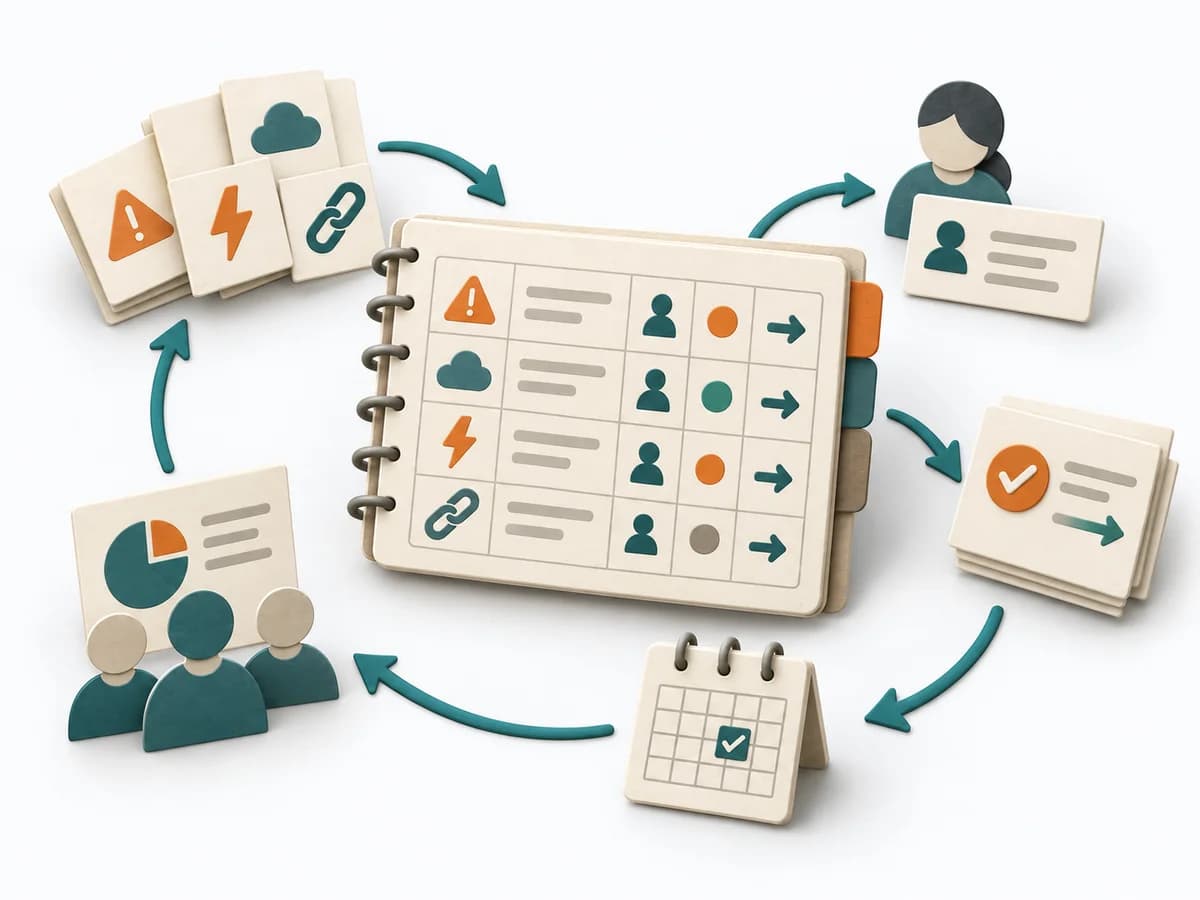 Delivery RAID Log |  Product Strategy Lean Canvas |  Decision Making Decision Rights Mapping |  Agile ROAM Board |
|---|---|---|---|---|
Purposedifferent | Helps clarify scope, sequence, and delivery flow in concrete terms. It makes work, boundaries, and order steerable. The result is captured as a RAID Log and a source for status reporting. | When an early product bet still has too many open points, it brings target group, problem, and assumptions into a single view. It condenses the idea so core risks become nameable. | In organizations with many stakeholders, it often blurs who actually decides and who is merely consulted. It separates options, evaluation criteria, and open risks. The result is captured as a Decision Rights matrix and an agreement. | When work needs to move between different states or columns, it makes that movement and its handoffs legible. It sorts work by value, risk, and delivery ability. The result is captured as a ROAM Board and an Owner List. |
Complexitydifferent | Low | Medium | Medium | Low |
Timedifferent | 30 min Setup, dann laufend | 45-90 min | 90-180 min | 20-40 min initial, dann laufend |
Participantsdifferent | 1-3 maintaining, briefing for everyone | 1-6 | 4-12 | 3-15 |
Formatdifferent | Async | Workshop + async | Workshop | Workshop + async |
Outputdifferent | RAID Log, Status Report Source | Lean Canvas, Core Assumptions, Experiment Backlog | Decision Rights Matrix, Agreement | ROAM Board, Owner List |
Tagsno overlap | RiskTrackingStakeholdersGovernance | StartupLeanAssumptionsBusiness model | DecisionGovernanceAlignmentResponsibility | RiskAgileTrackingAlignment |