View methods side by side.
Choose up to four methods. Add them using the search and share the comparison by copying its link.
| Criterion | 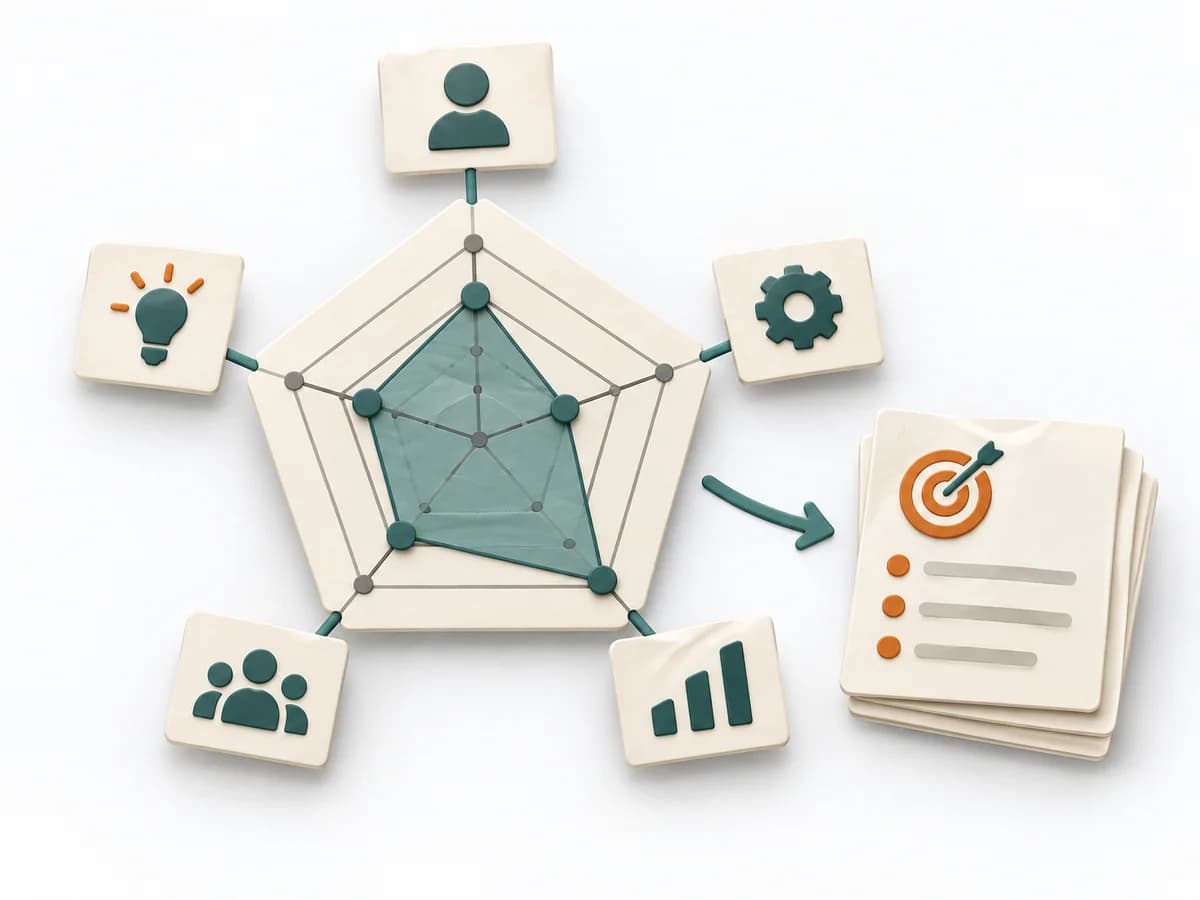 Decision Making Radar |  Decision Making Decision Tree |  Product Strategy DIBB |  Decision Making Delphi Method |
|---|---|---|---|---|
Purposedifferent | When capabilities, maturity levels, or market positions need to be compared across several dimensions, overview is easily lost. Radar brings different characteristics into a shared picture and shows patterns faster than tables do. | For decisions with follow-on paths and dependencies, a linear comparison is often not enough. A Decision Tree shows how options branch under conditions and which consequences hang on each branch. | DIBB helps clarify target groups, value, goals, and priorities by making the logic behind a decision explicit. It captures results as a DIBB document, belief list, bet list, and learning report. | When knowledge is distributed and direct dominance should be avoided, groups quickly fall under the sway of their opinion leaders. The Delphi Method gathers assessments iteratively and gradually brings expert judgments closer together. |
Complexitydifferent | Medium | Medium | Low | High |
Timedifferent | 1-2 h | 30-90 min | 1-2 h | 1-4 Wochen |
Participantsdifferent | 2-10 | 1-6 | 2-8 | 6-30 Experten |
Formatdifferent | Workshop + async | Workshop + async | Workshop + async | Async |
Outputdifferent | Radar Map, Capability Scores, Action Areas | Decision Tree, Option Map, Assumption List | DIBB document, Belief list, Bet list, Learning report | Expert Forecast, Consensus Range, Assumption Notes |
Tagsno overlap | AssessmentPortfolioCapability | DecisionTreeOptions | StrategyDecisionAssumptionsHypothesis | ForecastingExpertsDecisionStrategy |