View methods side by side.
Choose up to four methods. Add them using the search and share the comparison by copying its link.
| Criterion |  Facilitation Question Burst | 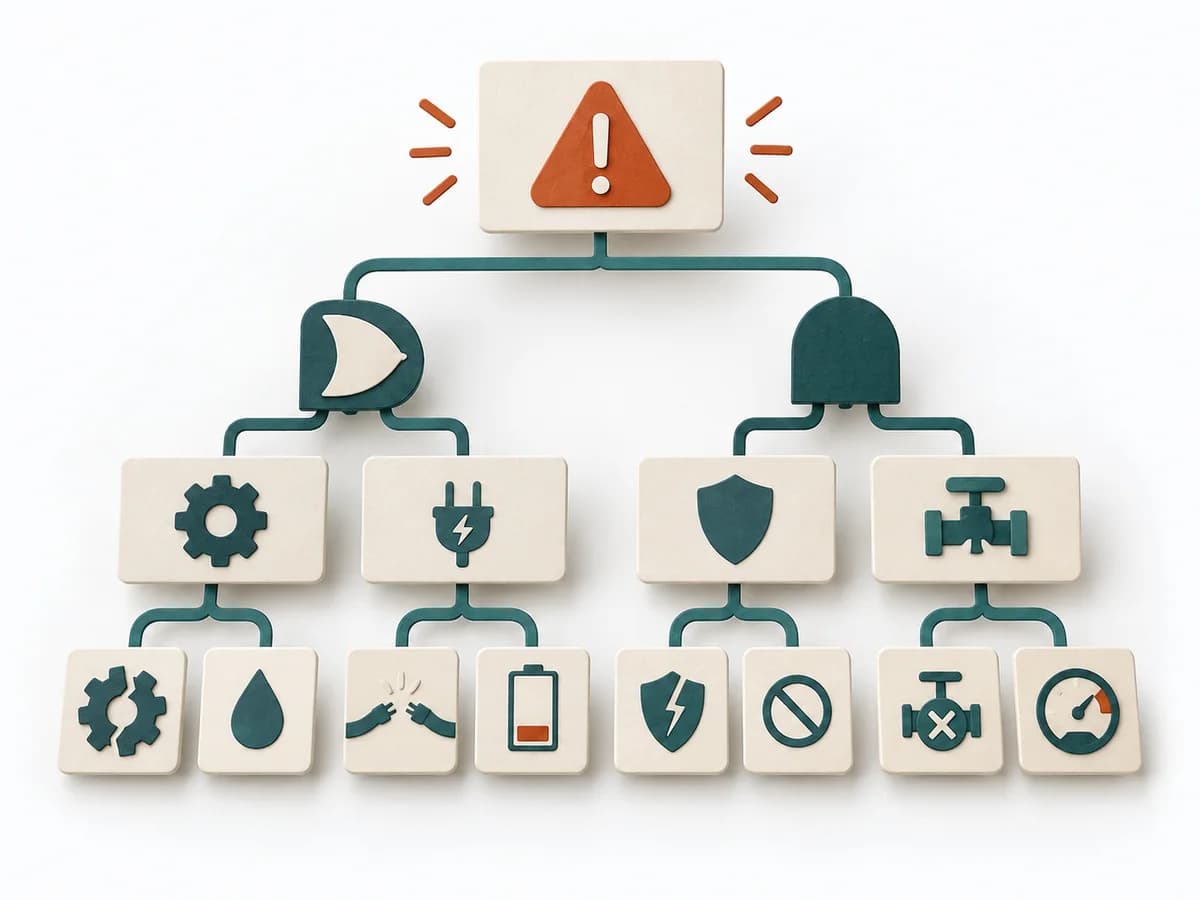 Operations Fault Tree Analysis |  Decision Making Red Teaming |  Decision Making Assumption Surfacing |
|---|---|---|---|---|
Purposedifferent | When a problem gets covered up too quickly with answers, Question Burst puts the better question at the center. The format opens the thinking space before the group commits to an interpretation. | For a critical top event with several possible triggers, the method logically models failure paths. It makes visible which combinations of conditions can lead to damage. | For strategic decisions with high reach, agreement and gut feeling are often not enough. Red teaming brings deliberate opposition into the situation and tests where a plan breaks under real counterarguments. | Plans often contain assumptions that were never openly stated and remain dangerous precisely because of that. Assumption Surfacing makes these silent premises visible and prioritizes which of them carry the initiative or could sink it. |
Complexitydifferent | Low | High | High | Low |
Timedifferent | 15-30 min | 2-6 h | 1-4 h | 45-90 min |
Participantsdifferent | 2-8 | 3-8 | 3-8 | 2-8 |
Formatdifferent | Workshop | Workshop + async | Workshop | Workshop + async |
Outputdifferent | Question List, Reframed Challenge, Learning Prompts | Fault Tree, Critical Paths, Cause Hypotheses, Control Actions | Challenge Findings, Risk Register, Mitigation Plan | Assumption List, Critical Assumptions, Learning Plan |
Tagsno overlap | QuestionsReframingFacilitationSensemaking | RiskRoot causeSafety | RiskDecisionSensemaking | AssumptionsRiskDecisionDiscovery |