View methods side by side.
Choose up to four methods. Add them using the search and share the comparison by copying its link.
| Criterion |  Decision Making Pre-Mortem |  Systems Thinking Current Reality Tree | 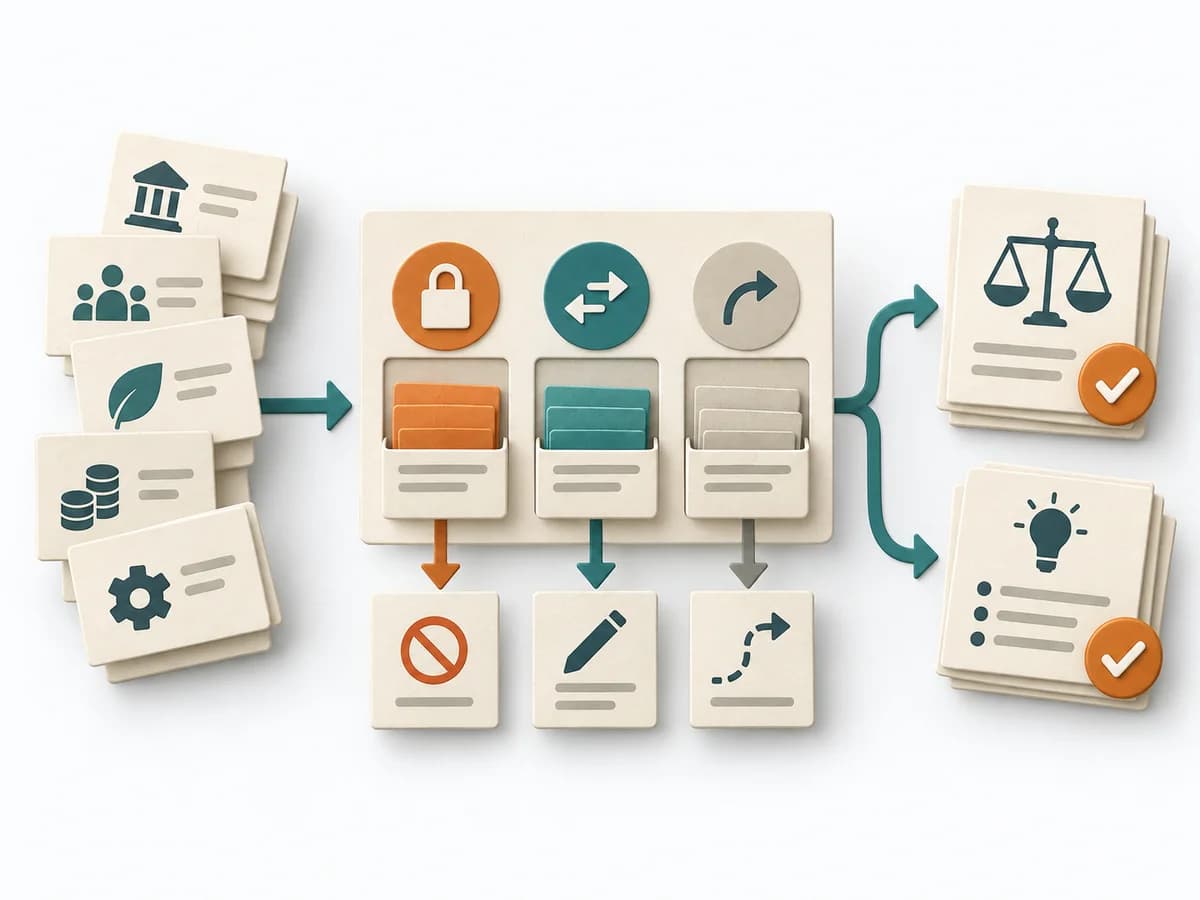 Decision Making Constraint Analysis |  Decision Making Assumption Surfacing |
|---|---|---|---|---|
Purposedifferent | In early initiatives with many uncertainties, planning quickly turns too optimistic. A pre-mortem makes the expected failure visible in advance and sharpens the view of causes, gaps, and countermeasures. | A Current Reality Tree condenses many symptoms into a few causal chains. The method makes visible which core problems drive several negative effects at once. | When an initiative stalls, the limit often lies not in the idea but in hard or soft boundary conditions. Constraint Analysis separates these limits and shows which of them can actually be shaped. | Plans often contain assumptions that were never openly stated and remain dangerous precisely because of that. Assumption Surfacing makes these silent premises visible and prioritizes which of them carry the initiative or could sink it. |
Complexitydifferent | Low | High | Low | Low |
Timedifferent | 20–45 min | 2-6 h | 30-90 min | 45-90 min |
Participantsdifferent | Small cross-functional group | 3-8 | 2-8 | 2-8 |
Formatdifferent | Workshop | Workshop | Workshop + async | Workshop + async |
Outputdifferent | Risk list, Mitigation plan, Assumption log | Current Reality Tree, Core Problems, Intervention Ideas | Constraint List, Hard/Soft Classification, Option Impact Notes, Decision Boundaries | Assumption List, Critical Assumptions, Learning Plan |
Tagsno overlap | RiskDecisionFailurePlanning | Systems thinkingRoot causeConstraintsCausality | ConstraintsDecisionPlanningOptions | AssumptionsRiskDecisionDiscovery |