View methods side by side.
Choose up to four methods. Add them using the search and share the comparison by copying its link.
| Criterion |  Systems Thinking Polarity Mapping |  Business Strategy Value Chain Analysis |  Growth A/B Testing | 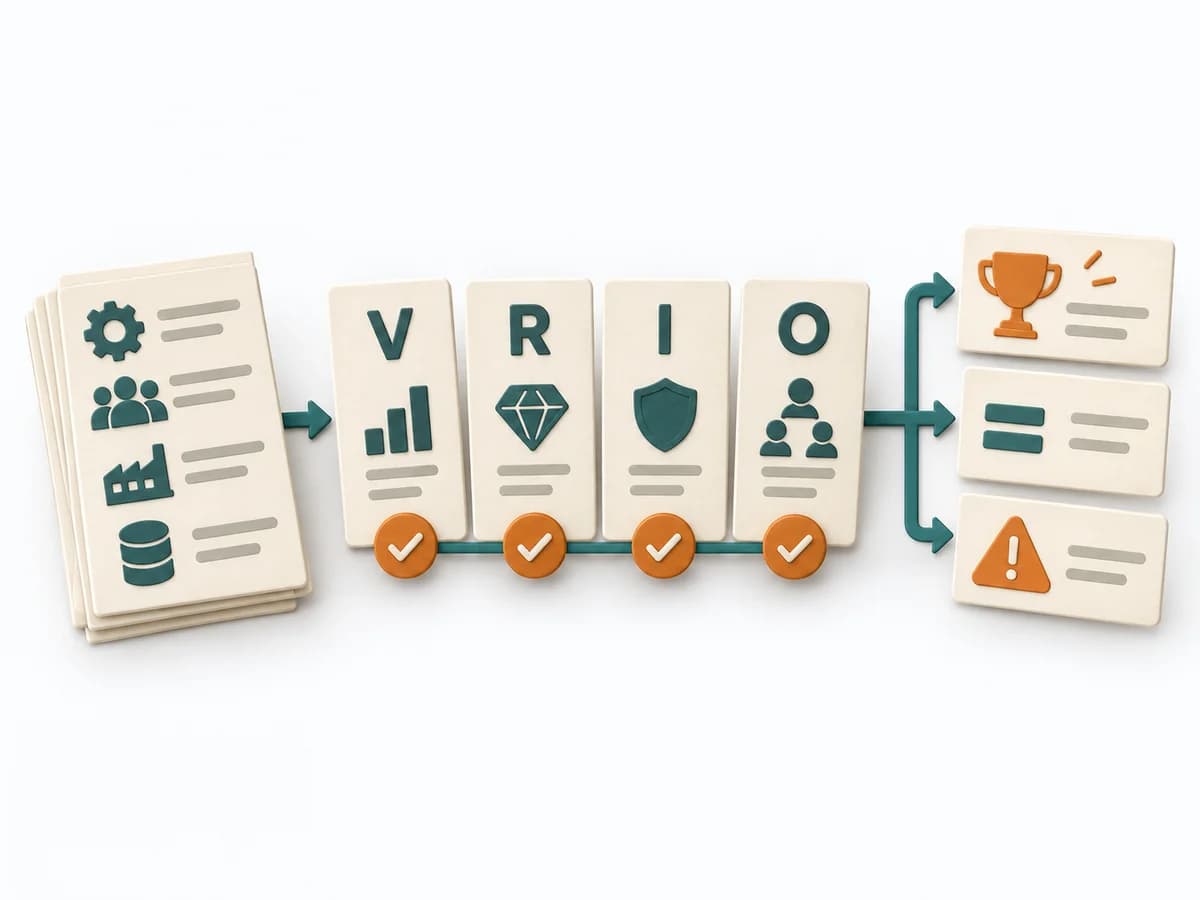 Business Strategy VRIO Framework |
|---|---|---|---|---|
Purposedifferent | Polarity Mapping makes tensions between two opposing poles tangible, such as standardization and adaptation or control and autonomy. The method guards against making apparent either-or decisions prematurely. | Value Chain Analysis shows where value is created, costs accrue, and differentiation becomes possible along the process. It compares strengths, risks, market logic, and courses of action. The result is captured as a value-chain map and lever list. | When two variants compete, discussions quickly decide by taste rather than effect. A/B Testing checks behavior under controlled conditions and separates real improvement from chance or expectation effects. | The VRIO Framework rates resources and capabilities on whether they are Valuable, Rare, Inimitable, and Organized. It compares strengths, risks, market logic, and courses of action. The result is captured as a VRIO table and strategic actions. |
Complexitydifferent | Medium | High | High | Medium |
Timedifferent | 1-2 h | Half day | 1-4 Wochen | 90-180 min |
Participantsdifferent | 3-12 | 3-8 | 1-6 | 3-6 |
Formatdifferent | Workshop | Workshop | Async | Workshop |
Outputdifferent | Polarity Map, Warning Signs, Balance Actions | Value Chain Map, Lever List | Experiment results, Decision log, Learning summary | VRIO Table, Strategic Actions |
Tagsno overlap | Systems thinkingTradeoffsLeadership | StrategyBusiness modelDiagnosisAnalysis | ExperimentsGrowthAnalyticsValidation | StrategyDiagnosisBusiness modelCapability |