View methods side by side.
Choose up to four methods. Add them using the search and share the comparison by copying its link.
| Criterion |  Systems Thinking Polarity Mapping |  Business Strategy GAP Analysis | 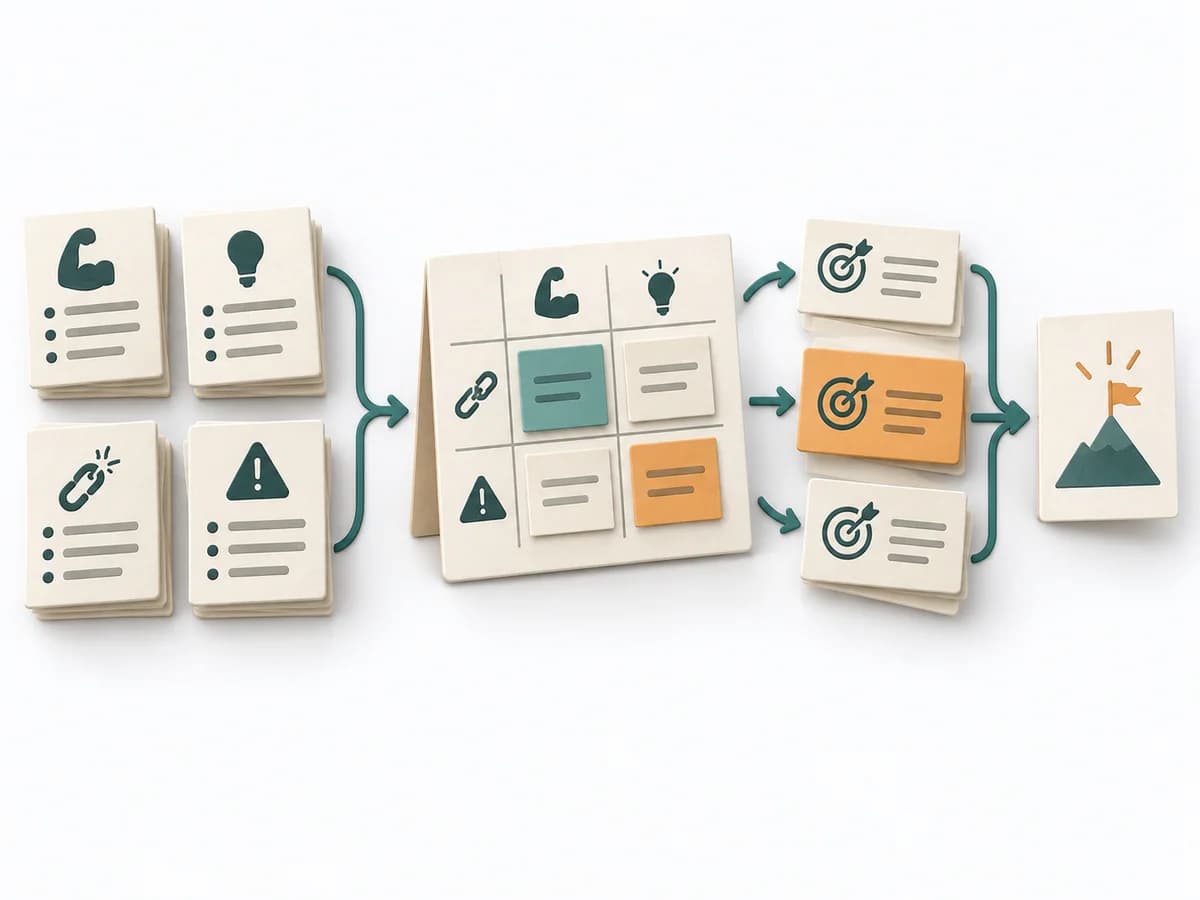 Business Strategy TOWS Matrix |  Decision Making Constraint Analysis |
|---|---|---|---|---|
Purposedifferent | Polarity Mapping makes tensions between two opposing poles tangible, such as standardization and adaptation or control and autonomy. The method guards against making apparent either-or decisions prematurely. | GAP Analysis compares the current state with a target picture and makes the distance manageable. It becomes useful when, ahead of new initiatives, it must become clear which capabilities, processes, or resources are missing. | The TOWS Matrix connects internal strengths and weaknesses with external opportunities and threats into action-oriented strategies. It goes a step further than a pure stocktaking. | When an initiative stalls, the limit often lies not in the idea but in hard or soft boundary conditions. Constraint Analysis separates these limits and shows which of them can actually be shaped. |
Complexitydifferent | Medium | Medium | Medium | Low |
Timedifferent | 1-2 h | 1-3 h | 1-2 h | 30-90 min |
Participantsdifferent | 3-12 | 2-8 | 3-10 | 2-8 |
Formatdifferent | Workshop | Workshop + async | Workshop | Workshop + async |
Outputdifferent | Polarity Map, Warning Signs, Balance Actions | Gap Matrix, Action Plan, Risk Notes | TOWS Matrix, Strategic Options, Priority Actions | Constraint List, Hard/Soft Classification, Option Impact Notes, Decision Boundaries |
Tagsno overlap | Systems thinkingTradeoffsLeadership | StrategyAnalysisPlanning | StrategyAnalysisOptions | ConstraintsDecisionPlanningOptions |