View methods side by side.
Choose up to four methods. Add them using the search and share the comparison by copying its link.
| Criterion |  Systems Thinking Polarity Mapping | 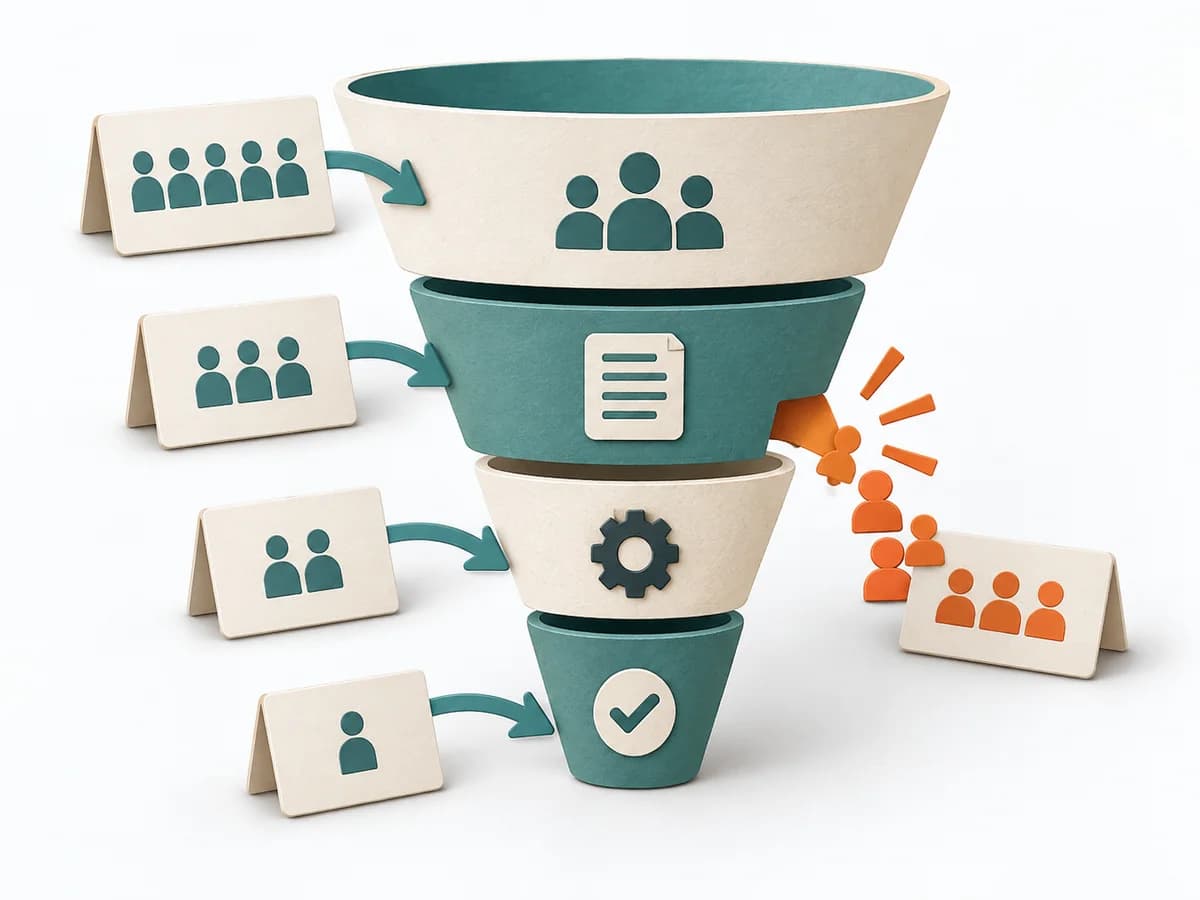 Growth Funnel Analysis |  Decision Making Force Field Analysis |  Growth A/B Testing |
|---|---|---|---|---|
Purposedifferent | Polarity Mapping makes tensions between two opposing poles tangible, such as standardization and adaptation or control and autonomy. The method guards against making apparent either-or decisions prematurely. | When many visitors or users drop off along the way, the reason behind the number often stays hidden. Funnel Analysis exposes these transitions and makes visible exactly where the path collapses. | In change initiatives, supporting and restraining forces sit at the table at the same time. Force Field Analysis makes these tensions explicit and shows where change can be pushed forward by strengthening or relieving. | When two variants compete, discussions quickly decide by taste rather than effect. A/B Testing checks behavior under controlled conditions and separates real improvement from chance or expectation effects. |
Complexitydifferent | Medium | Medium | Low | High |
Timedifferent | 1-2 h | 1-3 h | 45-90 min | 1-4 Wochen |
Participantsdifferent | 3-12 | 1-5 | 3-12 | 1-6 |
Formatdifferent | Workshop | Async | Workshop | Async |
Outputdifferent | Polarity Map, Warning Signs, Balance Actions | Funnel report, Drop-off analysis, Optimization hypotheses | Force Field Map, Change Levers, Risk Notes | Experiment results, Decision log, Learning summary |
Tagsno overlap | Systems thinkingTradeoffsLeadership | AnalyticsConversionGrowth | ChangeDecisionStrategy | ExperimentsGrowthAnalyticsValidation |