View methods side by side.
Choose up to four methods. Add them using the search and share the comparison by copying its link.
| Criterion |  UX Research Personas | 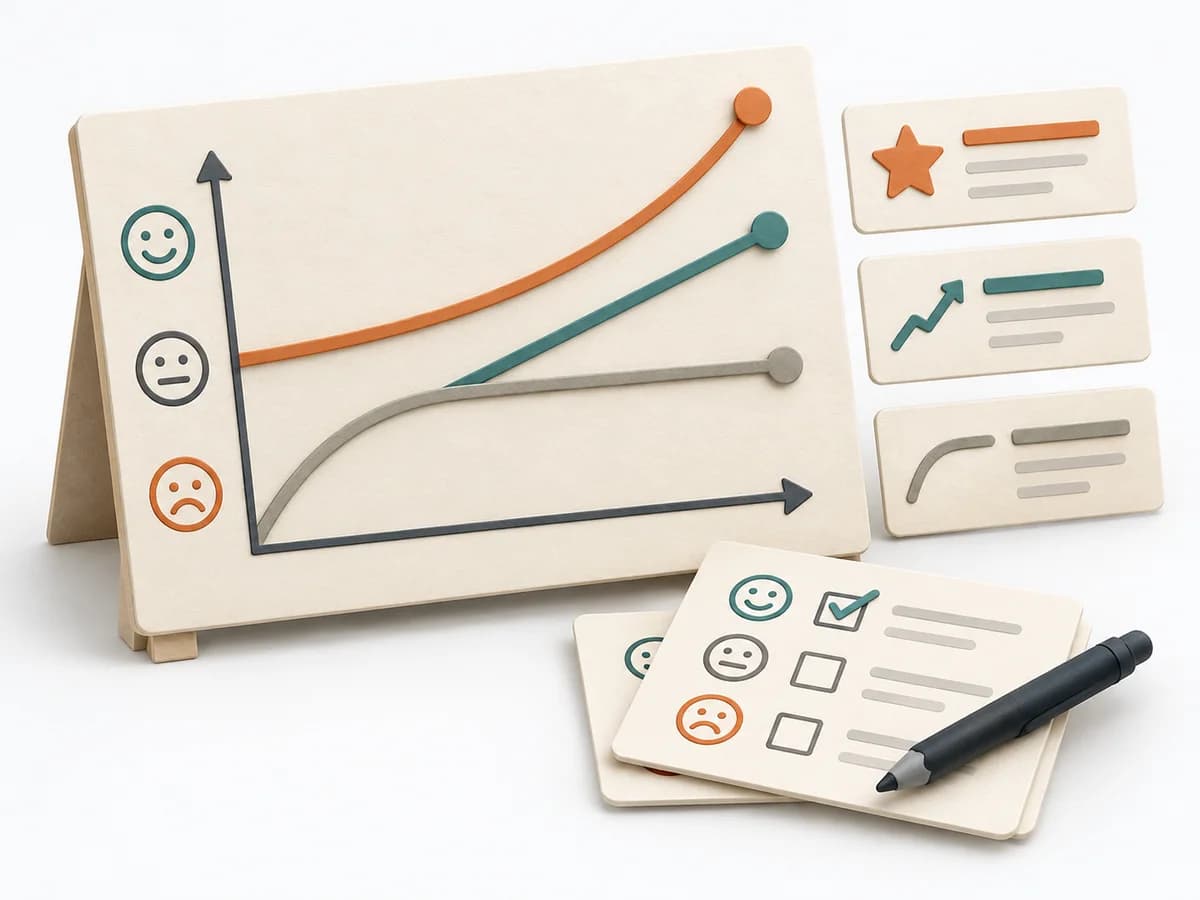 Product Discovery Kano Model |  Growth A/B Testing |  Product Discovery Assumption Mapping |
|---|---|---|---|---|
Purposedifferent | When target groups stay too vague and teams talk about the same people differently, personas create a shared, solid picture of usage. Condensed profiles make needs, contexts, and differences tangible enough for decisions. | When features need to be distinguished by their effect on satisfaction, it makes expectations and surprises comparable. It separates basic needs, performance contribution, and delight. | When two variants compete, discussions quickly decide by taste rather than effect. A/B Testing checks behavior under controlled conditions and separates real improvement from chance or expectation effects. | When assumptions still sit unordered in the room, it weighs uncertainty against leverage. It makes visible which hypotheses should be checked first. |
Complexitydifferent | Medium | Medium | High | Medium |
Timedifferent | 1-3 Tage | 1-2 Tage | 1-4 Wochen | 45-60 min |
Participantsdifferent | Internes Team | 10-50 | 1-6 | 2-8 |
Formatdifferent | Workshop + async | Workshop + async | Async | Workshop + async |
Outputdifferent | Persona Profiles, Needs Summary, Scenario Notes | Kano Matrix, Feature Classes, Priority Themes | Experiment results, Decision log, Learning summary | Assumption map, Test backlog, Risk ranking |
Tagsno overlap | ResearchCustomerSynthesis | SatisfactionPrioritizationCustomer | ExperimentsGrowthAnalyticsValidation | AssumptionsRiskExperimentsValidation |