View methods side by side.
Choose up to four methods. Add them using the search and share the comparison by copying its link.
| Criterion |  Operations PDCA Cycle |  Delivery MoSCoW | 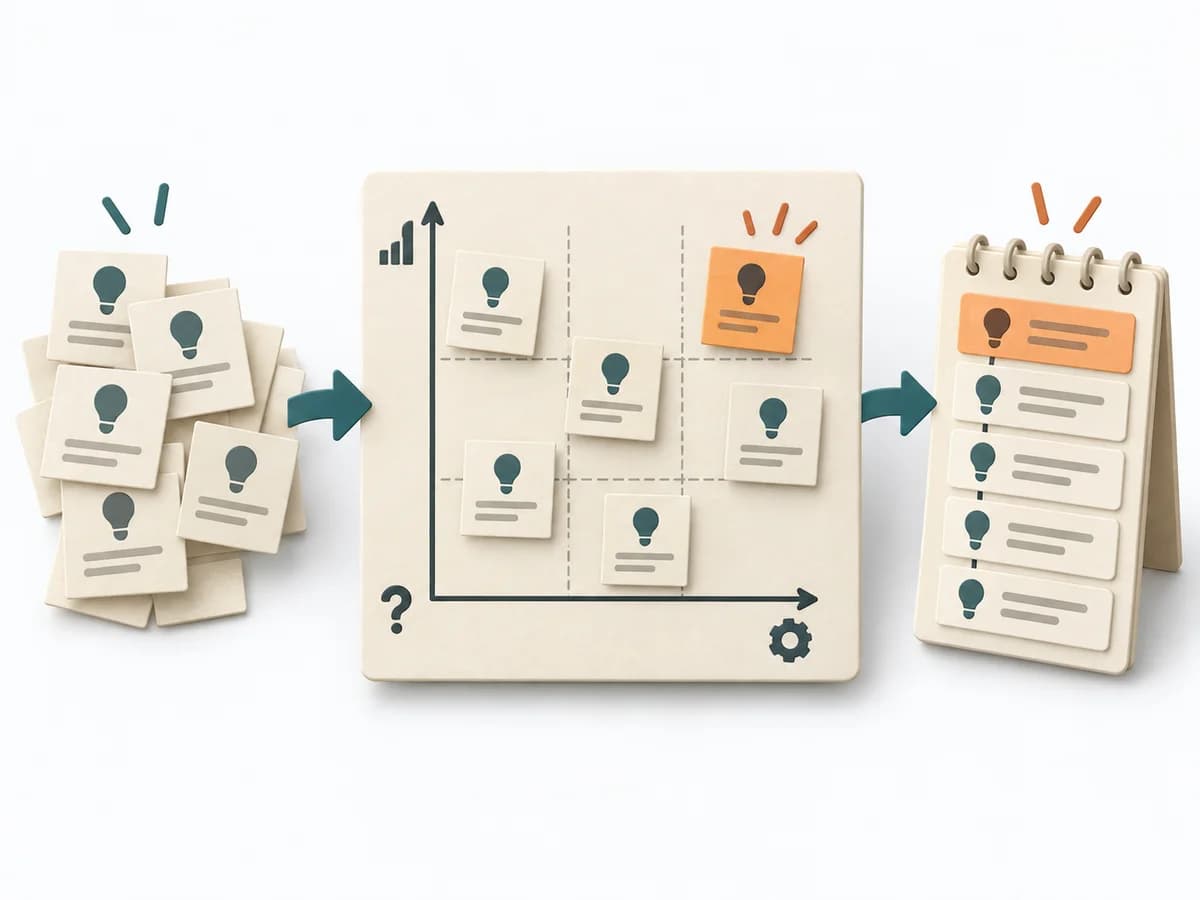 Product Discovery Hypothesis Prioritization Canvas |  Delivery Cost of Delay |
|---|---|---|---|---|
Purposedifferent | For an improvement that still has to prove itself in everyday work, the method runs it through small learning loops. It connects planning, checking, and standardization into a repeatable learning mode. | When a release carries too many demands and priorities are only ever negotiated, MoSCoW creates clear boundaries for the next cut. Must, Should, Could, and Won't make commitment, room for maneuver, and trade-off logic visible to everyone involved. | When many hypotheses compete for attention, it brings order to their learning sequence and importance. It separates problem, assumption, solution, and evidence. The result is captured as a prioritization canvas and a hypothesis backlog. | Helps clarify scope, order, and delivery flow in concrete terms. It makes work, constraints, and sequence manageable. The result is captured as a Cost of Delay table and prioritization sequence. |
Complexitydifferent | Low | Low | Medium | High |
Timedifferent | 1 h bis mehrere Wochen | 30-90 min | 60-90 min | 90-180 min |
Participantsdifferent | 1-8 | 3-12 | 3-8 | 3-8 |
Formatdifferent | Workshop + async | Workshop + async | Workshop | Workshop |
Outputdifferent | PDCA Log, Experiment Plan, Learning Outcome, Standard Change | Prioritized Backlog, Release Scope, Tradeoff Notes | Prioritization Canvas, Hypothesis Backlog | CoD Table, Prioritization Sequence |
Tagsno overlap | Continuous improvementLeanExperiments | PrioritizationScopeDecision | ExperimentsPrioritizationDiscoveryHypothesis | PrioritizationDeliveryEconomicsDecision |