View methods side by side.
Choose up to four methods. Add them using the search and share the comparison by copying its link.
| Criterion |  Operations PDCA Cycle |  Knowledge Modeling Domain Storytelling |  Operations Barrier Analysis | 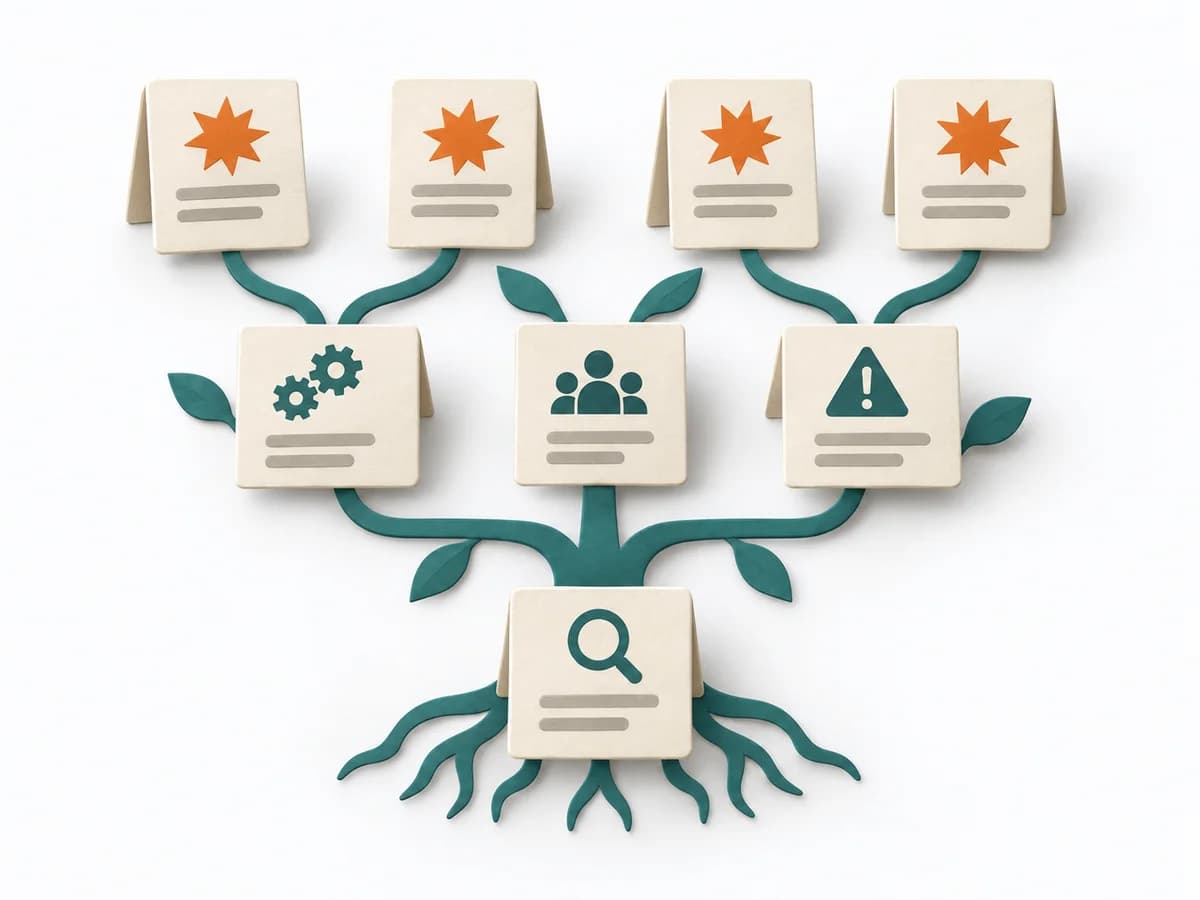 Operations Family Tree Analysis |
|---|---|---|---|---|
Purposedifferent | For an improvement that still has to prove itself in everyday work, the method runs it through small learning loops. It connects planning, checking, and standardization into a repeatable learning mode. | Domain Storytelling translates domain knowledge into a shared narrative of actors, objects, and workflows. It is especially useful when language, rules, and process understanding must be tightly connected. | For a risk that can only be managed through multiple layers of protection, the method examines the effectiveness of each barrier. It shows where safeguards are missing, too weak, or fail under real conditions. | For a series of incidents with a similar pattern, the method arranges individual events as branches of a common origin. It makes visible which conditions keep recurring. |
Complexitydifferent | Low | Low | Medium | Medium |
Timedifferent | 1 h bis mehrere Wochen | 1-2 h | 2-4 h | 2-4 h |
Participantsdifferent | 1-8 | 2-8 | 2-6 | 2-6 |
Formatdifferent | Workshop + async | Workshop | Workshop + async | Workshop + async |
Outputdifferent | PDCA Log, Experiment Plan, Learning Outcome, Standard Change | Domain Story, Glossary Notes, Process Narrative | Barrier Inventory, Failure Analysis per Barrier, Action Backlog | Family Tree Diagram, Pattern Notes, Systemic Measures |
Tagsno overlap | Continuous improvementLeanExperiments | KnowledgeDomain-Driven DesignProcess | Root causeSafetyIncident | Root causePatternsIncidentSystemic |