View methods side by side.
Choose up to four methods. Add them using the search and share the comparison by copying its link.
| Criterion |  Operations PDCA Cycle |  Growth A/B Testing | 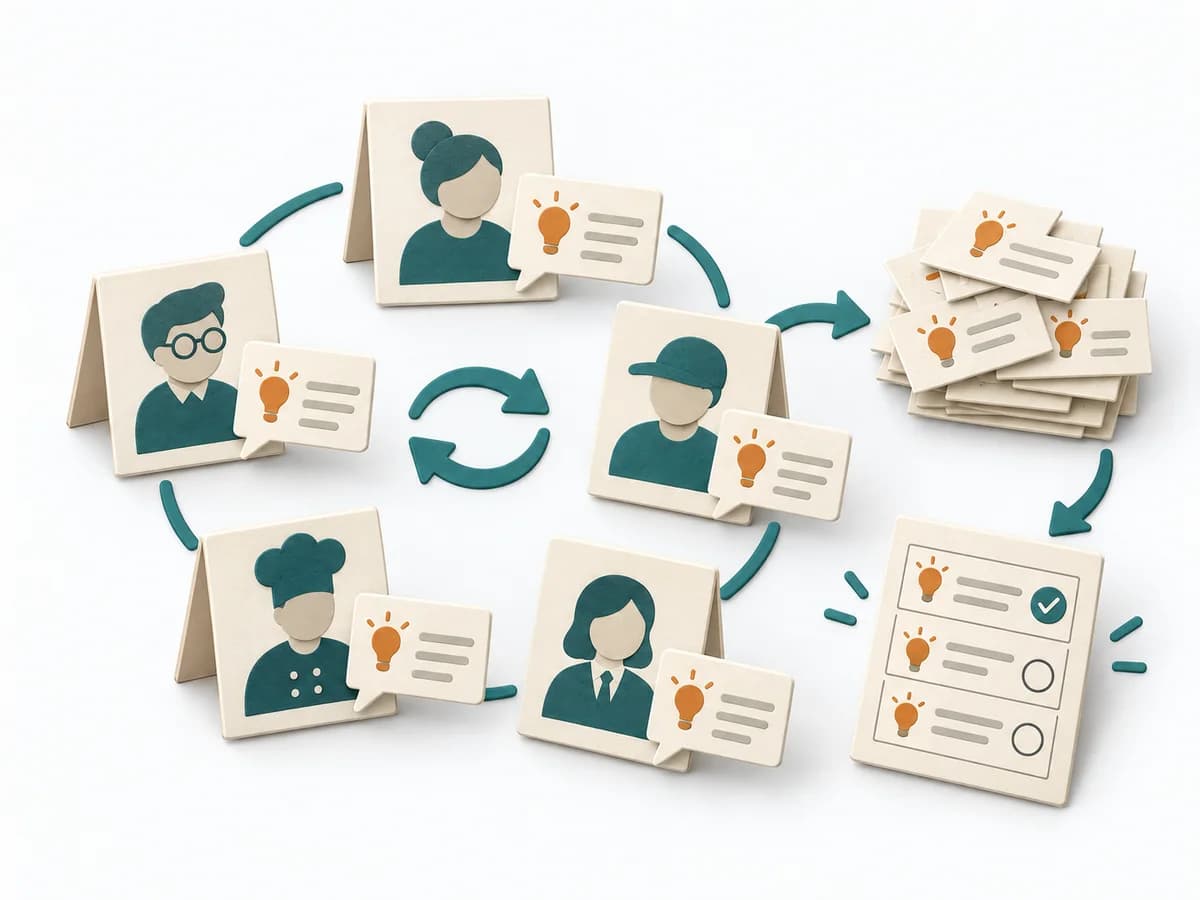 Innovation Rolestorming |  Innovation Reverse Brainstorming |
|---|---|---|---|---|
Purposedifferent | For an improvement that still has to prove itself in everyday work, the method runs it through small learning loops. It connects planning, checking, and standardization into a repeatable learning mode. | When two variants compete, discussions quickly decide by taste rather than effect. A/B Testing checks behavior under controlled conditions and separates real improvement from chance or expectation effects. | When a search for ideas stalls, switching roles helps people step outside their own perspective and activate new logics of action. The method reduces habit because contributions arise from a different stance. This brings unfamiliar, often fitting solution approaches into play. | For persistent errors or blockages, the method shifts the view to the opposite of the desired effect. It exposes the mechanics of failure and makes hidden causes easier to grasp. This makes improvement more concrete and the problem clearer. |
Complexitydifferent | Low | High | Low | Low |
Timedifferent | 1 h bis mehrere Wochen | 1-4 Wochen | 30-60 min | 30-60 min |
Participantsdifferent | 1-8 | 1-6 | 3-12 | 3-12 |
Formatdifferent | Workshop + async | Async | Workshop | Workshop |
Outputdifferent | PDCA Log, Experiment Plan, Learning Outcome, Standard Change | Experiment results, Decision log, Learning summary | Rollenkarten, Ideenpool pro Rolle, Konsolidierte Shortlist | Reverse Ideas, Risk Themes, Solution Ideas |
Tagsno overlap | Continuous improvementLeanExperiments | ExperimentsGrowthAnalyticsValidation | BrainstormingIdeationCreativity | BrainstormingIdeationCreativityRisk |