View methods side by side.
Choose up to four methods. Add them using the search and share the comparison by copying its link.
| Criterion | 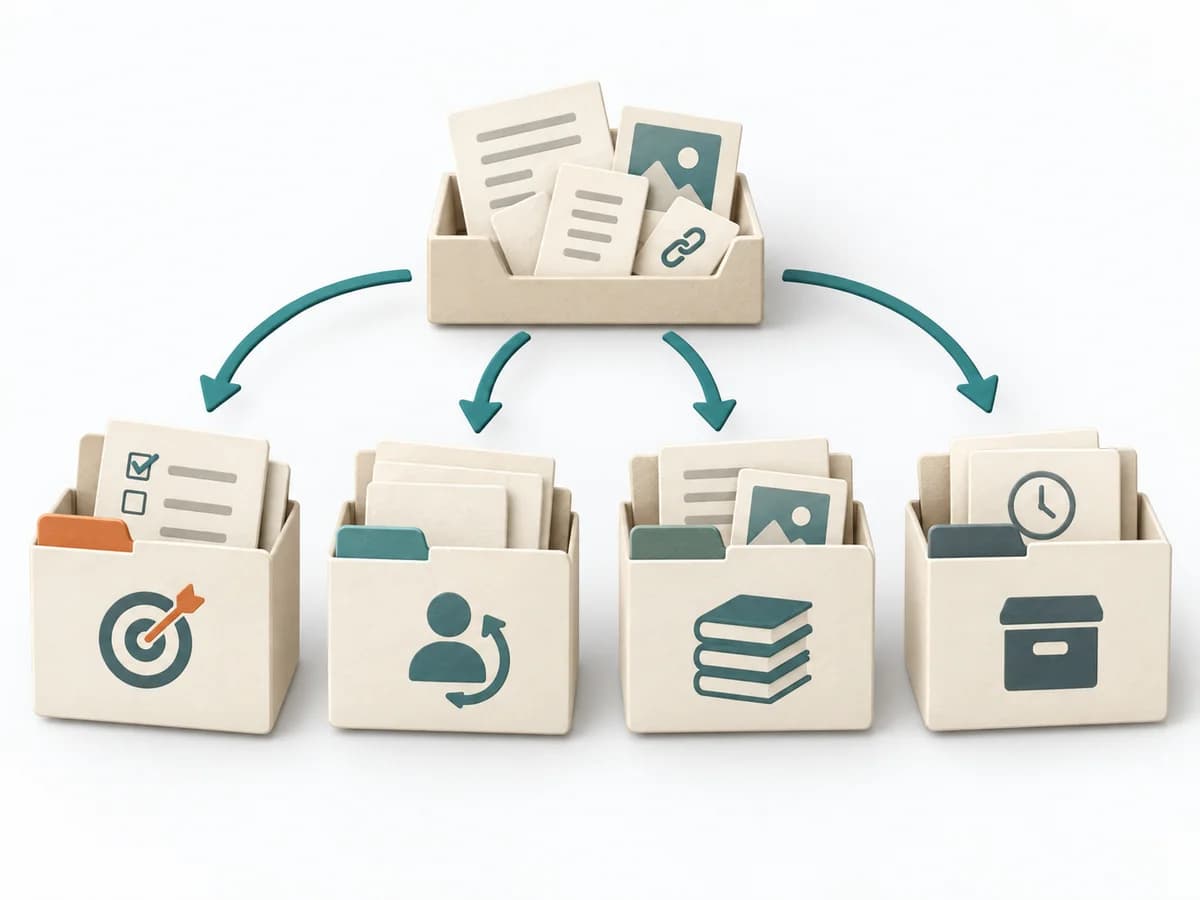 Knowledge Modeling PARA Method |  Product Discovery Smoke Test |  Decision Making Assumption Surfacing |  Product Discovery Fake Door Test |
|---|---|---|---|---|
Purposedifferent | The PARA Method organizes knowledge into Projects, Areas, Resources, and Archives. It creates order when digital notes, files, and tasks no longer cleanly fit current work. | When demand only needs to be roughly verified, it tests interest with minimal effort. It measures whether people would take a next step at all. | Plans often contain assumptions that were never openly stated and remain dangerous precisely because of that. Assumption Surfacing makes these silent premises visible and prioritizes which of them carry the initiative or could sink it. | When demand is still unclear, it measures interest in a feature before it is built. It separates real behavior from polite agreement and deliberately keeps build effort small. |
Complexitydifferent | Medium | Low | Low | Medium |
Timedifferent | 1-3 h Setup, laufend | 1-5 Tage | 45-90 min | 1-5 Tage |
Participantsdifferent | 1 | Nutzertraffic | 2-8 | Nutzertraffic |
Formatdifferent | Async | Async | Workshop + async | Async |
Outputdifferent | PARA Structure, Project Notes, Knowledge Archive | Interest Metrics, Conversion Signal, Learning Note | Assumption List, Critical Assumptions, Learning Plan | Click Data, Interest Signal, Learning Decision |
Tagsno overlap | KnowledgeProductivityOrganization | ValidationExperimentsDemandGrowth | AssumptionsRiskDecisionDiscovery | ValidationExperimentsDemandDiscovery |