View methods side by side.
Choose up to four methods. Add them using the search and share the comparison by copying its link.
| Criterion |  Knowledge Modeling PARA Method | 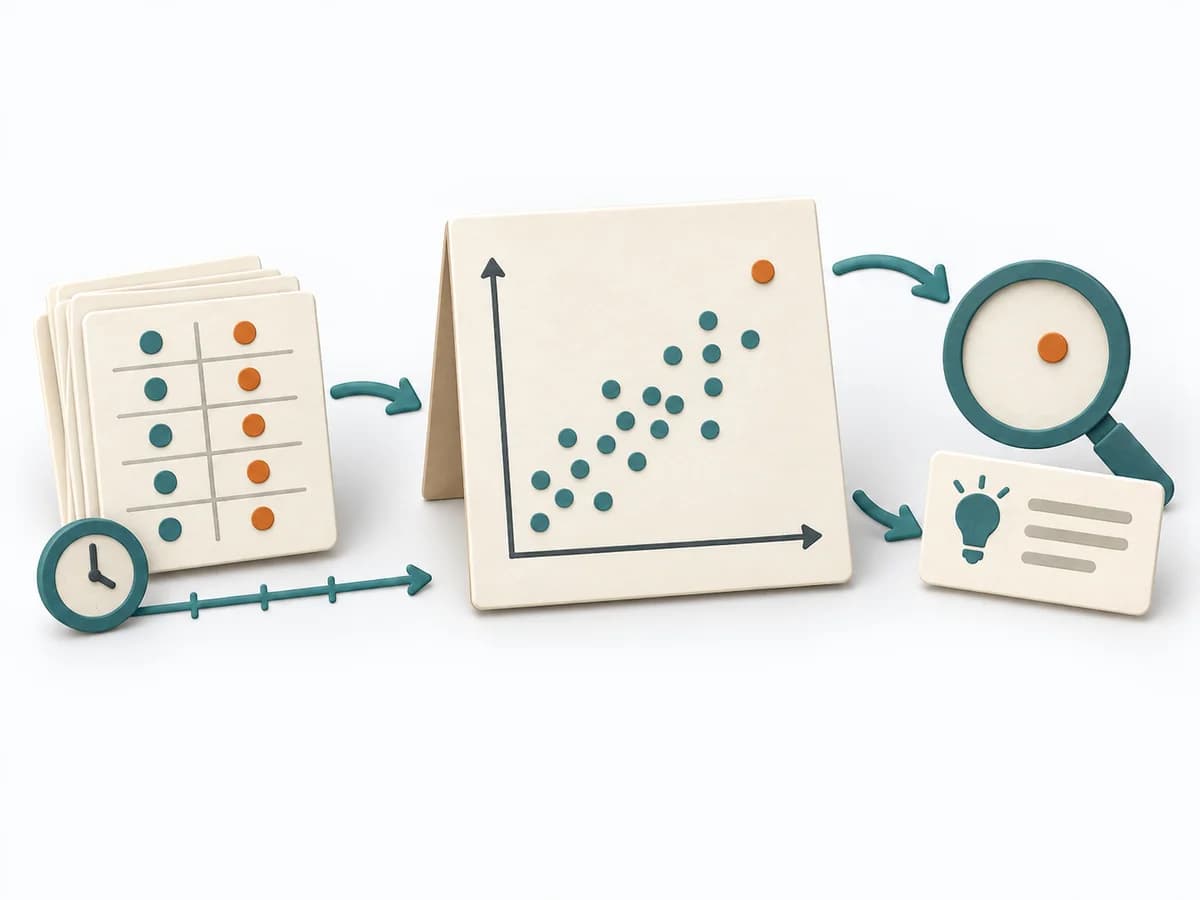 Operations Scatter Diagram |  Operations Kepner-Tregoe |  Operations Failure Mode and Effects Analysis |
|---|---|---|---|---|
Purposedifferent | The PARA Method organizes knowledge into Projects, Areas, Resources, and Archives. It creates order when digital notes, files, and tasks no longer cleanly fit current work. | When the question is whether two measures are related, the method makes patterns in the data picture visible. It separates felt correlations from relationships that actually show up in the data. | For a disturbance that's hard to pin down, the method cleanly separates problem, cause, and decision. It reduces mixing when symptoms allow several interpretations. | For a process, product, or service with noticeable failure risks, the method assesses possible failure modes in advance. It directs attention to combinations of occurrence, effect, and detectability. |
Complexitydifferent | Medium | Low | High | High |
Timedifferent | 1-3 h Setup, laufend | 30-90 min | 2-8 h | 2-6 h |
Participantsdifferent | 1 | 1-4 | 2-8 | 3-10 |
Formatdifferent | Async | Workshop + async | Workshop + async | Workshop |
Outputdifferent | PARA Structure, Project Notes, Knowledge Archive | Scatter Plot, Korrelationsnotiz, Hypothesenliste | Problem Analysis, Decision Analysis, Risk Plan | FMEA Table, Risk Priority, Mitigation Actions |
Tagsno overlap | KnowledgeProductivityOrganization | Root causeQualityVisualization | Problem solvingRoot causeDecisionOperations | RiskQualityOperationsRoot cause |