View methods side by side.
Choose up to four methods. Add them using the search and share the comparison by copying its link.
| Criterion |  Knowledge Modeling PARA Method | 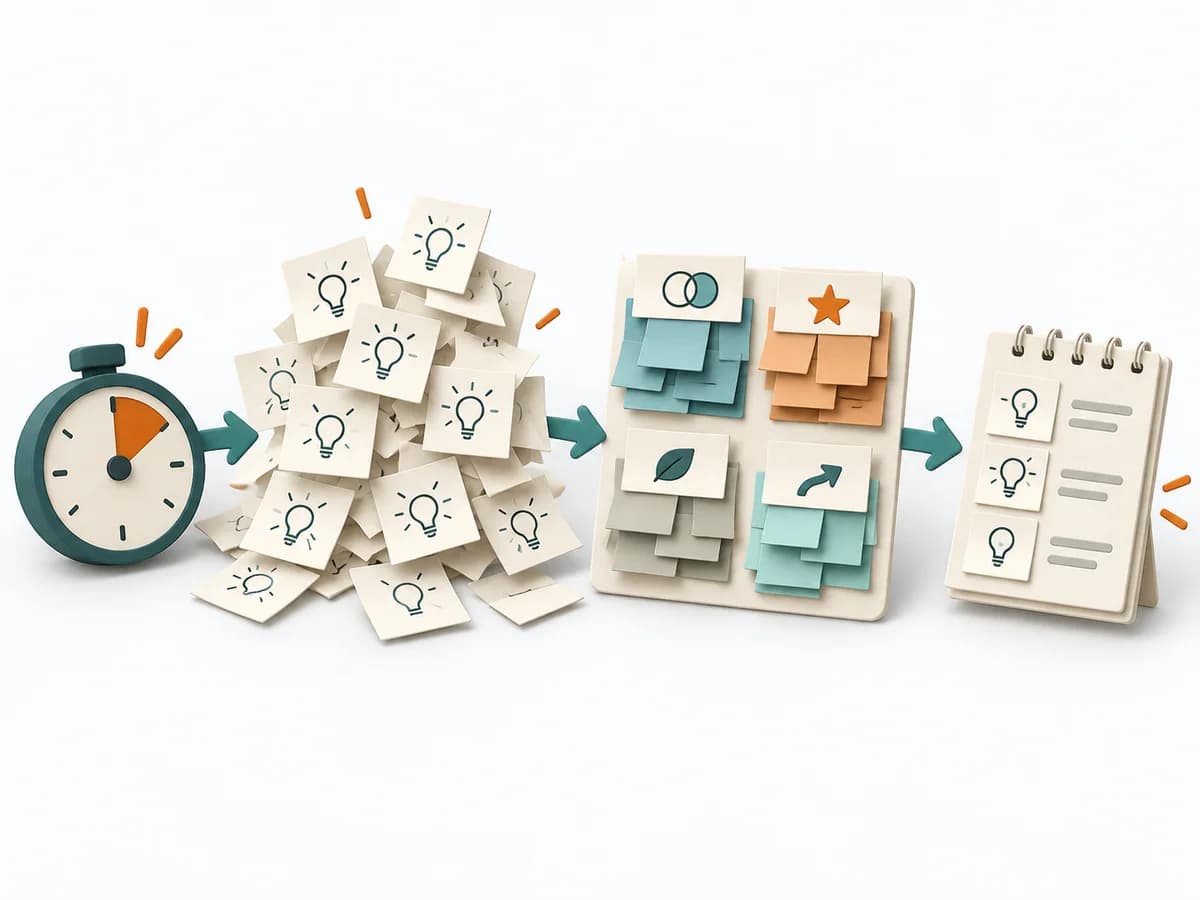 Innovation Rapid Ideation |  UX Design Design Studio |  Innovation Lotus Blossom |
|---|---|---|---|---|
Purposedifferent | The PARA Method organizes knowledge into Projects, Areas, Resources, and Archives. It creates order when digital notes, files, and tasks no longer cleanly fit current work. | When a decision needs to be prepared quickly, the method generates many solution-close variants in a short time. It deliberately relies on pace to undercut self-censorship and perfectionism. This quickly produces a usable field for prioritization and further work. | When several designs need to be quickly put in relation to each other, it makes ideas visible and comparable. It encourages early variants instead of long upfront debates. | When a central question feels too large, the method breaks it into neighboring topic fields with their own depth of ideation. It holds structure and openness at the same time, so adjacent perspectives don't get lost. This grows an idea space out of a core problem. |
Complexitydifferent | Medium | Low | Medium | Low |
Timedifferent | 1-3 h Setup, laufend | 5-20 min | 1-3 h | 45-90 min |
Participantsdifferent | 1 | 1-20 | 3-8 | 3-10 |
Formatdifferent | Async | Workshop + async | Workshop | Workshop |
Outputdifferent | PARA Structure, Project Notes, Knowledge Archive | Ideenpool, Roh-Shortlist, Cluster | Sketches, Concept Directions, Design Decisions | Lotus Diagram, Idea Themes, Shortlist |
Tagsno overlap | KnowledgeProductivityOrganization | BrainstormingIdeationDivergenceSpeed | SketchingCollaborationIdeation | BrainstormingIdeationCreativityDivergenceWorkshop |