View methods side by side.
Choose up to four methods. Add them using the search and share the comparison by copying its link.
| Criterion |  Knowledge Modeling PARA Method | 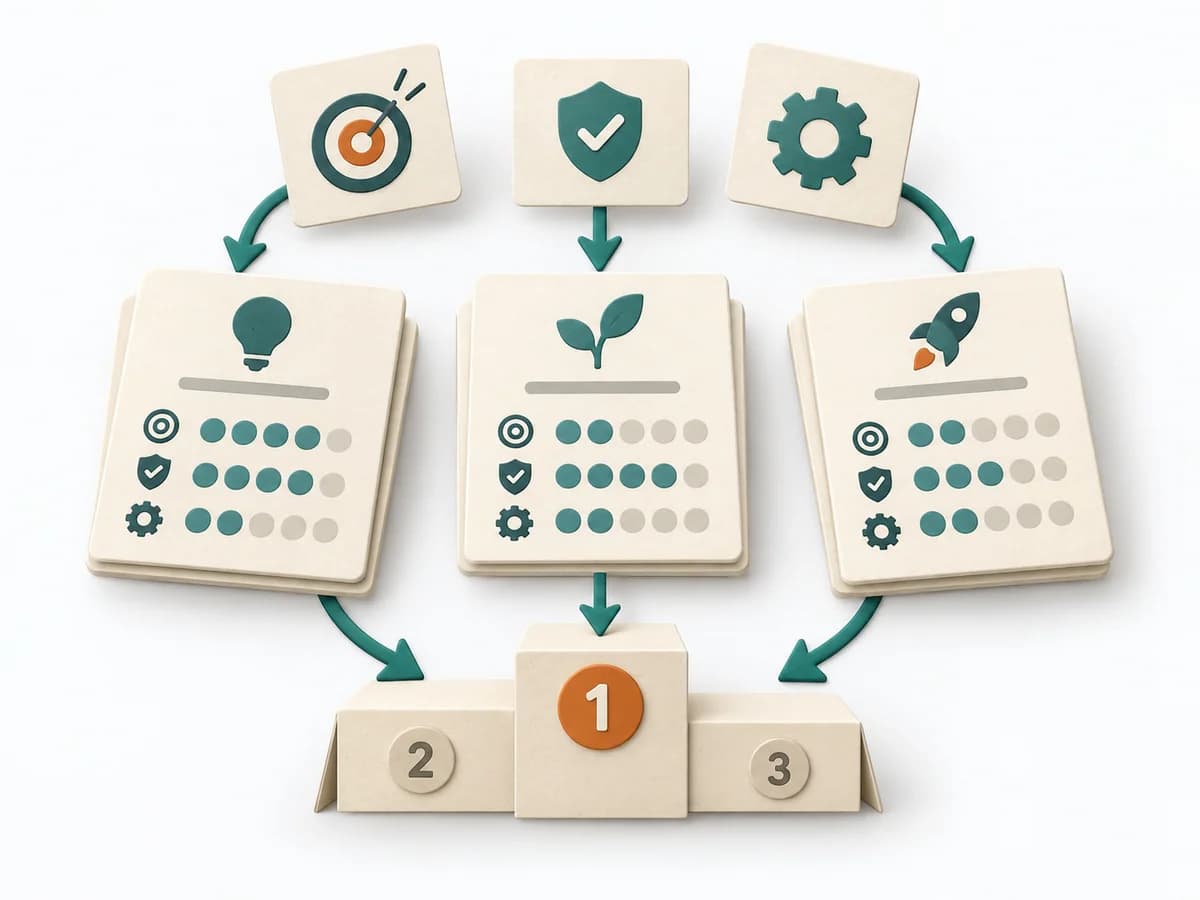 Product Strategy ICE Scoring |  Decision Making Decision Tree |  Delivery Cost of Delay |
|---|---|---|---|---|
Purposedifferent | The PARA Method organizes knowledge into Projects, Areas, Resources, and Archives. It creates order when digital notes, files, and tasks no longer cleanly fit current work. | When ideas need sorting quickly, it condenses impact, confidence, and effort into one compact score. It connects customer value, product logic, and decision priorities. The result is captured as an ICE table and top-ideas list. | For decisions with follow-on paths and dependencies, a linear comparison is often not enough. A Decision Tree shows how options branch under conditions and which consequences hang on each branch. | Helps clarify scope, order, and delivery flow in concrete terms. It makes work, constraints, and sequence manageable. The result is captured as a Cost of Delay table and prioritization sequence. |
Complexitydifferent | Medium | Low | Medium | High |
Timedifferent | 1-3 h Setup, laufend | 30-60 min | 30-90 min | 90-180 min |
Participantsdifferent | 1 | 2-8 | 1-6 | 3-8 |
Formatdifferent | Async | Workshop + async | Workshop + async | Workshop |
Outputdifferent | PARA Structure, Project Notes, Knowledge Archive | ICE Table, Top Idea List | Decision Tree, Option Map, Assumption List | CoD Table, Prioritization Sequence |
Tagsno overlap | KnowledgeProductivityOrganization | PrioritizationScoringGrowthDecision | DecisionTreeOptions | PrioritizationDeliveryEconomicsDecision |