View methods side by side.
Choose up to four methods. Add them using the search and share the comparison by copying its link.
| Criterion |  Knowledge Modeling PARA Method |  Engineering Goal Question Metric |  Growth Flywheel | 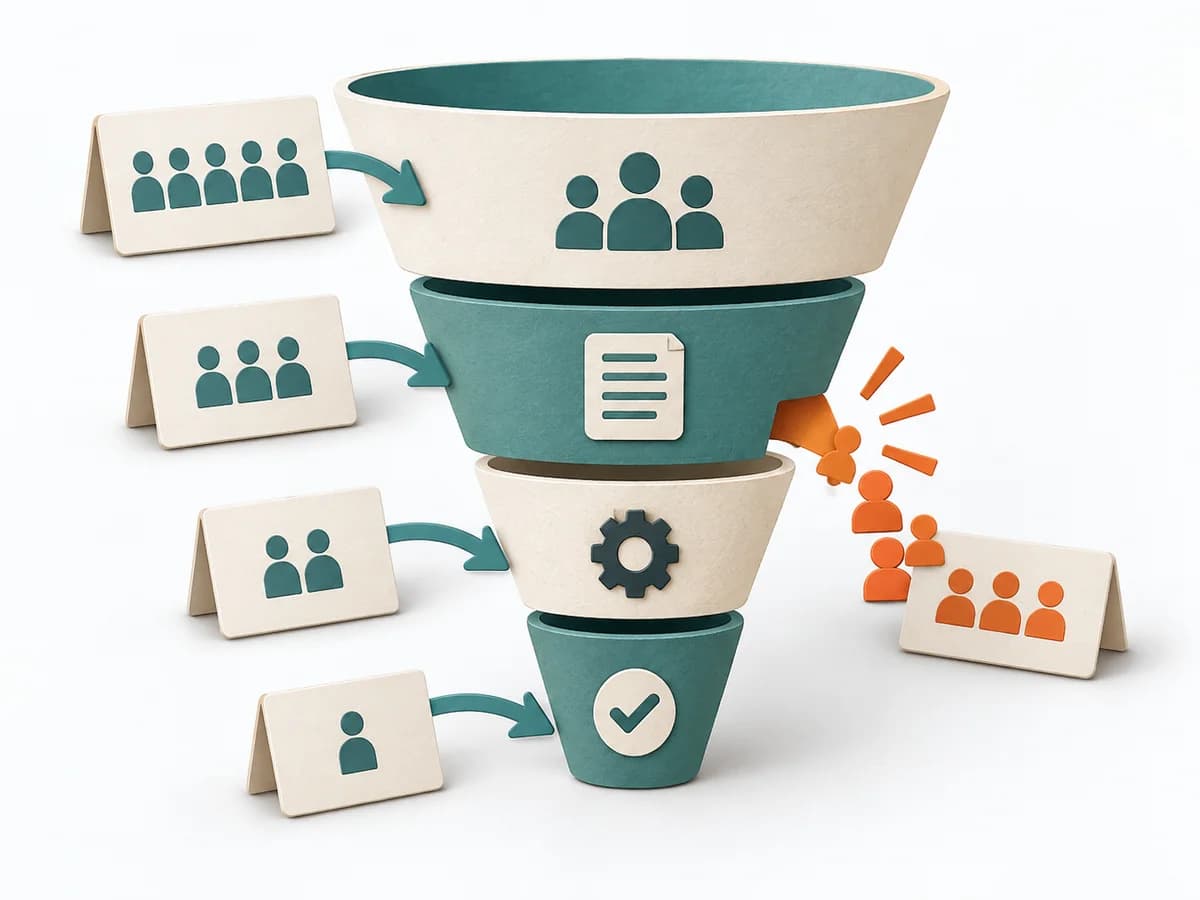 Growth Funnel Analysis |
|---|---|---|---|---|
Purposedifferent | The PARA Method organizes knowledge into Projects, Areas, Resources, and Archives. It creates order when digital notes, files, and tasks no longer cleanly fit current work. | Helps clarify technical problems, hypotheses, and next steps in concrete terms. It breaks a technical problem into testable parts. The result is captured as a GQM table and metric briefs. | Growth often breaks down where a reinforcing mechanism builds up too much friction. A Flywheel shows the cycle of value, repetition, and reinforcement meant to sustain growth. | When many visitors or users drop off along the way, the reason behind the number often stays hidden. Funnel Analysis exposes these transitions and makes visible exactly where the path collapses. |
Complexitysame | Medium | Medium | Medium | Medium |
Timedifferent | 1-3 h Setup, laufend | 90-180 min | 60-120 min | 1-3 h |
Participantsdifferent | 1 | 3-6 | 3-8 | 1-5 |
Formatdifferent | Async | Workshop | Workshop | Async |
Outputdifferent | PARA Structure, Project Notes, Knowledge Archive | GQM Table, Metric Profiles | Flywheel Map, Friction Points, Growth Levers, Experiment Backlog | Funnel report, Drop-off analysis, Optimization hypotheses |
Tagsno overlap | KnowledgeProductivityOrganization | MetricsMeasurementEngineeringAlignment | GrowthRetentionConversion | AnalyticsConversionGrowth |