View methods side by side.
Choose up to four methods. Add them using the search and share the comparison by copying its link.
| Criterion |  Knowledge Modeling PARA Method | 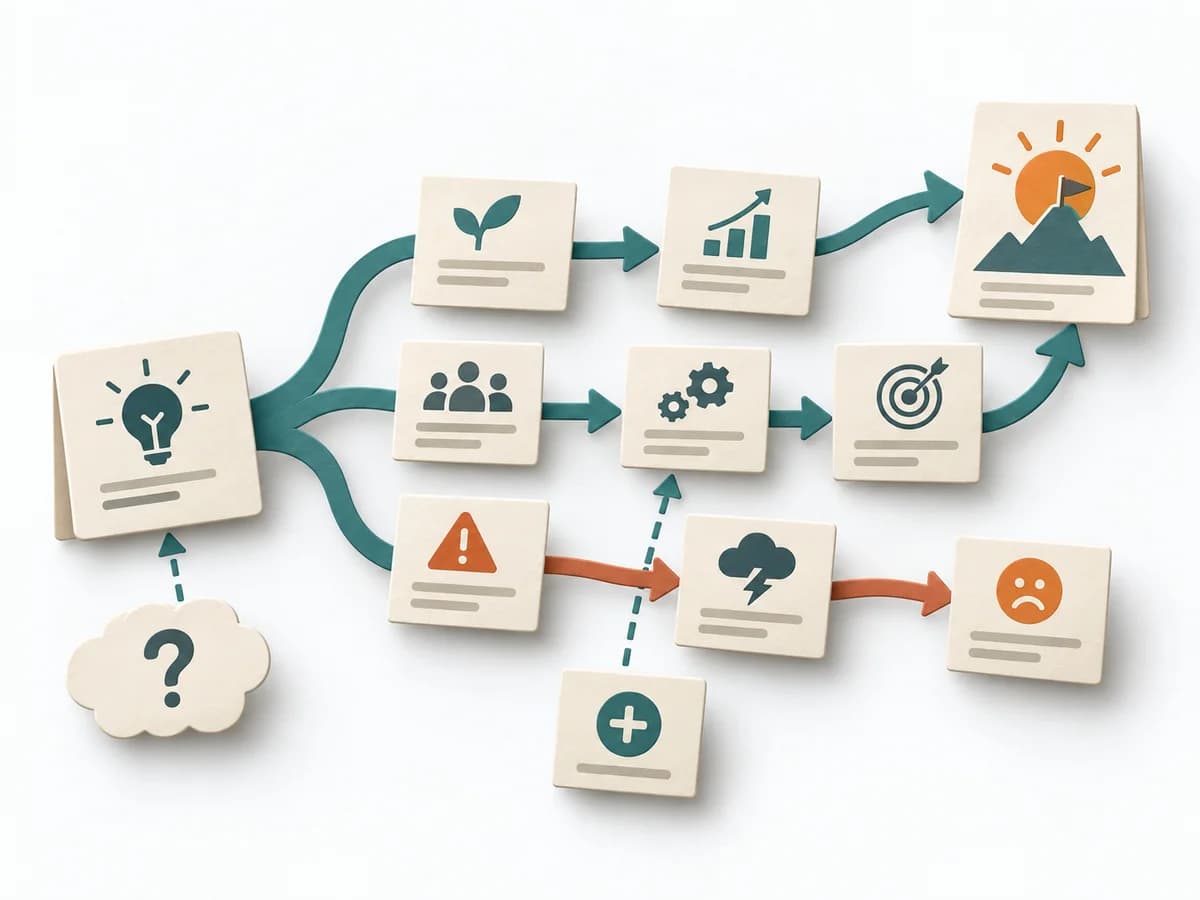 Systems Thinking Future Reality Tree |  Product Discovery Assumption Mapping |  Decision Making Assumption Surfacing |
|---|---|---|---|---|
Purposedifferent | The PARA Method organizes knowledge into Projects, Areas, Resources, and Archives. It creates order when digital notes, files, and tasks no longer cleanly fit current work. | A Future Reality Tree shows how desired actions are meant to lead to a better system state. The method checks whether a path of change holds together logically before time flows into implementation. | When assumptions still sit unordered in the room, it weighs uncertainty against leverage. It makes visible which hypotheses should be checked first. | Plans often contain assumptions that were never openly stated and remain dangerous precisely because of that. Assumption Surfacing makes these silent premises visible and prioritizes which of them carry the initiative or could sink it. |
Complexitydifferent | Medium | High | Medium | Low |
Timedifferent | 1-3 h Setup, laufend | 2-4 h | 45-60 min | 45-90 min |
Participantsdifferent | 1 | 3-8 | 2-8 | 2-8 |
Formatdifferent | Async | Workshop | Workshop + async | Workshop + async |
Outputdifferent | PARA Structure, Project Notes, Knowledge Archive | Future Reality Tree, Negative Branches, Assumption List, Improved Injections | Assumption map, Test backlog, Risk ranking | Assumption List, Critical Assumptions, Learning Plan |
Tagsno overlap | KnowledgeProductivityOrganization | Theory of ConstraintsSystems thinkingChange | AssumptionsRiskExperimentsValidation | AssumptionsRiskDecisionDiscovery |