View methods side by side.
Choose up to four methods. Add them using the search and share the comparison by copying its link.
| Criterion | 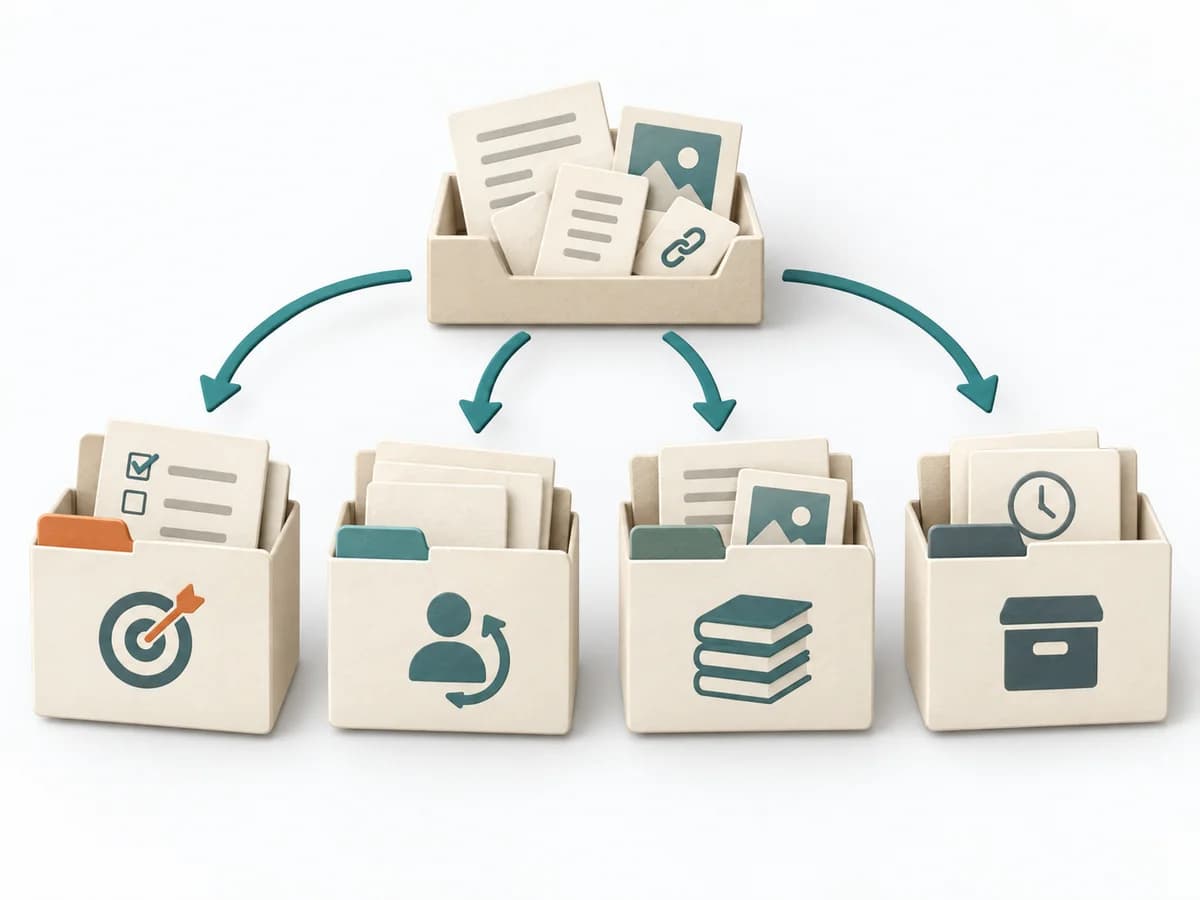 Knowledge Modeling PARA Method |  Growth Funnel Analysis |  Business Strategy PESTLE Analysis |  Growth Flywheel |
|---|---|---|---|---|
Purposedifferent | The PARA Method organizes knowledge into Projects, Areas, Resources, and Archives. It creates order when digital notes, files, and tasks no longer cleanly fit current work. | When many visitors or users drop off along the way, the reason behind the number often stays hidden. Funnel Analysis exposes these transitions and makes visible exactly where the path collapses. | PESTLE Analysis makes political, economic, social, technological, legal, and environmental influences visible. The environment of an initiative is thereby read systematically instead of through isolated trends. | Growth often breaks down where a reinforcing mechanism builds up too much friction. A Flywheel shows the cycle of value, repetition, and reinforcement meant to sustain growth. |
Complexitysame | Medium | Medium | Medium | Medium |
Timedifferent | 1-3 h Setup, laufend | 1-3 h | 1-3 h | 60-120 min |
Participantsdifferent | 1 | 1-5 | 2-10 | 3-8 |
Formatdifferent | Async | Async | Workshop + async | Workshop |
Outputdifferent | PARA Structure, Project Notes, Knowledge Archive | Funnel report, Drop-off analysis, Optimization hypotheses | PESTLE Map, External Risks, Strategic Questions | Flywheel Map, Friction Points, Growth Levers, Experiment Backlog |
Tagsno overlap | KnowledgeProductivityOrganization | AnalyticsConversionGrowth | StrategyMarketAnalysis | GrowthRetentionConversion |