View methods side by side.
Choose up to four methods. Add them using the search and share the comparison by copying its link.
| Criterion |  Knowledge Modeling PARA Method | 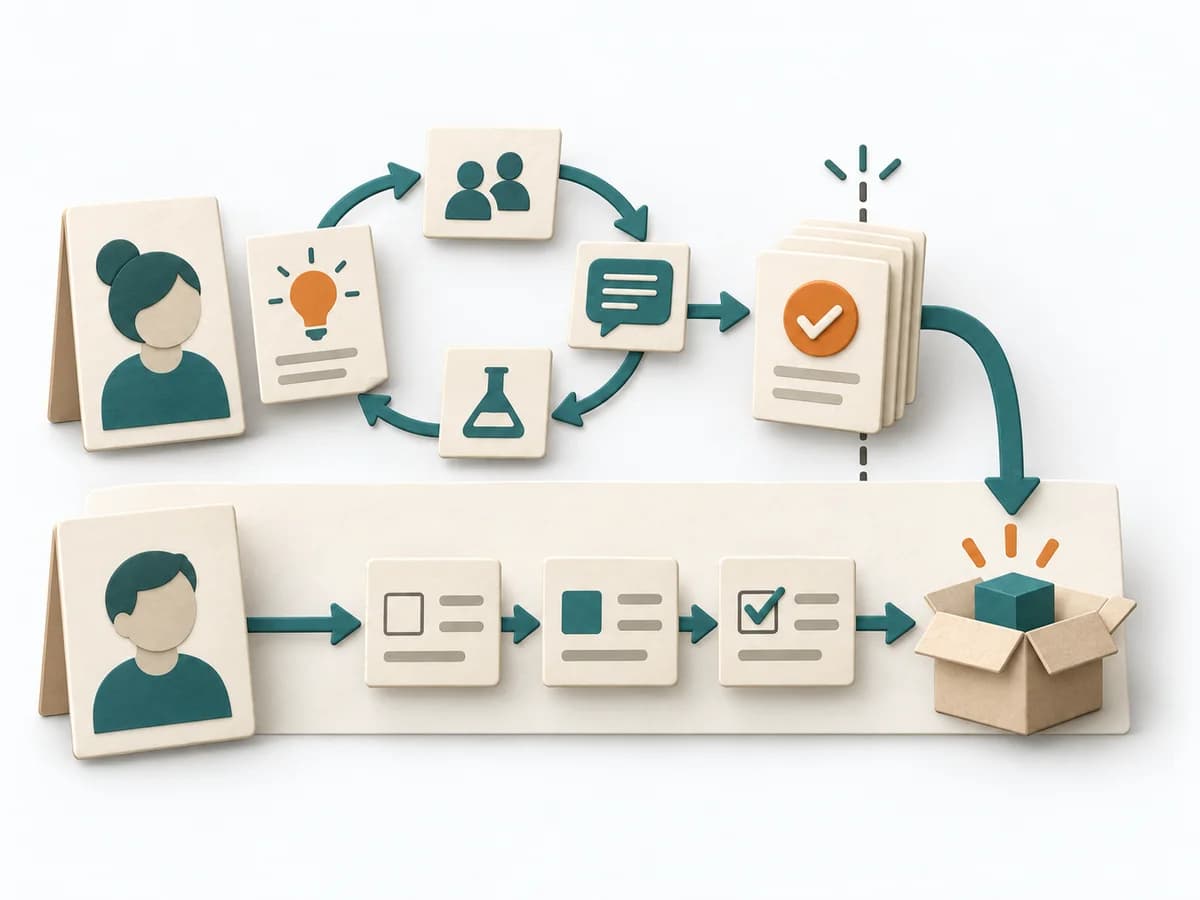 Product Discovery Dual-Track Agile |  Product Strategy DIBB |  Decision Making Assumption Surfacing |
|---|---|---|---|---|
Purposedifferent | The PARA Method organizes knowledge into Projects, Areas, Resources, and Archives. It creates order when digital notes, files, and tasks no longer cleanly fit current work. | When uncertainty and delivery run in parallel, it separates learning work from implementation while keeping both connected. It prevents unvalidated ideas from falling directly into the delivery stream. | DIBB helps clarify target groups, value, goals, and priorities by making the logic behind a decision explicit. It captures results as a DIBB document, belief list, bet list, and learning report. | Plans often contain assumptions that were never openly stated and remain dangerous precisely because of that. Assumption Surfacing makes these silent premises visible and prioritizes which of them carry the initiative or could sink it. |
Complexitydifferent | Medium | Medium | Low | Low |
Timedifferent | 1-3 h Setup, laufend | Laufend, Wochen bis Monate | 1-2 h | 45-90 min |
Participantsdifferent | 1 | 4-10 | 2-8 | 2-8 |
Formatdifferent | Async | Workshop + async | Workshop + async | Workshop + async |
Outputdifferent | PARA Structure, Project Notes, Knowledge Archive | Discovery Backlog, Delivery Backlog, Experiment-Ergebnisse, Validierte Stories | DIBB document, Belief list, Bet list, Learning report | Assumption List, Critical Assumptions, Learning Plan |
Tagsno overlap | KnowledgeProductivityOrganization | AgileDiscoveryDelivery | StrategyDecisionAssumptionsHypothesis | AssumptionsRiskDecisionDiscovery |