View methods side by side.
Choose up to four methods. Add them using the search and share the comparison by copying its link.
| Criterion |  Knowledge Modeling PARA Method |  UX Design Customer Journey Canvas | 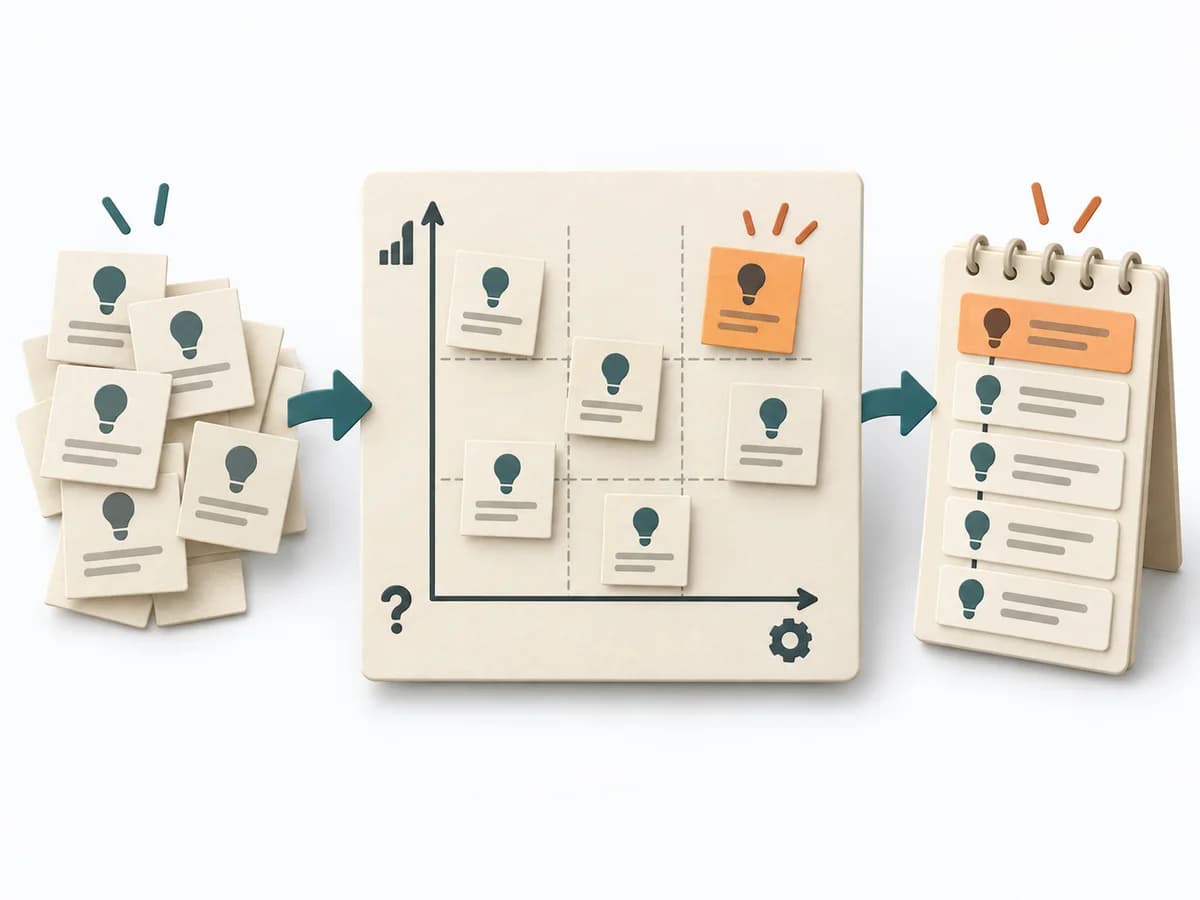 Product Discovery Hypothesis Prioritization Canvas |  UX Research Customer Journey Mapping |
|---|---|---|---|---|
Purposedifferent | The PARA Method organizes knowledge into Projects, Areas, Resources, and Archives. It creates order when digital notes, files, and tasks no longer cleanly fit current work. | When a journey needs to be understood across several phases, it arranges experience, touchpoints, and opportunities into one picture. It makes gaps and friction along the user path clear. | When many hypotheses compete for attention, it brings order to their learning sequence and importance. It separates problem, assumption, solution, and evidence. The result is captured as a prioritization canvas and a hypothesis backlog. | When a user journey falls apart across many touchpoints, customer journey mapping makes the experience visible as a coherent arc. Phases, emotions, and breaks become legible enough to prioritize critical moments deliberately. |
Complexitysame | Medium | Medium | Medium | Medium |
Timedifferent | 1-3 h Setup, laufend | 1-3 h | 60-90 min | 2-4 h |
Participantsdifferent | 1 | 3-10 | 3-8 | 4-10 |
Formatdifferent | Async | Workshop | Workshop | Workshop |
Outputdifferent | PARA Structure, Project Notes, Knowledge Archive | Customer Journey Canvas, Pain Points, Experience Opportunities | Prioritization Canvas, Hypothesis Backlog | Journey Map, Pain-point List, Opportunity Backlog |
Tagsno overlap | KnowledgeProductivityOrganization | JourneyCustomerService designCanvas | ExperimentsPrioritizationDiscoveryHypothesis | JourneyServiceService design |