View methods side by side.
Choose up to four methods. Add them using the search and share the comparison by copying its link.
| Criterion |  Knowledge Modeling PARA Method |  Domain Modeling Context Map | 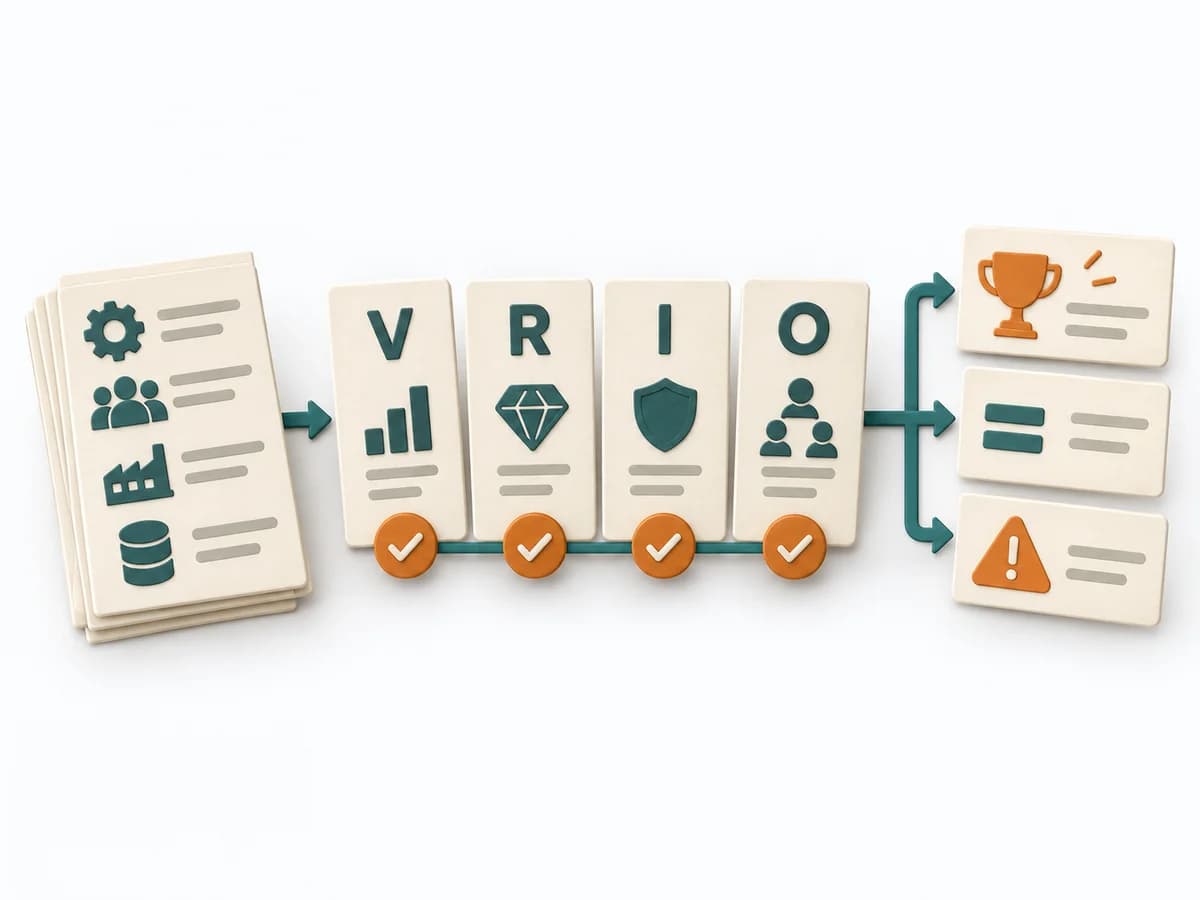 Business Strategy VRIO Framework |  Domain Modeling Bounded Context Canvas |
|---|---|---|---|---|
Purposedifferent | The PARA Method organizes knowledge into Projects, Areas, Resources, and Archives. It creates order when digital notes, files, and tasks no longer cleanly fit current work. | When several contexts need to talk to each other, it makes their relationships and dependencies legible. It helps sort integration pressure and responsibilities across system boundaries. | The VRIO Framework rates resources and capabilities on whether they are Valuable, Rare, Inimitable, and Organized. It compares strengths, risks, market logic, and courses of action. The result is captured as a VRIO table and strategic actions. | When a business context is still loosely outlined, it shapes language, responsibility, and integration space. It clarifies what belongs together and where a boundary needs to hold. |
Complexitysame | Medium | Medium | Medium | Medium |
Timedifferent | 1-3 h Setup, laufend | 1-3 h | 90-180 min | 1-3 h |
Participantsdifferent | 1 | 2-8 | 3-6 | 3-8 |
Formatdifferent | Async | Workshop + async | Workshop | Workshop + async |
Outputdifferent | PARA Structure, Project Notes, Knowledge Archive | Context Map, Integration Patterns, Boundary Notes | VRIO Table, Strategic Actions | Context Canvas, Glossary, Integration Notes |
Tagsno overlap | KnowledgeProductivityOrganization | Domain-Driven DesignBoundariesStrategy | StrategyDiagnosisBusiness modelCapability | Domain-Driven DesignBoundariesModeling |