View methods side by side.
Choose up to four methods. Add them using the search and share the comparison by copying its link.
| Criterion |  Knowledge Modeling PARA Method |  Knowledge Modeling Concept Mapping |  Innovation Reverse Brainstorming | 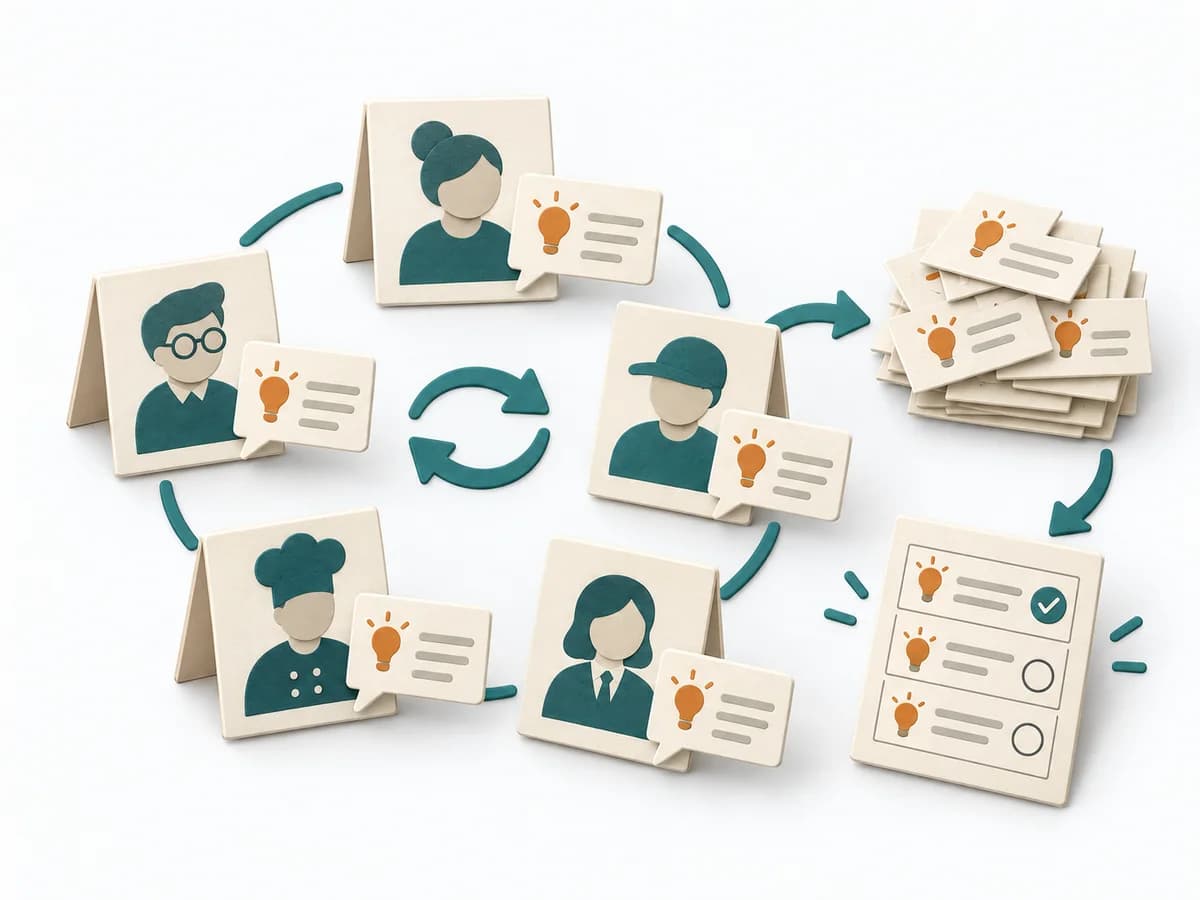 Innovation Rolestorming |
|---|---|---|---|---|
Purposedifferent | The PARA Method organizes knowledge into Projects, Areas, Resources, and Archives. It creates order when digital notes, files, and tasks no longer cleanly fit current work. | Concept Mapping arranges terms and relationships in a network that makes subject-matter connections tangible. It fits when a topic needs to be understood structurally rather than linearly. | For persistent errors or blockages, the method shifts the view to the opposite of the desired effect. It exposes the mechanics of failure and makes hidden causes easier to grasp. This makes improvement more concrete and the problem clearer. | When a search for ideas stalls, switching roles helps people step outside their own perspective and activate new logics of action. The method reduces habit because contributions arise from a different stance. This brings unfamiliar, often fitting solution approaches into play. |
Complexitydifferent | Medium | Medium | Low | Low |
Timedifferent | 1-3 h Setup, laufend | 1-2 h | 30-60 min | 30-60 min |
Participantsdifferent | 1 | 1-8 | 3-12 | 3-12 |
Formatdifferent | Async | Workshop + async | Workshop | Workshop |
Outputdifferent | PARA Structure, Project Notes, Knowledge Archive | Concept Map, Relationship Labels, Knowledge Gaps | Reverse Ideas, Risk Themes, Solution Ideas | Rollenkarten, Ideenpool pro Rolle, Konsolidierte Shortlist |
Tagsno overlap | KnowledgeProductivityOrganization | KnowledgeConceptsMappingSensemaking | BrainstormingIdeationCreativityRisk | BrainstormingIdeationCreativity |