View methods side by side.
Choose up to four methods. Add them using the search and share the comparison by copying its link.
| Criterion |  Knowledge Modeling PARA Method | 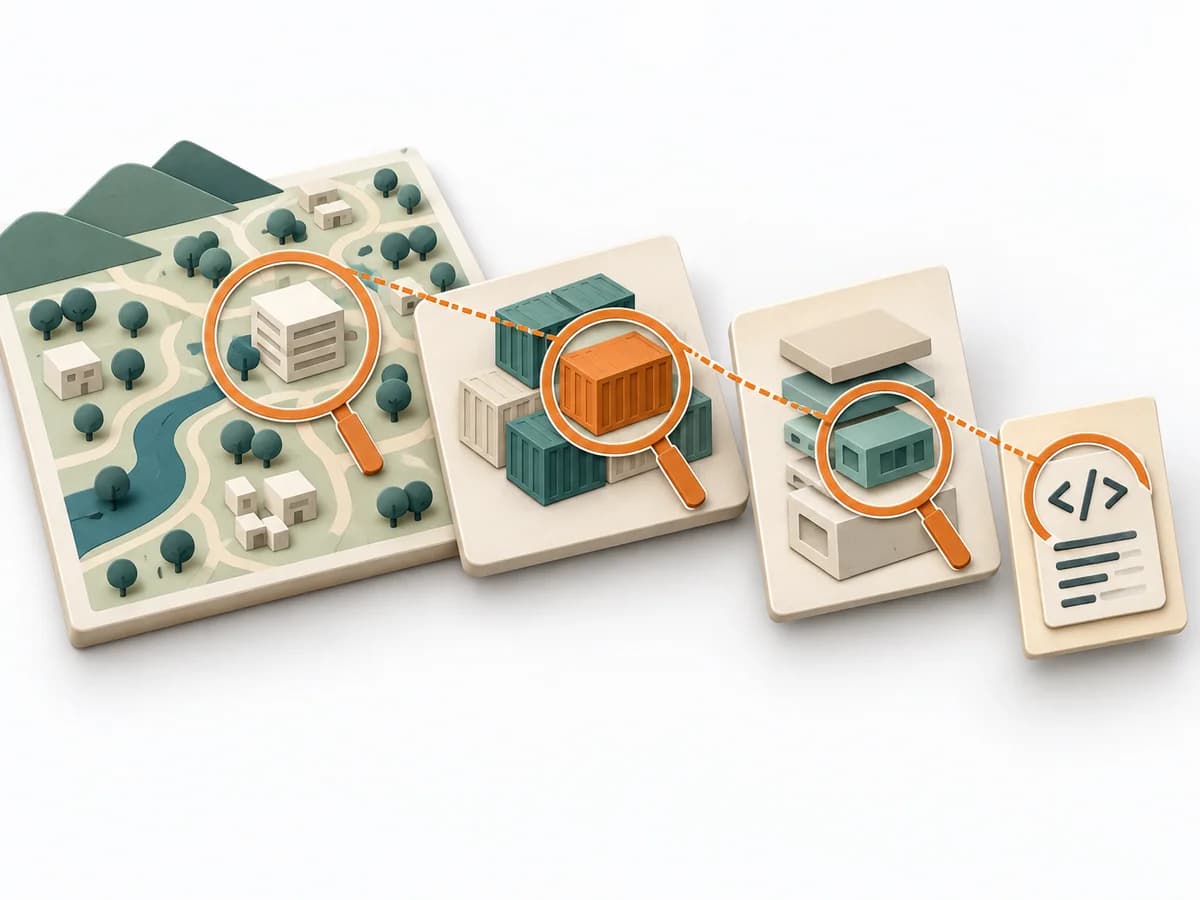 Architecture C4 Model |  Decision Making Constraint Analysis |  Architecture Architecture Communication Canvas |
|---|---|---|---|---|
Purposedifferent | The PARA Method organizes knowledge into Projects, Areas, Resources, and Archives. It creates order when digital notes, files, and tasks no longer cleanly fit current work. | The C4 Model makes a system legible across several resolution levels, from context down to code. It suits situations where different audiences need to understand the same architecture from different altitudes. | When an initiative stalls, the limit often lies not in the idea but in hard or soft boundary conditions. Constraint Analysis separates these limits and shows which of them can actually be shaped. | The Architecture Communication Canvas plans architecture communication so the right people receive the right message. The method turns technical complexity into deliberate communication design. |
Complexitydifferent | Medium | Low | Low | Medium |
Timedifferent | 1-3 h Setup, laufend | 1-4 h | 30-90 min | 60-120 min |
Participantsdifferent | 1 | 1-5 | 2-8 | 2-8 |
Formatdifferent | Async | Workshop + async | Workshop + async | Workshop + async |
Outputdifferent | PARA Structure, Project Notes, Knowledge Archive | Context Diagram, Container Diagram, Component Diagram | Constraint List, Hard/Soft Classification, Option Impact Notes, Decision Boundaries | Communication Canvas, Stakeholder Messages, Architecture Communication Plan |
Tagsno overlap | KnowledgeProductivityOrganization | ArchitectureCommunicationVisualization | ConstraintsDecisionPlanningOptions | ArchitectureCommunicationStakeholdersCanvas |