View methods side by side.
Choose up to four methods. Add them using the search and share the comparison by copying its link.
| Criterion |  Knowledge Modeling PARA Method | 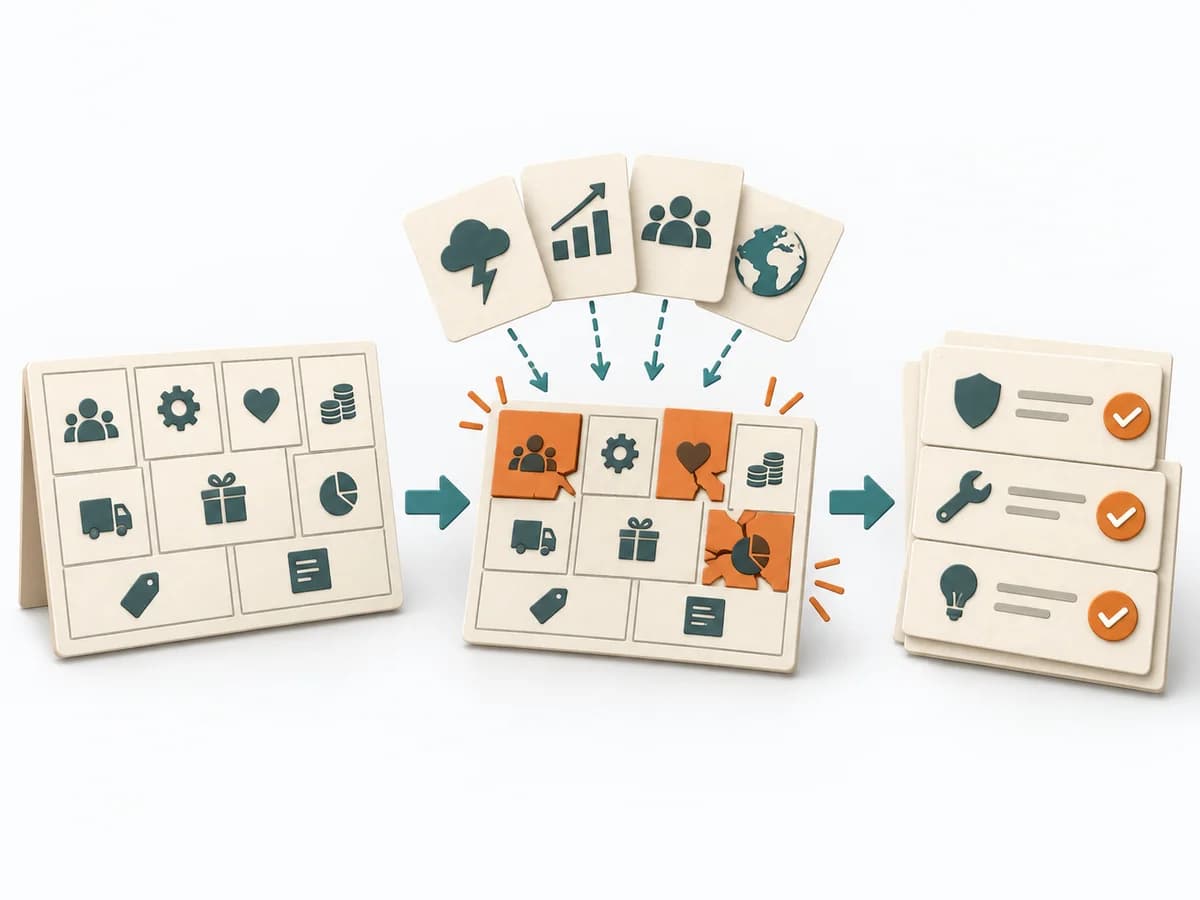 Business Strategy Business Model Stress Test |  Knowledge Modeling IBIS |  Business Strategy Value Chain Analysis |
|---|---|---|---|---|
Purposedifferent | The PARA Method organizes knowledge into Projects, Areas, Resources, and Archives. It creates order when digital notes, files, and tasks no longer cleanly fit current work. | A Business Model Stress Test checks how well a business model holds up under pressure and headwinds. It compares strengths, risks, market logic, and courses of action. The result is captured as a stress-test report and action plan per scenario. | IBIS structures thinking about complex questions as a sequence of issues, ideas, and arguments. The method keeps discussions open without forcing them into premature consensus. | Value Chain Analysis shows where value is created, costs accrue, and differentiation becomes possible along the process. It compares strengths, risks, market logic, and courses of action. The result is captured as a value-chain map and lever list. |
Complexitydifferent | Medium | High | Medium | High |
Timedifferent | 1-3 h Setup, laufend | Half day | 1-3 h | Half day |
Participantsdifferent | 1 | 3-8 | 2-8 | 3-8 |
Formatdifferent | Async | Workshop | Workshop + async | Workshop |
Outputdifferent | PARA Structure, Project Notes, Knowledge Archive | Stress Test Report, Action Plan per Scenario | Issue Map, Positions, Argument Notes | Value Chain Map, Lever List |
Tagsno overlap | KnowledgeProductivityOrganization | StrategyBusiness modelRiskDiagnosis | RationaleKnowledgeDecision | StrategyBusiness modelDiagnosisAnalysis |