View methods side by side.
Choose up to four methods. Add them using the search and share the comparison by copying its link.
| Criterion |  Knowledge Modeling PARA Method |  Operations After-Action Review | 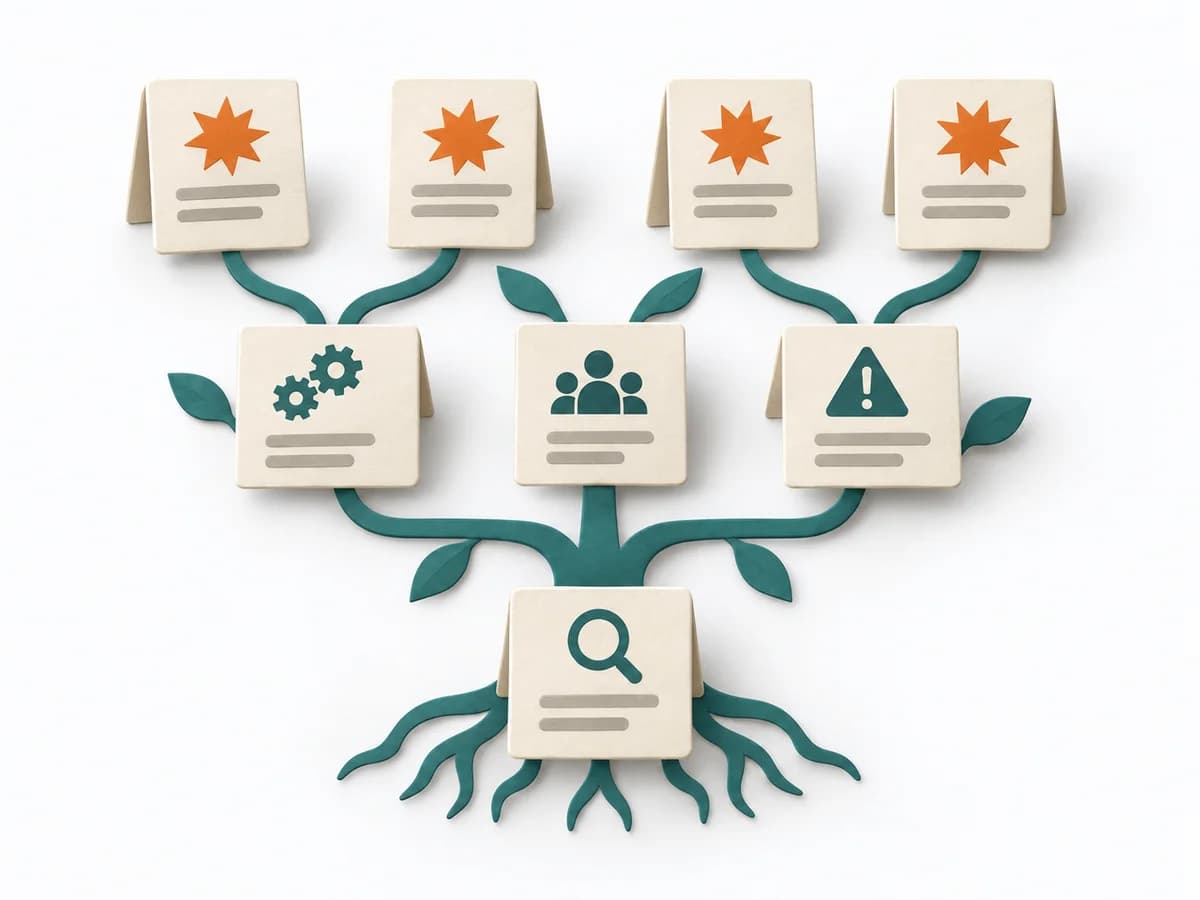 Operations Family Tree Analysis |  Operations 5 Whys |
|---|---|---|---|---|
Purposedifferent | The PARA Method organizes knowledge into Projects, Areas, Resources, and Archives. It creates order when digital notes, files, and tasks no longer cleanly fit current work. | After missions or project phases with unclear outcomes, the method makes visible what actually happened and what can be learned from it. It separates course, effect, and causes so experience turns into solid improvement. | For a series of incidents with a similar pattern, the method arranges individual events as branches of a common origin. It makes visible which conditions keep recurring. | For a single, hard-to-explain deviation, the method exposes the causal chain behind the visible symptom. It keeps the cause open until a controllable condition emerges instead of a mere description. |
Complexitydifferent | Medium | Low | Medium | Low |
Timedifferent | 1-3 h Setup, laufend | 20-45 min | 2-4 h | 15-30 min |
Participantsdifferent | 1 | 3-12 | 2-6 | 2-6 |
Formatdifferent | Async | Workshop + async | Workshop + async | Workshop |
Outputdifferent | PARA Structure, Project Notes, Knowledge Archive | Lessons learned, Action items, Event summary | Family Tree Diagram, Pattern Notes, Systemic Measures | Root cause notes, Countermeasures |
Tagsno overlap | KnowledgeProductivityOrganization | LearningOperationsImprovement | Root causePatternsIncidentSystemic | Root causeIncidentLeanProblem solving |