View methods side by side.
Choose up to four methods. Add them using the search and share the comparison by copying its link.
| Criterion | 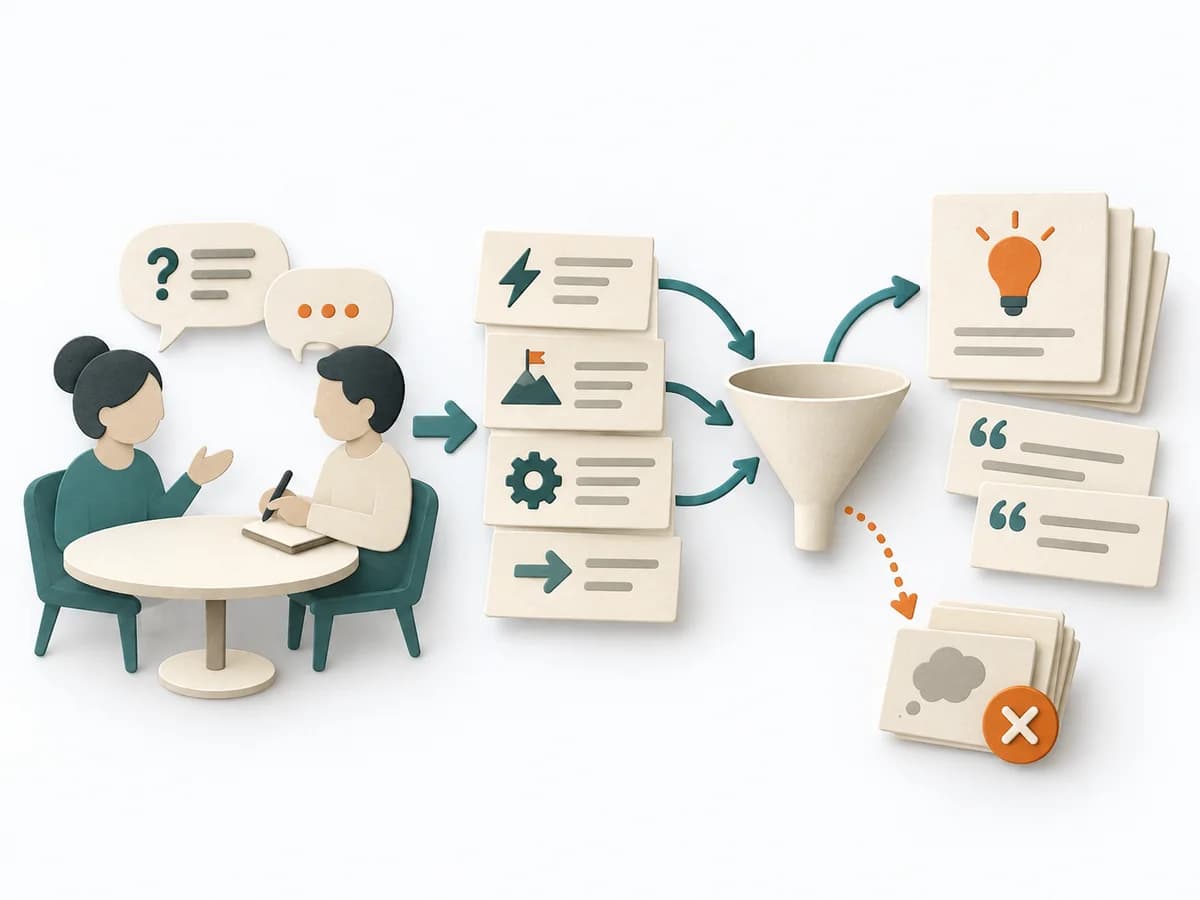 Product Discovery Opportunity Interview |  UX Research Empathy Mapping |  Knowledge Modeling Concept Mapping |  Domain Modeling EventStorming |
|---|---|---|---|---|
Purposedifferent | When opportunities are still hidden behind signals of need, it structures conversations around needs and obstacles. It looks for patterns that lead to new product opportunities. | When a lot is assumed about a target group but little is seen jointly, empathy mapping makes knowledge and gaps directly comparable. The picture also shows which assumptions hold up and where evidence is missing. | Concept Mapping arranges terms and relationships in a network that makes subject-matter connections tangible. It fits when a topic needs to be understood structurally rather than linearly. | When a domain consists of many events, rules, and states, it creates a shared modeling space for the team. It bundles language, flows, and boundaries before domain knowledge fragments into siloed views. |
Complexitydifferent | Medium | Low | Medium | Medium |
Timedifferent | 30-60 min je Interview | 30–60 min | 1-2 h | 2-8 h |
Participantsdifferent | 5-12 Interviews | 4-8 | 1-8 | 5-12 |
Formatdifferent | Workshop + async | Workshop | Workshop + async | Workshop |
Outputdifferent | Interview Notes, Opportunity Themes, Customer Quotes | Empathy Map, Assumptions List, Research Gaps | Concept Map, Relationship Labels, Knowledge Gaps | Event Timeline, Ubiquitous Language, Boundaries, Open Questions |
Tagsno overlap | DiscoveryInterviewsOpportunityCustomer | SynthesisQualitativeWorkshop | KnowledgeConceptsMappingSensemaking | Domain-Driven DesignEventsDiscoveryWorkshop |