View methods side by side.
Choose up to four methods. Add them using the search and share the comparison by copying its link.
| Criterion |  Facilitation Open Space Technology |  Architecture Architecture Decision Record | 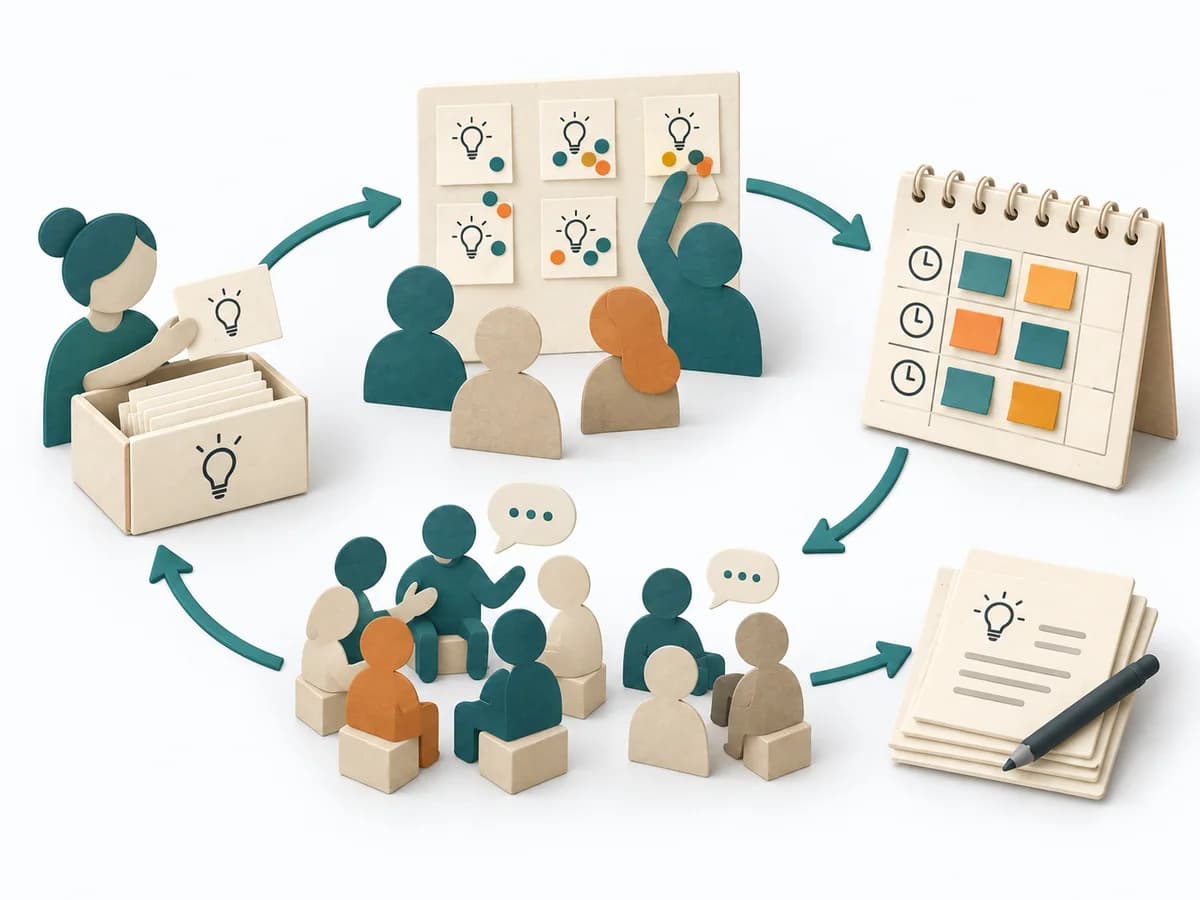 Facilitation Barcamp |  Knowledge Modeling Peer Instruction |
|---|---|---|---|---|
Purposedifferent | When a complex topic does not yet have a fitting agenda, Open Space Technology hands topic ownership back to the participants. The format suits questions that only move forward when real interest determines the order. | An ADR permanently records an architecture decision with context, trade-offs, and consequence. It creates continuity for later changes because the decision path stays traceable. | When many people can contribute knowledge and the flow should stay open, Barcamp provides a framework for self-organized sessions. The format channels energy without defining the content too narrowly in advance. | Peer Instruction uses group thinking to clarify difficult terms or concepts faster. The method combines individual reflection with social correction and shared precision. |
Complexitydifferent | High | Low | Medium | Medium |
Timedifferent | 0.5-2 Tage | 15-45 min | Halber Tag bis 2 Tage | 10-20 min je Frage |
Participantsdifferent | 20-500+ | 1-3 | 15-200 | 6-50 |
Formatdifferent | Workshop | Async | Workshop | Workshop |
Outputdifferent | Session Marketplace, Proceedings, Action Topics | ADR File, Decision Log, Rationale | Session Board, Session Notes, Community Learnings | Concept Questions, Vote Results, Learning Notes |
Tagsno overlap | FacilitationLarge groupAutonomy | ArchitectureRationaleDocumentationGovernance | FacilitationLarge groupLearning | LearningDialogueFacilitation |