View methods side by side.
Choose up to four methods. Add them using the search and share the comparison by copying its link.
| Criterion |  Decision Making OODA Loop | 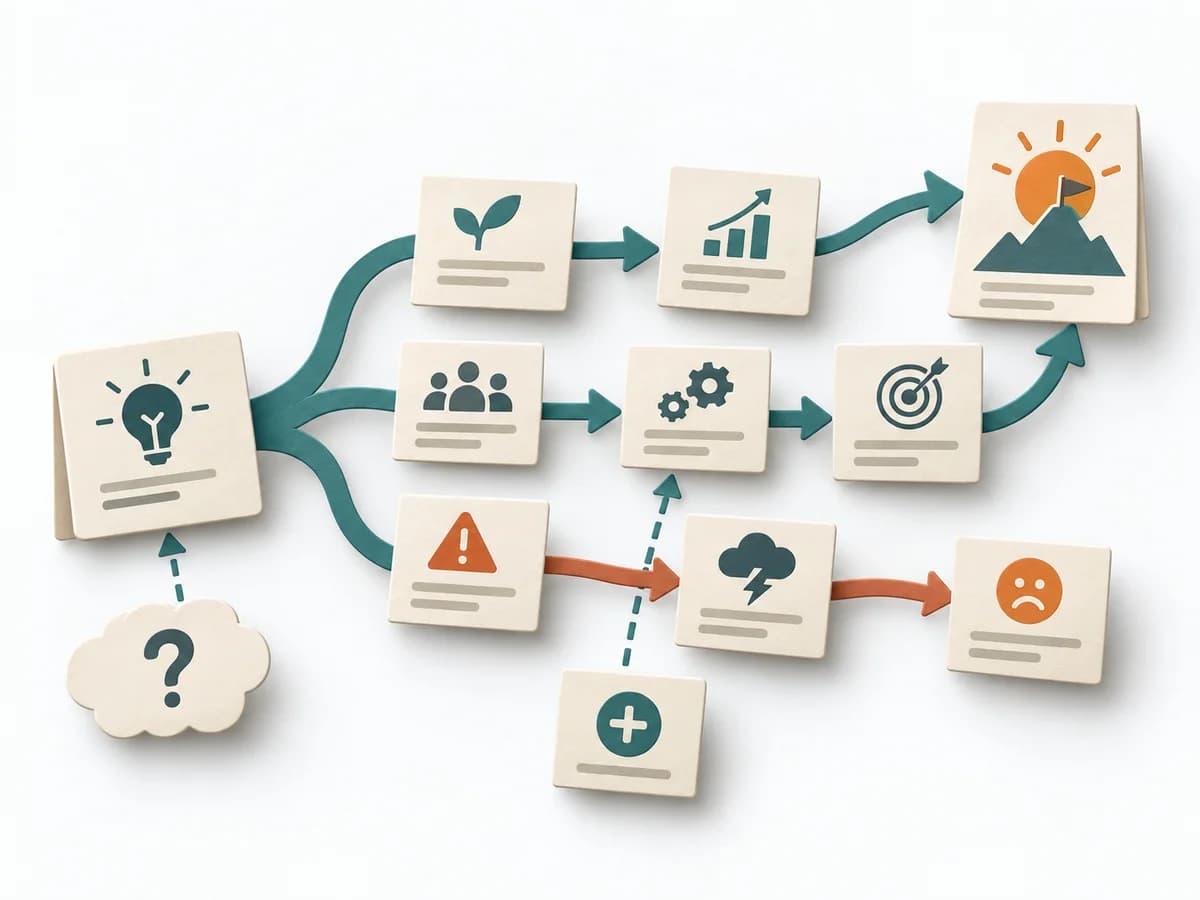 Systems Thinking Future Reality Tree |  Facilitation Stakeholder Mapping |  Systems Thinking Leverage Points |
|---|---|---|---|---|
Purposedifferent | In dynamic situations, decisions become outdated faster than they can be prepared. The OODA Loop holds observing, orienting, deciding, and acting together as a recurring rhythm so reaction does not slide into inertia. | A Future Reality Tree shows how desired actions are meant to lead to a better system state. The method checks whether a path of change holds together logically before time flows into implementation. | When an initiative depends on many people, interests, and power dynamics, Stakeholder Mapping systematically orders the environment. It shows who influences, who is affected, and where relationship management or safeguarding matters first. | Leverage Points show exactly where interventions in a system produce a disproportionate effect. It draws relationships, patterns, and feedback loops. The result is captured as a leverage map and action strategy. |
Complexitydifferent | Medium | High | Low | High |
Timedifferent | 15-60 min je Zyklus | 2-4 h | 60–90 min | Half day |
Participantsdifferent | 1-8 | 3-8 | 2-8 | 3-12 |
Formatdifferent | Workshop + async | Workshop | Workshop + async | Workshop |
Outputdifferent | Situation Assessment, Decision Loop, Action Updates | Future Reality Tree, Negative Branches, Assumption List, Improved Injections | Stakeholder Map, Engagement Plan, Risk Notes | Leverage Map, Action Strategy |
Tags1 shared | DecisionChangeLearningStrategy | Theory of ConstraintsSystems thinkingChange | StakeholdersAlignmentFacilitationChange | Systems thinkingChangeStrategy |