View methods side by side.
Choose up to four methods. Add them using the search and share the comparison by copying its link.
| Criterion |  Decision Making OODA Loop |  Decision Making Force Field Analysis |  Knowledge Modeling NeOn Methodology | 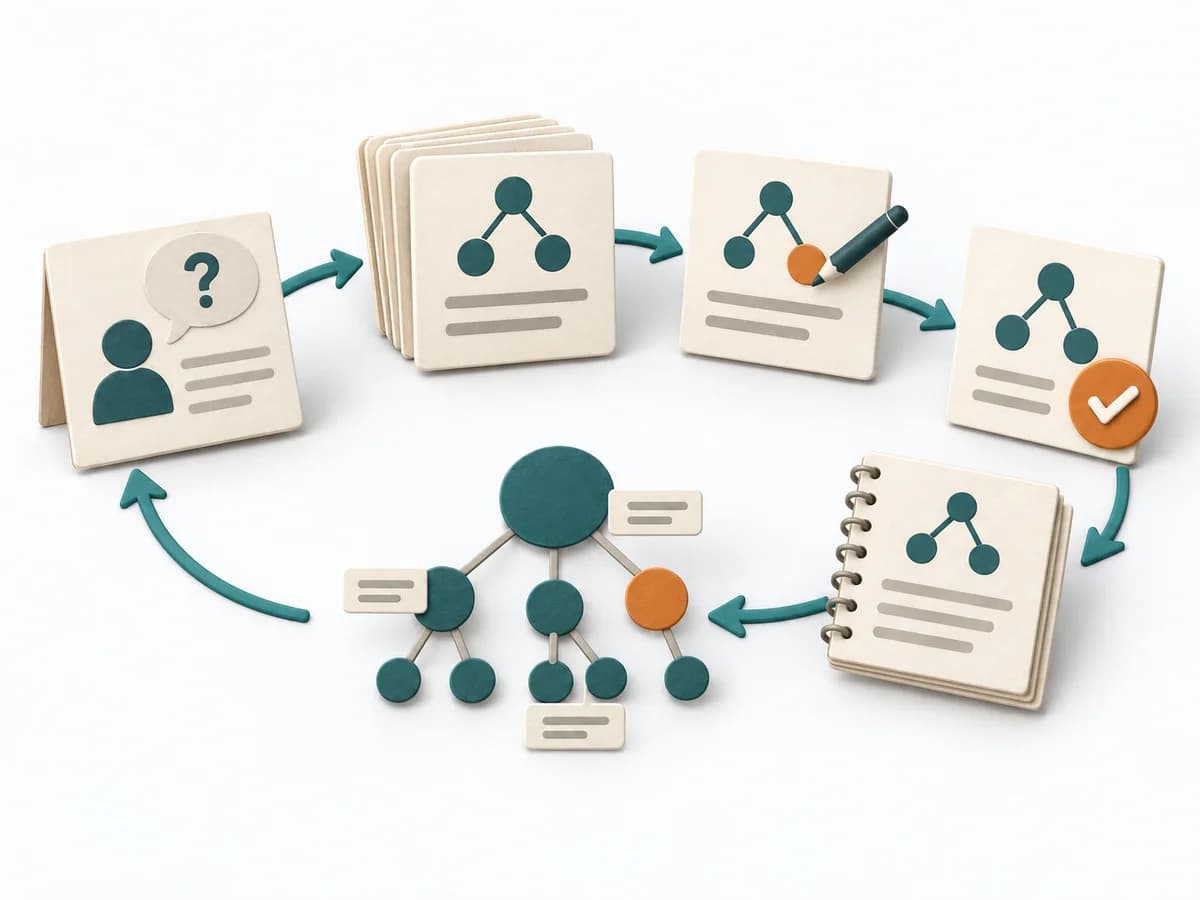 Knowledge Modeling Ontology Design Patterns |
|---|---|---|---|---|
Purposedifferent | In dynamic situations, decisions become outdated faster than they can be prepared. The OODA Loop holds observing, orienting, deciding, and acting together as a recurring rhythm so reaction does not slide into inertia. | In change initiatives, supporting and restraining forces sit at the table at the same time. Force Field Analysis makes these tensions explicit and shows where change can be pushed forward by strengthening or relieving. | The NeOn Methodology structures ontology work as a controlled process with reuse, scenarios, and reviews. It is useful when ontologies should not emerge ad hoc but modularly and reusably. | Ontology Design Patterns provide reusable building blocks for recurring modeling problems. The method brings structure to the search for clean concepts, relationships, and roles. |
Complexitydifferent | Medium | Low | High | Medium |
Timedifferent | 15-60 min je Zyklus | 45-90 min | Mehrere Wochen bis Monate | 1-3 h pro Pattern |
Participantsdifferent | 1-8 | 3-12 | 2-10 | 1-6 |
Formatdifferent | Workshop + async | Workshop | Workshop + async | Workshop + async |
Outputdifferent | Situation Assessment, Decision Loop, Action Updates | Force Field Map, Change Levers, Risk Notes | Ontology Requirements Specification, Reuse Plan, Ontology Modules, Evaluation Report | Selected Patterns, Adapted Schema Fragments, Pattern Documentation |
Tagsno overlap | DecisionChangeLearningStrategy | ChangeDecisionStrategy | OntologyMethodologyReuseSemanticEngineering | OntologyPatternsReuseSemanticModeling |