View methods side by side.
Choose up to four methods. Add them using the search and share the comparison by copying its link.
| Criterion |  Knowledge Modeling Ontology Design Patterns |  Systems Thinking Leverage Points |  Systems Thinking Behavior Over Time Graph | 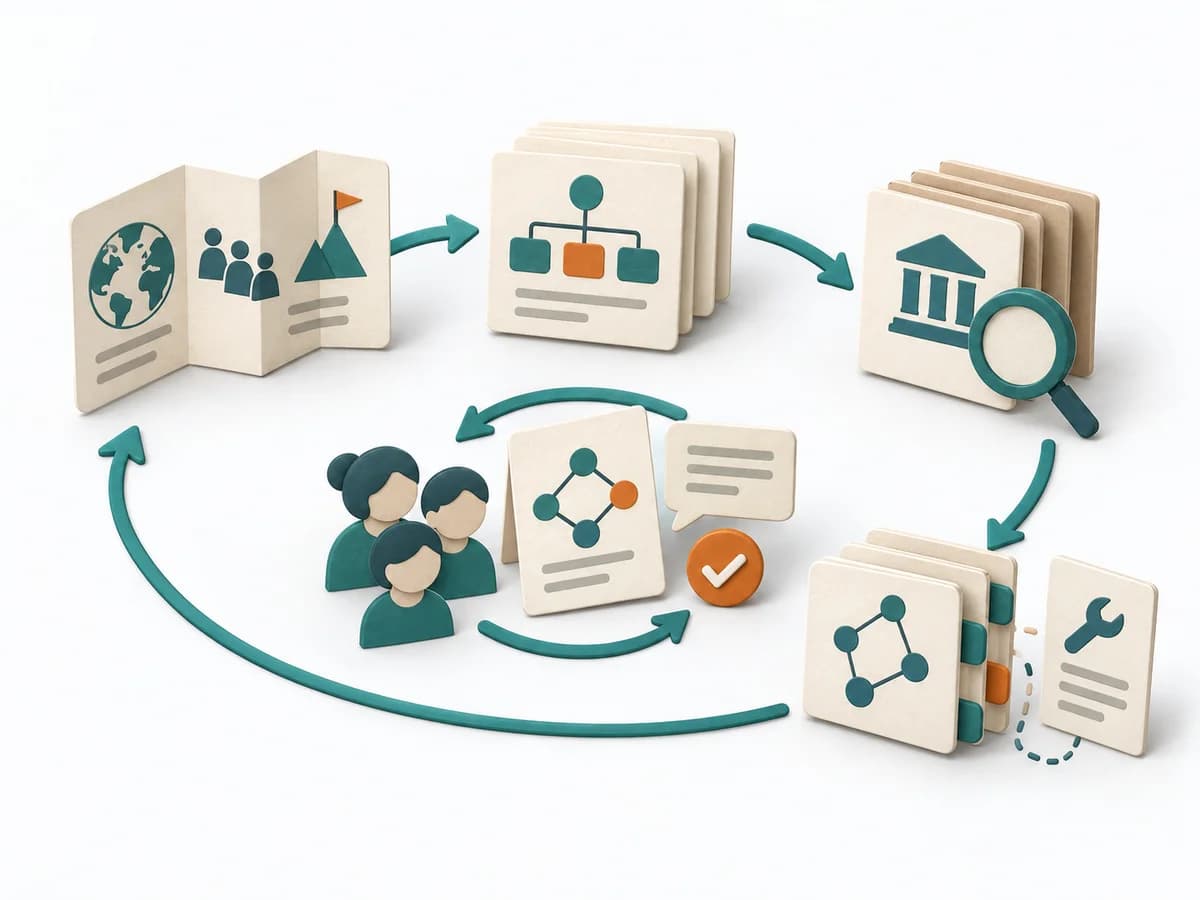 Knowledge Modeling NeOn Methodology |
|---|---|---|---|---|
Purposedifferent | Ontology Design Patterns provide reusable building blocks for recurring modeling problems. The method brings structure to the search for clean concepts, relationships, and roles. | Leverage Points show exactly where interventions in a system produce a disproportionate effect. It draws relationships, patterns, and feedback loops. The result is captured as a leverage map and action strategy. | A Behavior Over Time Graph shows how a metric or observation develops over time. The method makes trends, breaks, and recurring patterns visible that get lost in snapshots. | The NeOn Methodology structures ontology work as a controlled process with reuse, scenarios, and reviews. It is useful when ontologies should not emerge ad hoc but modularly and reusably. |
Complexitydifferent | Medium | High | Low | High |
Timedifferent | 1-3 h pro Pattern | Half day | 20-45 min | Mehrere Wochen bis Monate |
Participantsdifferent | 1-6 | 3-12 | 1-10 | 2-10 |
Formatdifferent | Workshop + async | Workshop | Workshop + async | Workshop + async |
Outputdifferent | Selected Patterns, Adapted Schema Fragments, Pattern Documentation | Leverage Map, Action Strategy | Behavior Over Time Graph, Trend Hypotheses, Key Events | Ontology Requirements Specification, Reuse Plan, Ontology Modules, Evaluation Report |
Tagsno overlap | OntologyPatternsReuseSemanticModeling | Systems thinkingChangeStrategy | Systems thinkingPatternsDynamics | OntologyMethodologyReuseSemanticEngineering |