View methods side by side.
Choose up to four methods. Add them using the search and share the comparison by copying its link.
| Criterion |  Delivery MoSCoW |  Agile Planning Poker |  Agile Affinity Estimation | 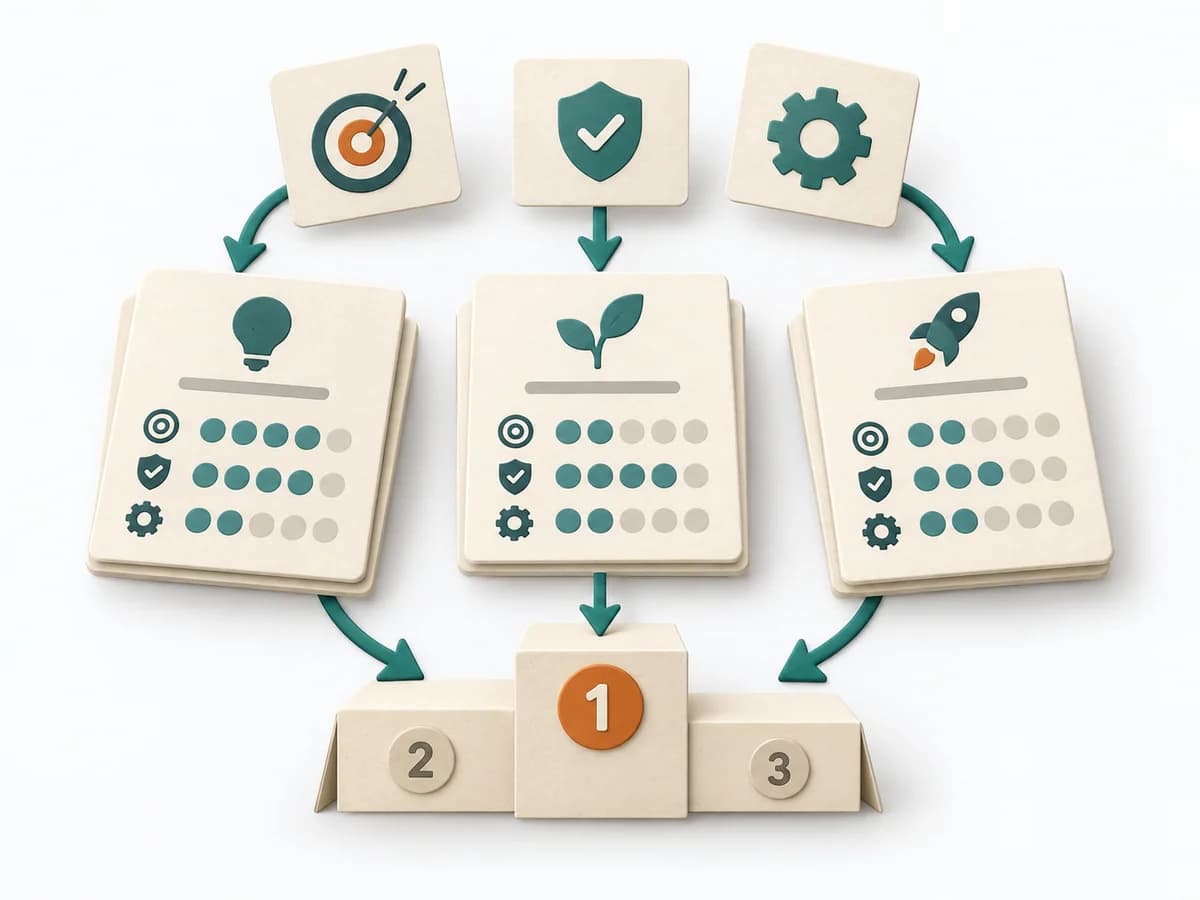 Product Strategy ICE Scoring |
|---|---|---|---|---|
Purposedifferent | When a release carries too many demands and priorities are only ever negotiated, MoSCoW creates clear boundaries for the next cut. Must, Should, Could, and Won't make commitment, room for maneuver, and trade-off logic visible to everyone involved. | When estimates within the team diverge too much, it puts differing expectations on a common test bench. It separates rough complexity from unspoken assumptions. | When many tasks need to be classified quickly, it sorts them by perceived effort and similarity. It reduces the effort of fine-grained estimation for large volumes. | When ideas need sorting quickly, it condenses impact, confidence, and effort into one compact score. It connects customer value, product logic, and decision priorities. The result is captured as an ICE table and top-ideas list. |
Complexitydifferent | Low | Low | Medium | Low |
Timedifferent | 30-90 min | 2-5 min je Item | 30-90 min | 30-60 min |
Participantsdifferent | 3-12 | 3-9 | 3-12 | 2-8 |
Formatdifferent | Workshop + async | Workshop + async | Workshop | Workshop + async |
Outputdifferent | Prioritized Backlog, Release Scope, Tradeoff Notes | Relative Estimates, Assumption Notes, Split Candidates | Affinity Size Map, Grouped Estimates, Unclear Items | ICE Table, Top Idea List |
Tagsno overlap | PrioritizationScopeDecision | EstimationAgileRelative sizingTeam | EstimationBacklogRelative sizing | PrioritizationScoringGrowthDecision |