View methods side by side.
Choose up to four methods. Add them using the search and share the comparison by copying its link.
| Criterion |  Delivery MoSCoW | 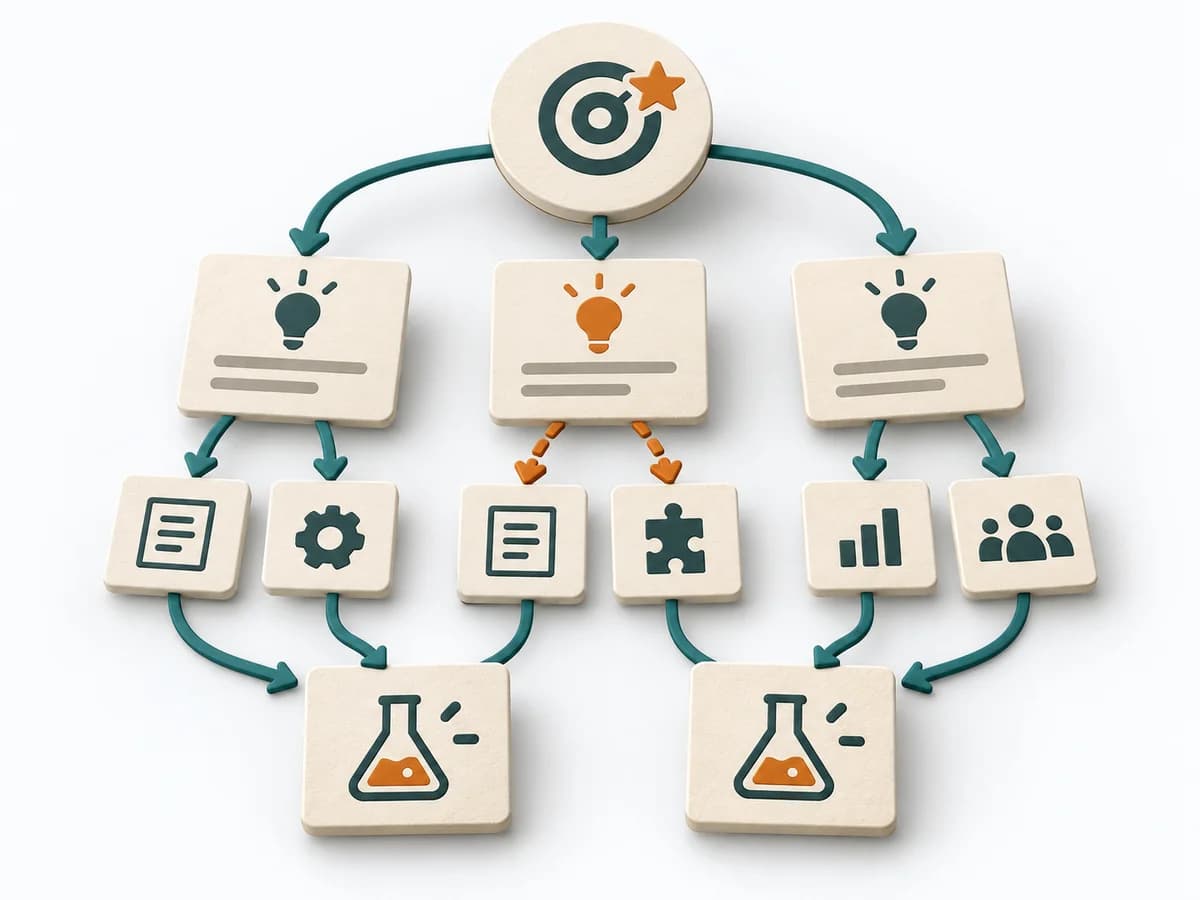 Product Discovery Opportunity Solution Tree |  Product Discovery Test Card |  UX Design Lean UX Canvas |
|---|---|---|---|---|
Purposedifferent | When a release carries too many demands and priorities are only ever negotiated, MoSCoW creates clear boundaries for the next cut. Must, Should, Could, and Won't make commitment, room for maneuver, and trade-off logic visible to everyone involved. | When discovery keeps swinging between goals, ideas, and learning loops, it creates clear steering logic. It connects the desired outcome, opportunities, and experiments into a legible structure. | The Test Card turns a critical assumption into a testable claim and specifies in advance which result counts as success. | The Lean UX Canvas helps clarify user behavior, touchpoints, and concept decisions. It makes assumptions and desired outcomes visible and captures the result as a completed canvas, hypothesis list, and first experiment. |
Complexitydifferent | Low | Medium | Low | Medium |
Timedifferent | 30-90 min | 1-2 h Setup, laufend | 20-35 min | 2-3 h |
Participantsdifferent | 3-12 | 2-6 | 1-5 | 3-8 |
Formatsame | Workshop + async | Workshop + async | Workshop + async | Workshop + async |
Outputdifferent | Prioritized Backlog, Release Scope, Tradeoff Notes | Opportunity Solution Tree, Experiment Backlog, Learning Log | Test Card with a pre-set threshold | Completed Lean UX Canvas, Hypothesis list, First experiment |
Tagsno overlap | PrioritizationScopeDecision | DiscoveryOutcomesExperimentsOpportunity | ExperimentsValidationDiscoveryHypothesis | CanvasHypothesisOutcomesDiscovery |