View methods side by side.
Choose up to four methods. Add them using the search and share the comparison by copying its link.
| Criterion |  Delivery MoSCoW |  Decision Making Decision Tree |  Facilitation Decision Jam | 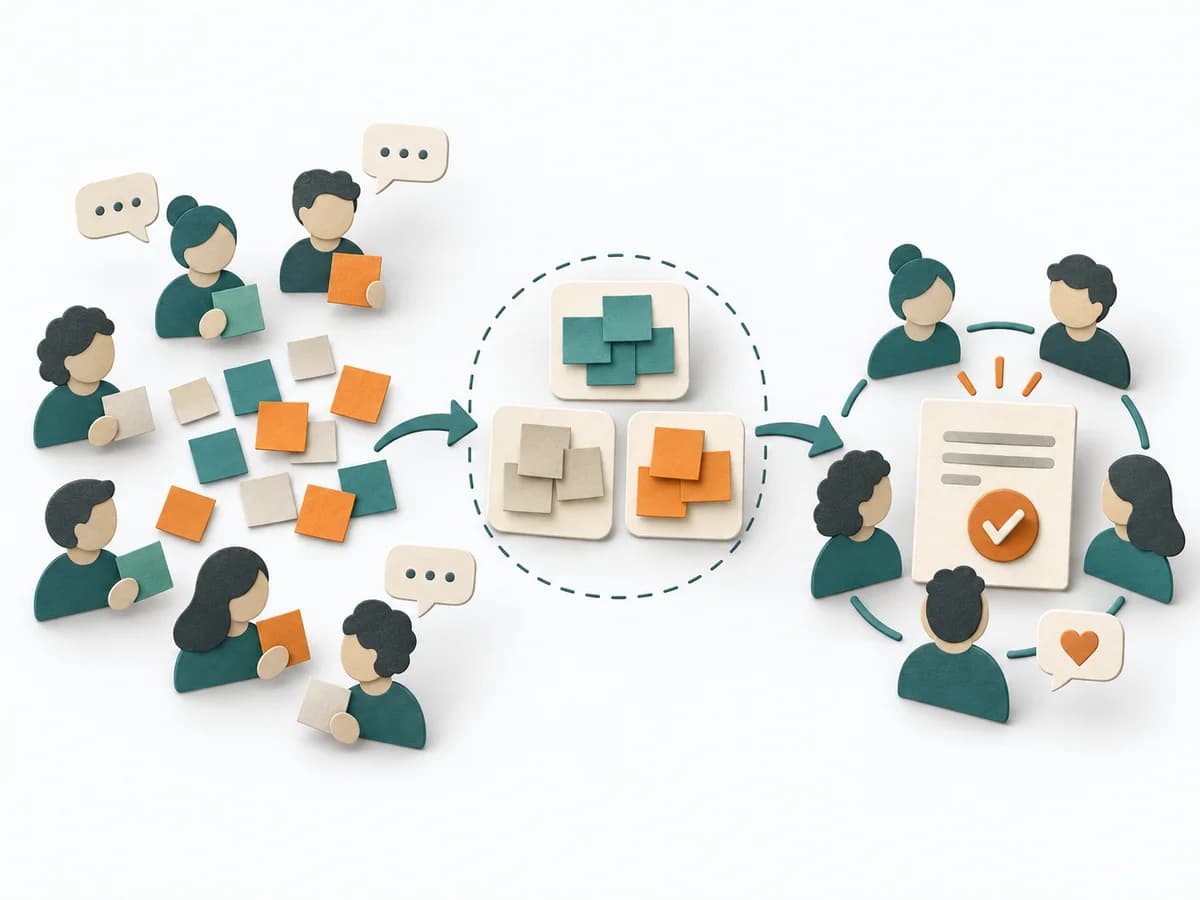 Facilitation Consensus Workshop |
|---|---|---|---|---|
Purposedifferent | When a release carries too many demands and priorities are only ever negotiated, MoSCoW creates clear boundaries for the next cut. Must, Should, Could, and Won't make commitment, room for maneuver, and trade-off logic visible to everyone involved. | For decisions with follow-on paths and dependencies, a linear comparison is often not enough. A Decision Tree shows how options branch under conditions and which consequences hang on each branch. | When a decision is stuck, Decision Jam loosens the knot through structured separation of problem, idea, and selection. The format creates movement without jumping prematurely at the first seemingly elegant answer. | When a group needs a solid decision without outvoting individual factions, a Consensus Workshop creates a negotiable common ground. It makes agreement, reservations, and open tensions discussable at the same time. |
Complexitydifferent | Low | Medium | Low | Medium |
Timedifferent | 30-90 min | 30-90 min | 60-90 min | 1-3 h |
Participantsdifferent | 3-12 | 1-6 | 4-10 | 5-30 |
Formatdifferent | Workshop + async | Workshop + async | Workshop | Workshop |
Outputdifferent | Prioritized Backlog, Release Scope, Tradeoff Notes | Decision Tree, Option Map, Assumption List | Problem Cluster, Prioritized Challenge, Experiment | Consensus Clusters, Theme Titles, Priority Areas |
Tagsno overlap | PrioritizationScopeDecision | DecisionTreeOptions | FacilitationDecisionProblem solvingWorkshop | FacilitationConsensusWorkshopAlignment |