View methods side by side.
Choose up to four methods. Add them using the search and share the comparison by copying its link.
| Criterion |  Innovation Morphological Analysis | 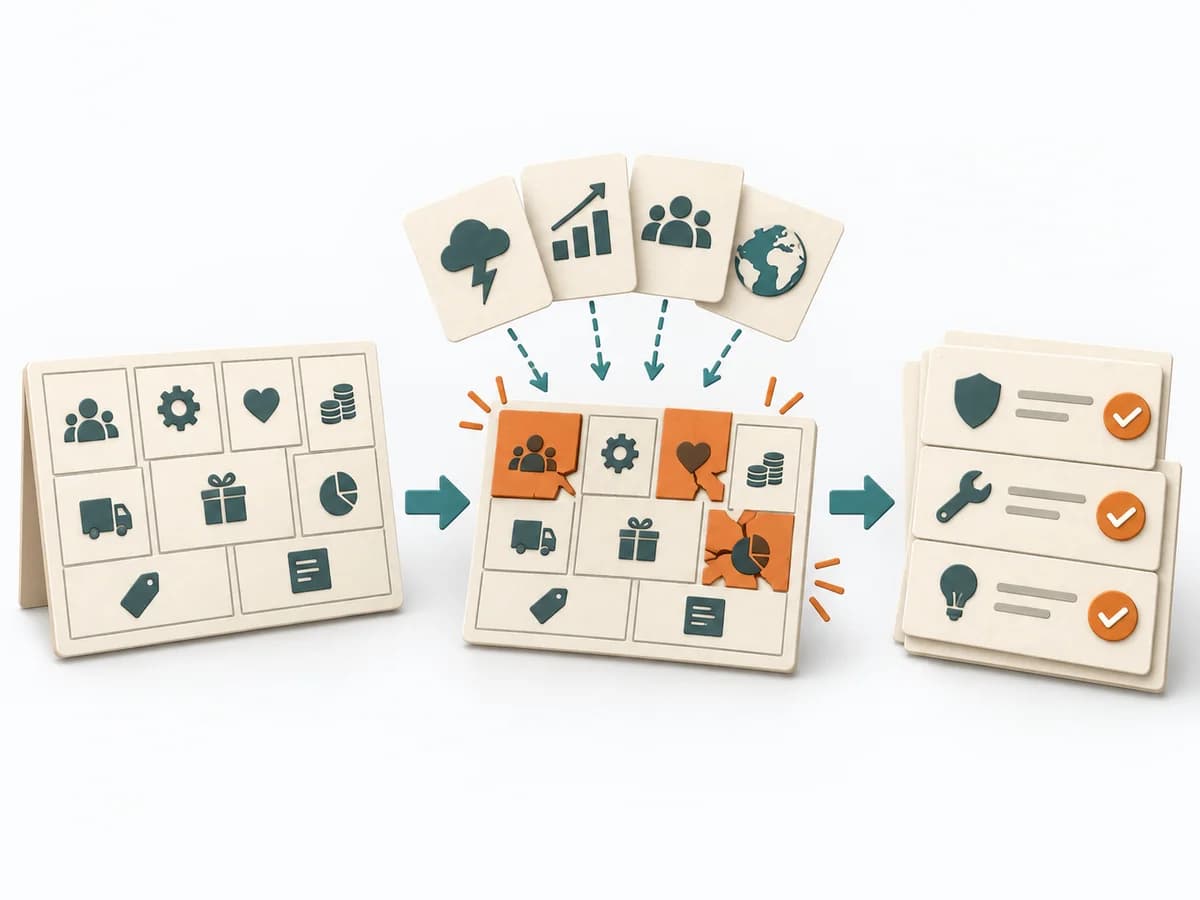 Business Strategy Business Model Stress Test |  Innovation Reverse Brainstorming |  Innovation Lotus Blossom |
|---|---|---|---|---|
Purposedifferent | For a search for solutions with many degrees of freedom, a grid emerges for systematic combinations. The method separates features, variants, and exclusion criteria, so the space gets explored deliberately. | A Business Model Stress Test checks how well a business model holds up under pressure and headwinds. It compares strengths, risks, market logic, and courses of action. The result is captured as a stress-test report and action plan per scenario. | For persistent errors or blockages, the method shifts the view to the opposite of the desired effect. It exposes the mechanics of failure and makes hidden causes easier to grasp. This makes improvement more concrete and the problem clearer. | When a central question feels too large, the method breaks it into neighboring topic fields with their own depth of ideation. It holds structure and openness at the same time, so adjacent perspectives don't get lost. This grows an idea space out of a core problem. |
Complexitydifferent | Medium | High | Low | Low |
Timedifferent | 1-3 h | Half day | 30-60 min | 45-90 min |
Participantsdifferent | 2-8 | 3-8 | 3-12 | 3-10 |
Formatdifferent | Workshop + async | Workshop | Workshop | Workshop |
Outputdifferent | Morphological Box, Concept Combinations, Idea Shortlist | Stress Test Report, Action Plan per Scenario | Reverse Ideas, Risk Themes, Solution Ideas | Lotus Diagram, Idea Themes, Shortlist |
Tagsno overlap | IdeationInnovationCreativity | StrategyBusiness modelRiskDiagnosis | BrainstormingIdeationCreativityRisk | BrainstormingIdeationCreativityDivergenceWorkshop |