View methods side by side.
Choose up to four methods. Add them using the search and share the comparison by copying its link.
| Criterion |  Facilitation Mind Mapping | 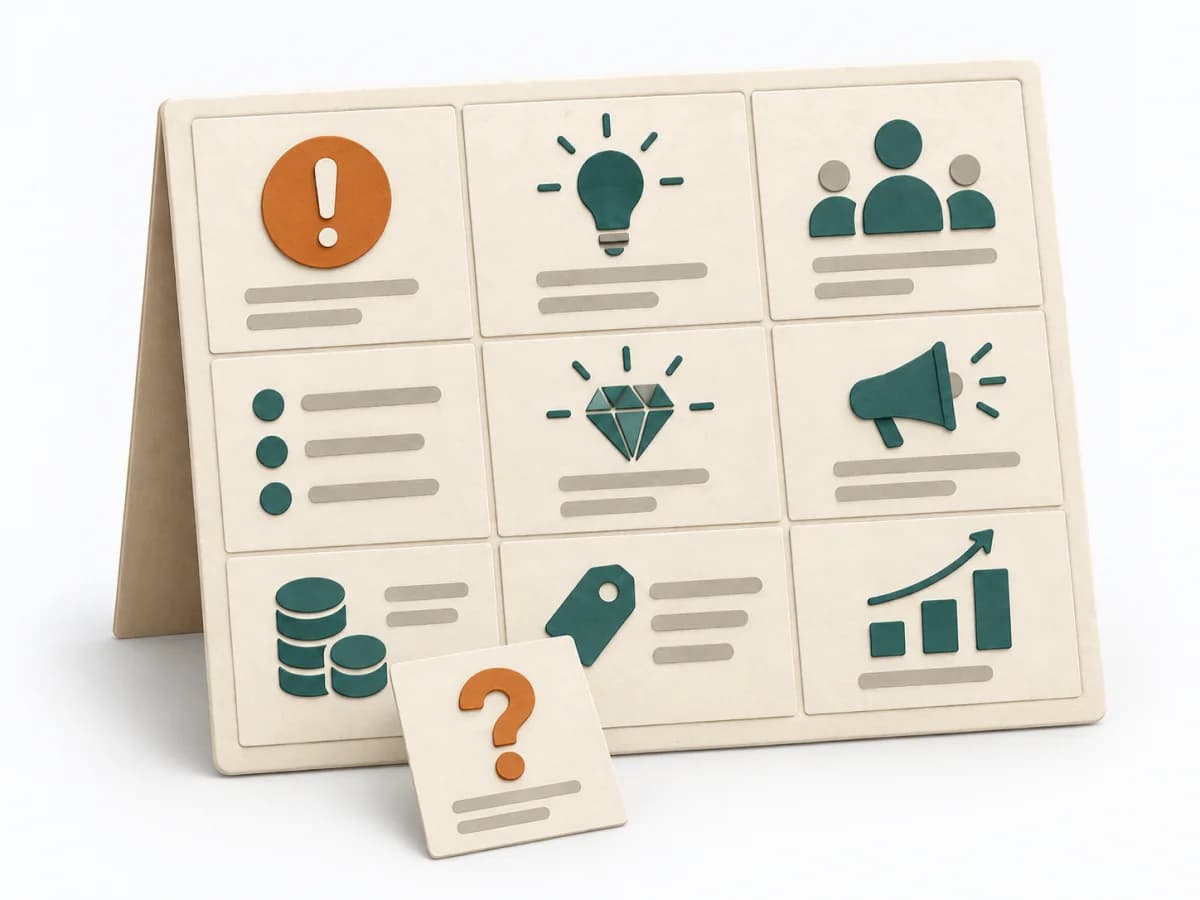 Product Strategy Lean Canvas |  Product Discovery Smoke Test |  Product Discovery Fake Door Test |
|---|---|---|---|---|
Purposedifferent | When a topic is still unclear and too many thoughts surface at once, Mind Mapping creates an open surface for ordering them. It makes connections, subtopics, and starting points visible without fixing them too early. | When an early product bet still has too many open points, it brings target group, problem, and assumptions into a single view. It condenses the idea so core risks become nameable. | When demand only needs to be roughly verified, it tests interest with minimal effort. It measures whether people would take a next step at all. | When demand is still unclear, it measures interest in a feature before it is built. It separates real behavior from polite agreement and deliberately keeps build effort small. |
Complexitydifferent | Low | Medium | Low | Medium |
Timedifferent | 15-45 min | 45-90 min | 1-5 Tage | 1-5 Tage |
Participantsdifferent | 1-10 | 1-6 | Nutzertraffic | Nutzertraffic |
Formatdifferent | Workshop + async | Workshop + async | Async | Async |
Outputdifferent | Mind Map, Topic Clusters, Open Questions | Lean Canvas, Core Assumptions, Experiment Backlog | Interest Metrics, Conversion Signal, Learning Note | Click Data, Interest Signal, Learning Decision |
Tagsno overlap | BrainstormingIdeasMappingStructureFacilitation | StartupLeanAssumptionsBusiness model | ValidationExperimentsDemandGrowth | ValidationExperimentsDemandDiscovery |