View methods side by side.
Choose up to four methods. Add them using the search and share the comparison by copying its link.
| Criterion |  Facilitation Mind Mapping |  Systems Thinking Intervention Mapping | 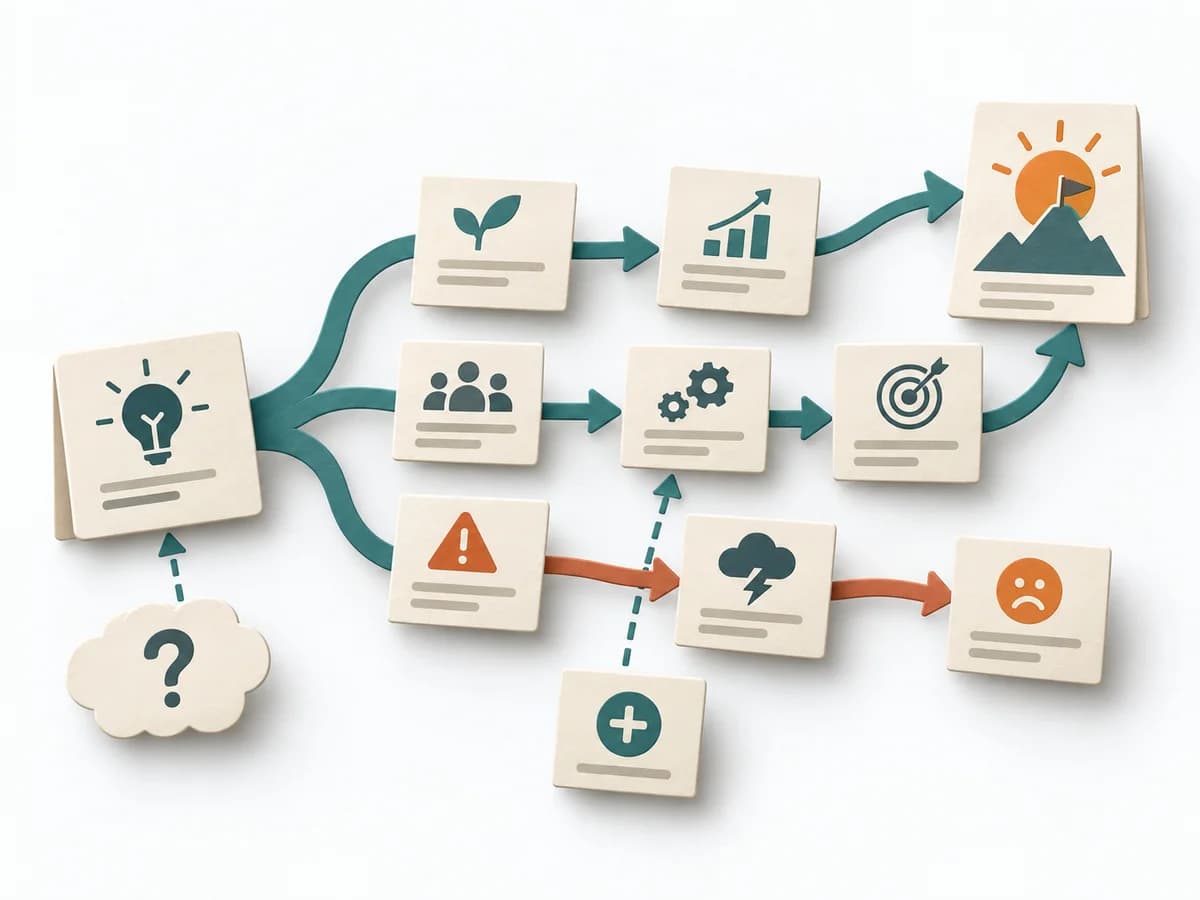 Systems Thinking Future Reality Tree |  Innovation Brainwriting |
|---|---|---|---|---|
Purposedifferent | When a topic is still unclear and too many thoughts surface at once, Mind Mapping creates an open surface for ordering them. It makes connections, subtopics, and starting points visible without fixing them too early. | Intervention Mapping translates a need for change into a planned, evaluable program. The method connects target group, determinants, actions, and measurement into a traceable chain. | A Future Reality Tree shows how desired actions are meant to lead to a better system state. The method checks whether a path of change holds together logically before time flows into implementation. | When loud voices or hierarchy distort the idea search, the method creates a quiet entry into joint development. It gives everyone thinking space and gathers contributions without social brakes, making diversity more visible and easier to build on. |
Complexitydifferent | Low | High | High | Low |
Timedifferent | 15-45 min | 1-5 Tage | 2-4 h | 15-30 min |
Participantsdifferent | 1-10 | 4-12 | 3-8 | 3-12 |
Formatdifferent | Workshop + async | Workshop + async | Workshop | Workshop + async |
Outputdifferent | Mind Map, Topic Clusters, Open Questions | Logic Model, Change Objectives, Intervention Components, Evaluation Plan | Future Reality Tree, Negative Branches, Assumption List, Improved Injections | Idea sheets, Expanded concepts, Prioritized list |
Tagsno overlap | BrainstormingIdeasMappingStructureFacilitation | ChangeSystems thinkingCapability | Theory of ConstraintsSystems thinkingChange | BrainstormingCollaborationInclusionIdeas |