View methods side by side.
Choose up to four methods. Add them using the search and share the comparison by copying its link.
| Criterion |  Facilitation Mind Mapping |  Knowledge Modeling IBIS | 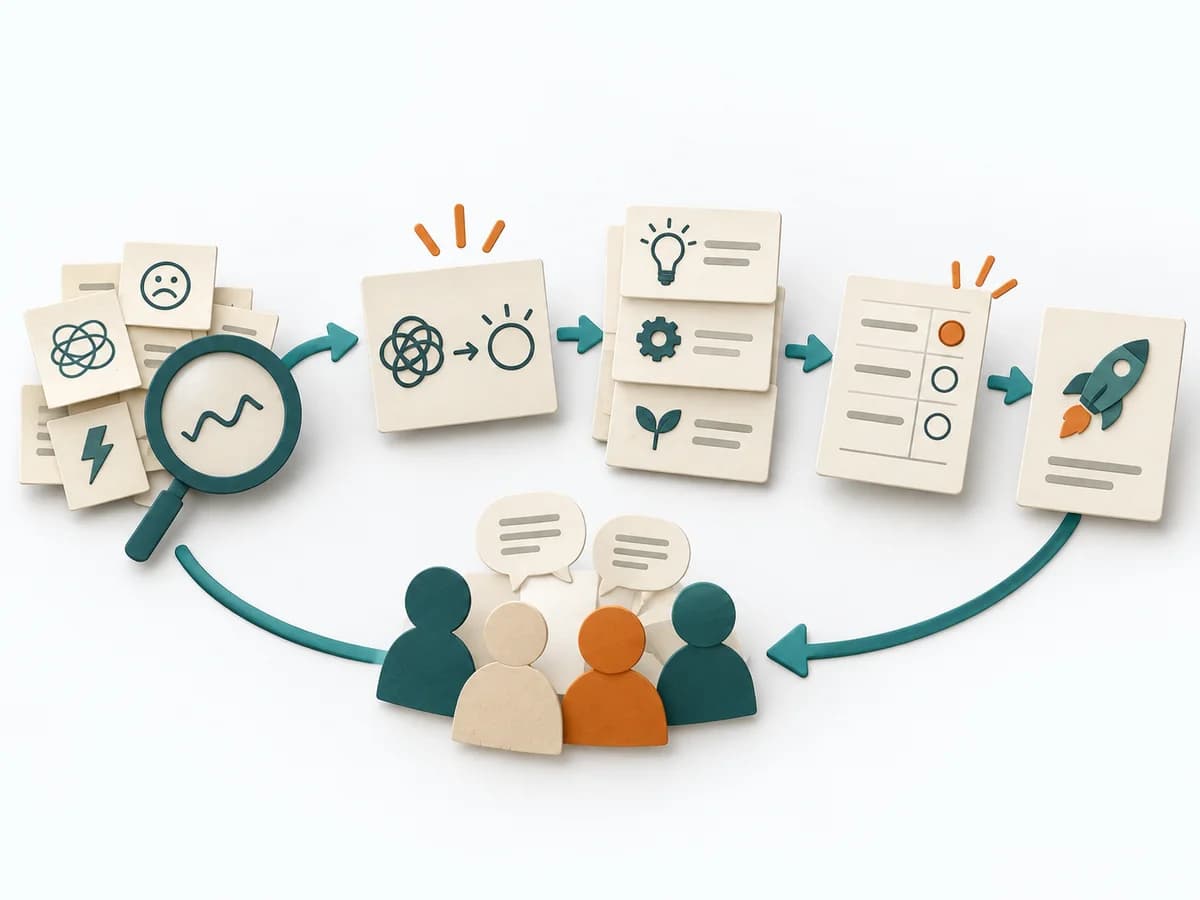 Facilitation Decision Jam |  Knowledge Modeling Concept Mapping |
|---|---|---|---|---|
Purposedifferent | When a topic is still unclear and too many thoughts surface at once, Mind Mapping creates an open surface for ordering them. It makes connections, subtopics, and starting points visible without fixing them too early. | IBIS structures thinking about complex questions as a sequence of issues, ideas, and arguments. The method keeps discussions open without forcing them into premature consensus. | When a decision is stuck, Decision Jam loosens the knot through structured separation of problem, idea, and selection. The format creates movement without jumping prematurely at the first seemingly elegant answer. | Concept Mapping arranges terms and relationships in a network that makes subject-matter connections tangible. It fits when a topic needs to be understood structurally rather than linearly. |
Complexitydifferent | Low | Medium | Low | Medium |
Timedifferent | 15-45 min | 1-3 h | 60-90 min | 1-2 h |
Participantsdifferent | 1-10 | 2-8 | 4-10 | 1-8 |
Formatdifferent | Workshop + async | Workshop + async | Workshop | Workshop + async |
Outputdifferent | Mind Map, Topic Clusters, Open Questions | Issue Map, Positions, Argument Notes | Problem Cluster, Prioritized Challenge, Experiment | Concept Map, Relationship Labels, Knowledge Gaps |
Tagsno overlap | BrainstormingIdeasMappingStructureFacilitation | RationaleKnowledgeDecision | FacilitationDecisionProblem solvingWorkshop | KnowledgeConceptsMappingSensemaking |