View methods side by side.
Choose up to four methods. Add them using the search and share the comparison by copying its link.
| Criterion |  Knowledge Modeling Linked Open Terms |  Delivery RAID Log |  Architecture Views and Beyond | 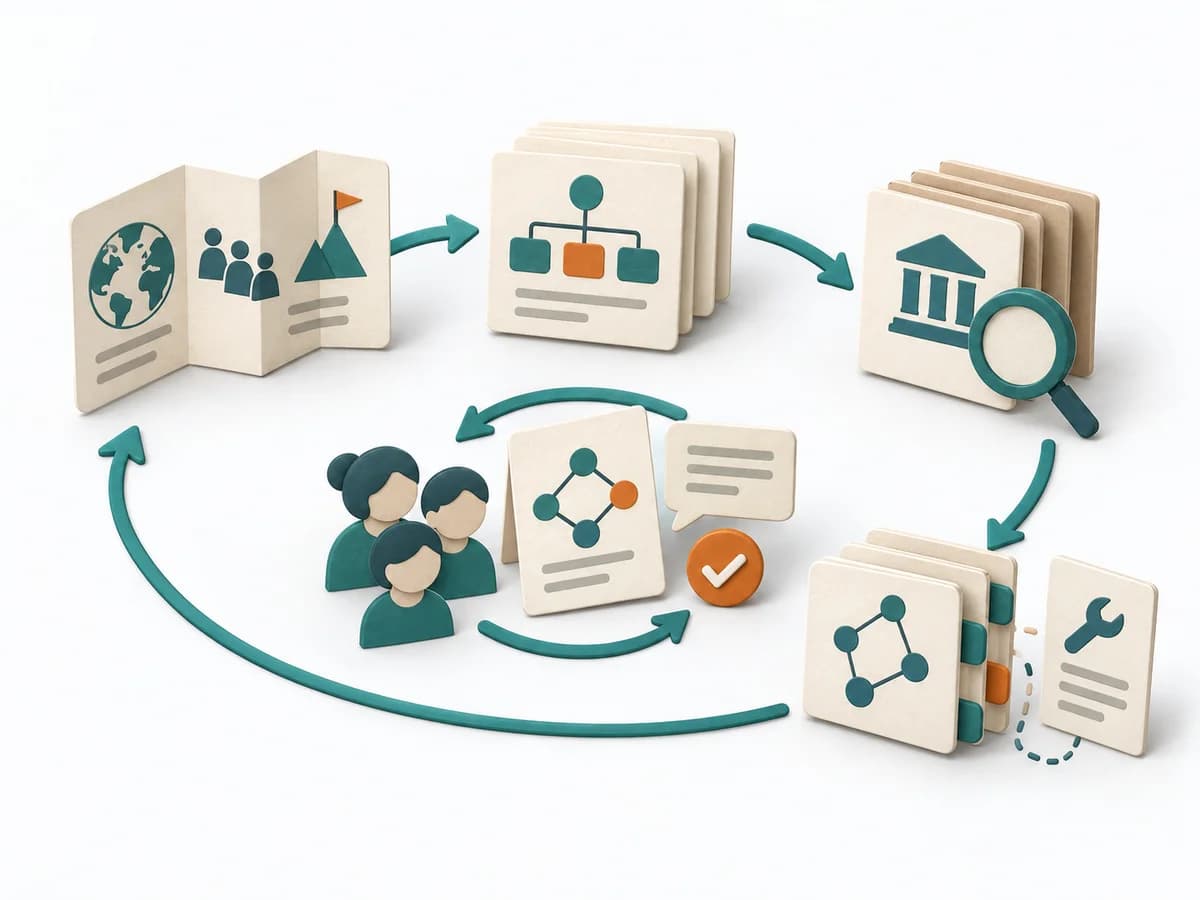 Knowledge Modeling NeOn Methodology |
|---|---|---|---|---|
Purposedifferent | Linked Open Terms connects terminology work with linked-data thinking and makes terminology technically connectable. Vocabulary, meanings, and references can thereby be maintained consistently. | Helps clarify scope, sequence, and delivery flow in concrete terms. It makes work, boundaries, and order steerable. The result is captured as a RAID Log and a source for status reporting. | Views and Beyond organizes architecture into several views so no single diagram has to do everything at once. This makes it possible to choose the representation that fits the stakeholder's question. | The NeOn Methodology structures ontology work as a controlled process with reuse, scenarios, and reviews. It is useful when ontologies should not emerge ad hoc but modularly and reusably. |
Complexitydifferent | Medium | Low | Medium | High |
Timedifferent | Wochen bis Monate | 30 min Setup, dann laufend | 1-3 Tage | Mehrere Wochen bis Monate |
Participantsdifferent | 2-8 | 1-3 maintaining, briefing for everyone | 1-4 | 2-10 |
Formatdifferent | Workshop + async | Async | Workshop + async | Workshop + async |
Outputdifferent | Ontology Requirements, Conceptual Model, Published Ontology, Documentation, Maintenance Plan | RAID Log, Status Report Source | Architecture Views, Cross-view Notes, Rationale | Ontology Requirements Specification, Reuse Plan, Ontology Modules, Evaluation Report |
Tagsno overlap | OntologyMethodologyAgileSemantic | RiskTrackingStakeholdersGovernance | DocumentationStakeholdersArchitecture | OntologyMethodologyReuseSemanticEngineering |