View methods side by side.
Choose up to four methods. Add them using the search and share the comparison by copying its link.
| Criterion |  Knowledge Modeling Linked Open Terms | 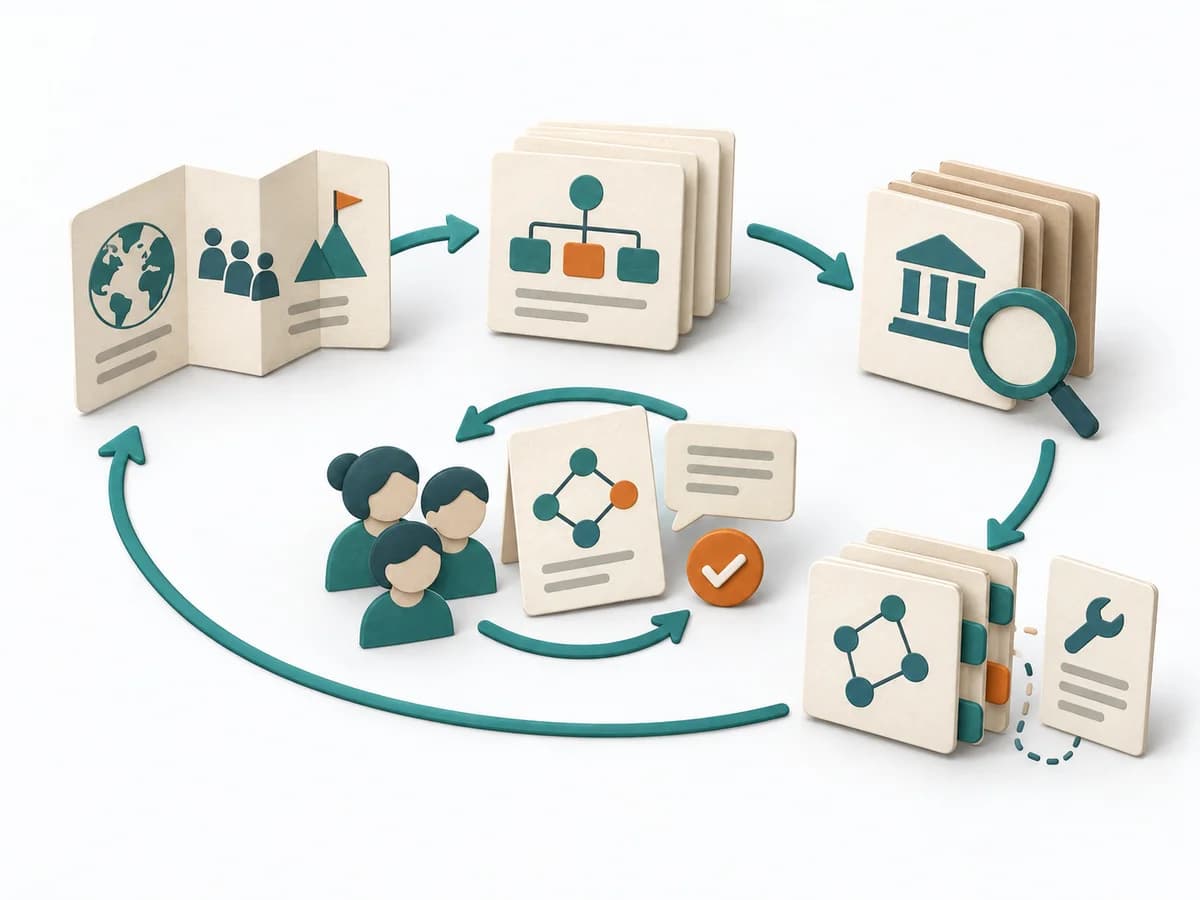 Knowledge Modeling NeOn Methodology |  DevOps ChatOps |  Knowledge Modeling Ontology Design Patterns |
|---|---|---|---|---|
Purposedifferent | Linked Open Terms connects terminology work with linked-data thinking and makes terminology technically connectable. Vocabulary, meanings, and references can thereby be maintained consistently. | The NeOn Methodology structures ontology work as a controlled process with reuse, scenarios, and reviews. It is useful when ontologies should not emerge ad hoc but modularly and reusably. | For operational work in a distributed team, the method links communication with direct system control. It records decisions right where the signal, the context, and the execution come together. | Ontology Design Patterns provide reusable building blocks for recurring modeling problems. The method brings structure to the search for clean concepts, relationships, and roles. |
Complexitydifferent | Medium | High | Medium | Medium |
Timedifferent | Wochen bis Monate | Mehrere Wochen bis Monate | Ongoing | 1-3 h pro Pattern |
Participantsdifferent | 2-8 | 2-10 | 2-20 | 1-6 |
Formatsame | Workshop + async | Workshop + async | Workshop + async | Workshop + async |
Outputdifferent | Ontology Requirements, Conceptual Model, Published Ontology, Documentation, Maintenance Plan | Ontology Requirements Specification, Reuse Plan, Ontology Modules, Evaluation Report | Chat Transcript, Action Log, Automations | Selected Patterns, Adapted Schema Fragments, Pattern Documentation |
Tagsno overlap | OntologyMethodologyAgileSemantic | OntologyMethodologyReuseSemanticEngineering | CollaborationEngineeringIncident | OntologyPatternsReuseSemanticModeling |