View methods side by side.
Choose up to four methods. Add them using the search and share the comparison by copying its link.
| Criterion |  Knowledge Modeling Linked Open Terms |  Decision Making Force Field Analysis |  Product Discovery Assumption Mapping | 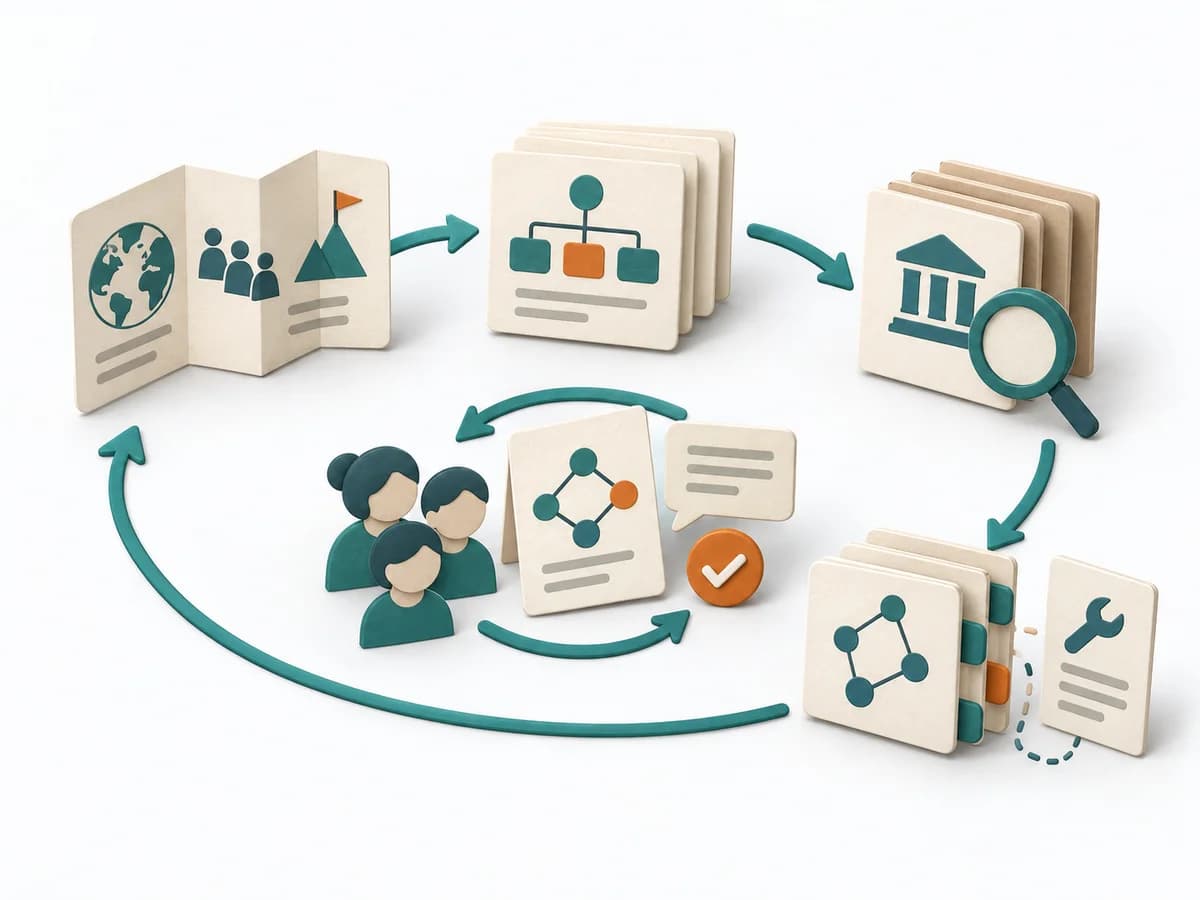 Knowledge Modeling NeOn Methodology |
|---|---|---|---|---|
Purposedifferent | Linked Open Terms connects terminology work with linked-data thinking and makes terminology technically connectable. Vocabulary, meanings, and references can thereby be maintained consistently. | In change initiatives, supporting and restraining forces sit at the table at the same time. Force Field Analysis makes these tensions explicit and shows where change can be pushed forward by strengthening or relieving. | When assumptions still sit unordered in the room, it weighs uncertainty against leverage. It makes visible which hypotheses should be checked first. | The NeOn Methodology structures ontology work as a controlled process with reuse, scenarios, and reviews. It is useful when ontologies should not emerge ad hoc but modularly and reusably. |
Complexitydifferent | Medium | Low | Medium | High |
Timedifferent | Wochen bis Monate | 45-90 min | 45-60 min | Mehrere Wochen bis Monate |
Participantsdifferent | 2-8 | 3-12 | 2-8 | 2-10 |
Formatdifferent | Workshop + async | Workshop | Workshop + async | Workshop + async |
Outputdifferent | Ontology Requirements, Conceptual Model, Published Ontology, Documentation, Maintenance Plan | Force Field Map, Change Levers, Risk Notes | Assumption map, Test backlog, Risk ranking | Ontology Requirements Specification, Reuse Plan, Ontology Modules, Evaluation Report |
Tagsno overlap | OntologyMethodologyAgileSemantic | ChangeDecisionStrategy | AssumptionsRiskExperimentsValidation | OntologyMethodologyReuseSemanticEngineering |