View methods side by side.
Choose up to four methods. Add them using the search and share the comparison by copying its link.
| Criterion |  Systems Thinking Leverage Points |  Business Strategy Value Chain Analysis |  Domain Modeling Bounded Context Canvas | 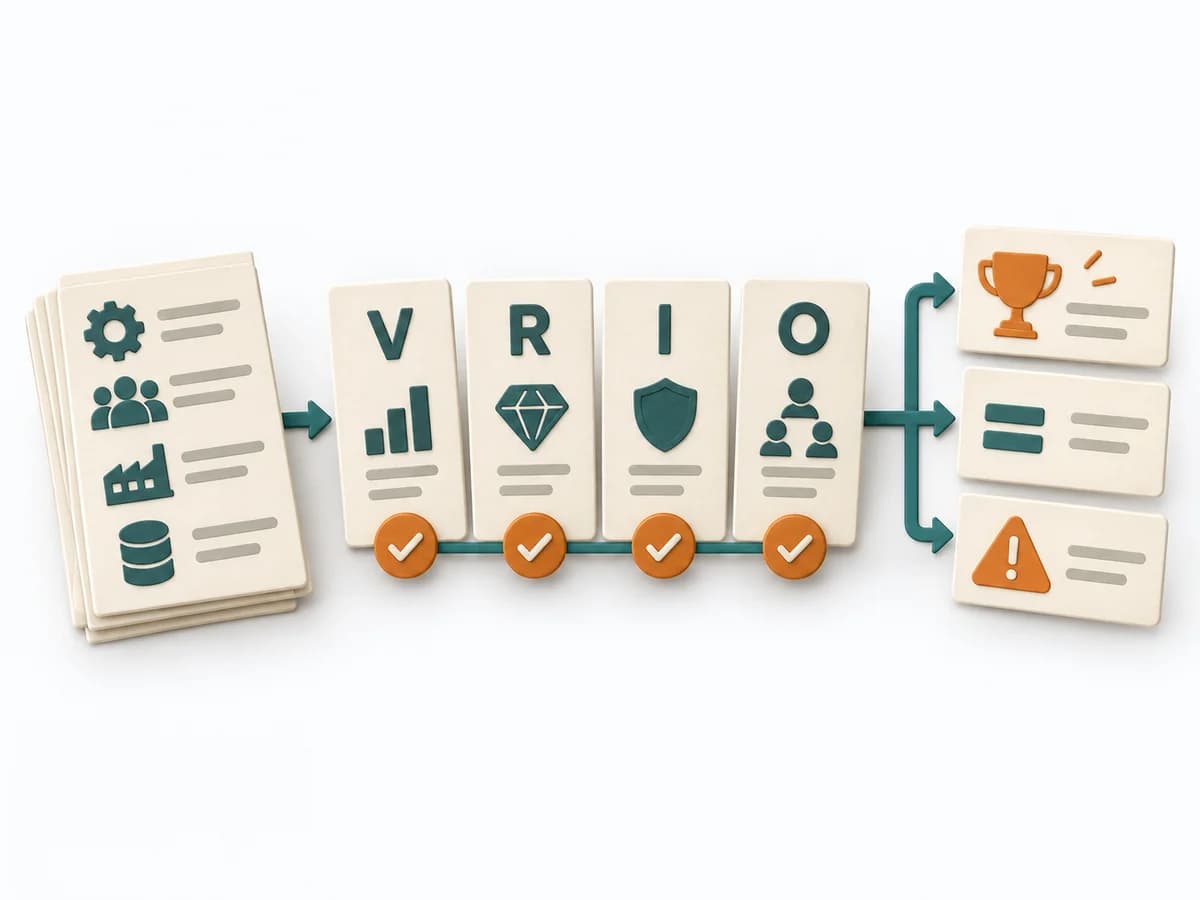 Business Strategy VRIO Framework |
|---|---|---|---|---|
Purposedifferent | Leverage Points show exactly where interventions in a system produce a disproportionate effect. It draws relationships, patterns, and feedback loops. The result is captured as a leverage map and action strategy. | Value Chain Analysis shows where value is created, costs accrue, and differentiation becomes possible along the process. It compares strengths, risks, market logic, and courses of action. The result is captured as a value-chain map and lever list. | When a business context is still loosely outlined, it shapes language, responsibility, and integration space. It clarifies what belongs together and where a boundary needs to hold. | The VRIO Framework rates resources and capabilities on whether they are Valuable, Rare, Inimitable, and Organized. It compares strengths, risks, market logic, and courses of action. The result is captured as a VRIO table and strategic actions. |
Complexitydifferent | High | High | Medium | Medium |
Timedifferent | Half day | Half day | 1-3 h | 90-180 min |
Participantsdifferent | 3-12 | 3-8 | 3-8 | 3-6 |
Formatdifferent | Workshop | Workshop | Workshop + async | Workshop |
Outputdifferent | Leverage Map, Action Strategy | Value Chain Map, Lever List | Context Canvas, Glossary, Integration Notes | VRIO Table, Strategic Actions |
Tagsno overlap | Systems thinkingChangeStrategy | StrategyBusiness modelDiagnosisAnalysis | Domain-Driven DesignBoundariesModeling | StrategyDiagnosisBusiness modelCapability |