View methods side by side.
Choose up to four methods. Add them using the search and share the comparison by copying its link.
| Criterion |  Systems Thinking Leverage Points | 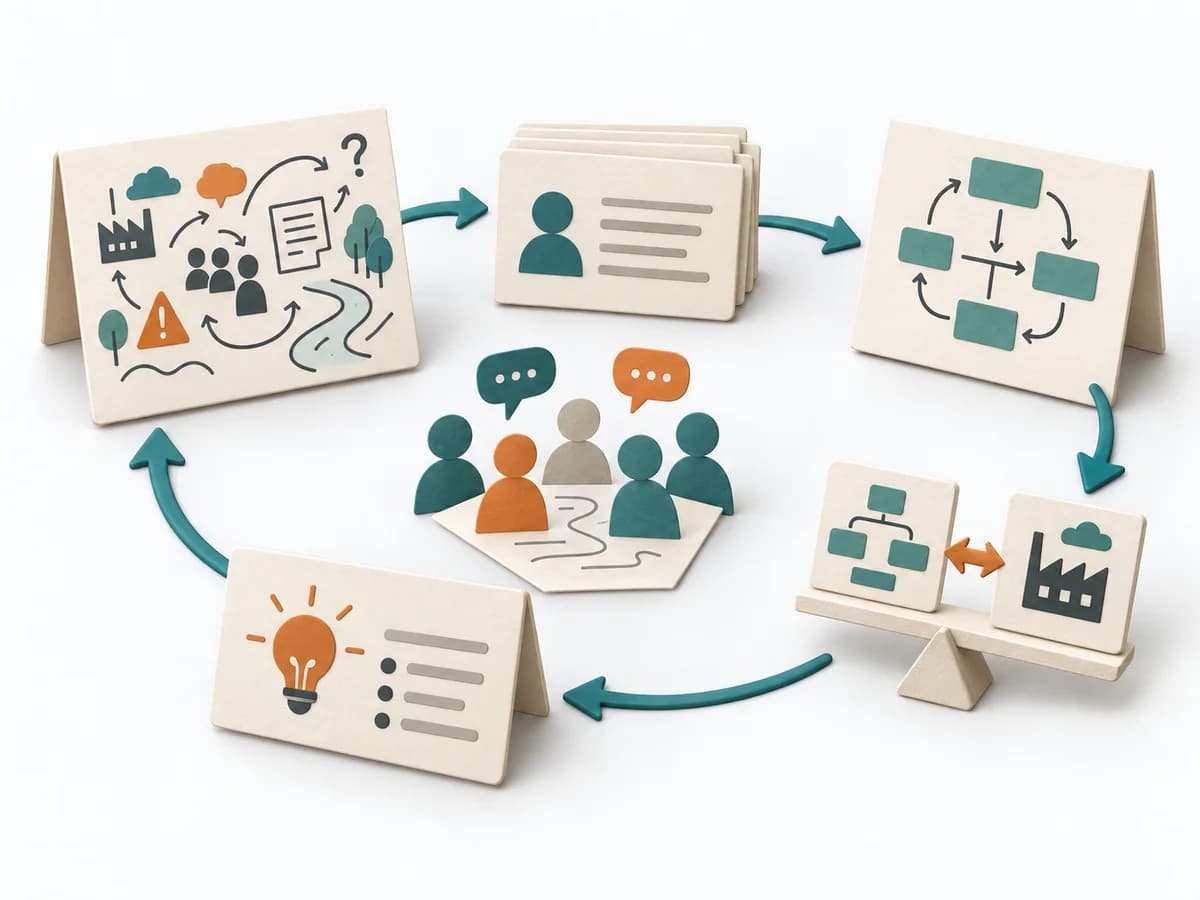 Systems Thinking Soft Systems Methodology |  Domain Modeling Context Map |  Domain Modeling Bounded Context Canvas |
|---|---|---|---|---|
Purposedifferent | Leverage Points show exactly where interventions in a system produce a disproportionate effect. It draws relationships, patterns, and feedback loops. The result is captured as a leverage map and action strategy. | Soft Systems Methodology helps explore unclear or politically charged problems systematically. Instead of forcing a quick answer, the method builds a shared understanding of perspectives and room for action. | When several contexts need to talk to each other, it makes their relationships and dependencies legible. It helps sort integration pressure and responsibilities across system boundaries. | When a business context is still loosely outlined, it shapes language, responsibility, and integration space. It clarifies what belongs together and where a boundary needs to hold. |
Complexitydifferent | High | High | Medium | Medium |
Timedifferent | Half day | 0.5-3 Tage | 1-3 h | 1-3 h |
Participantsdifferent | 3-12 | 5-15 | 2-8 | 3-8 |
Formatdifferent | Workshop | Workshop | Workshop + async | Workshop + async |
Outputdifferent | Leverage Map, Action Strategy | Rich Picture, Root Definitions, Conceptual Models, Change Agenda | Context Map, Integration Patterns, Boundary Notes | Context Canvas, Glossary, Integration Notes |
Tagsno overlap | Systems thinkingChangeStrategy | Soft systemsComplexitySensemakingSystems thinking | Domain-Driven DesignBoundariesStrategy | Domain-Driven DesignBoundariesModeling |