View methods side by side.
Choose up to four methods. Add them using the search and share the comparison by copying its link.
| Criterion |  Systems Thinking Leverage Points | 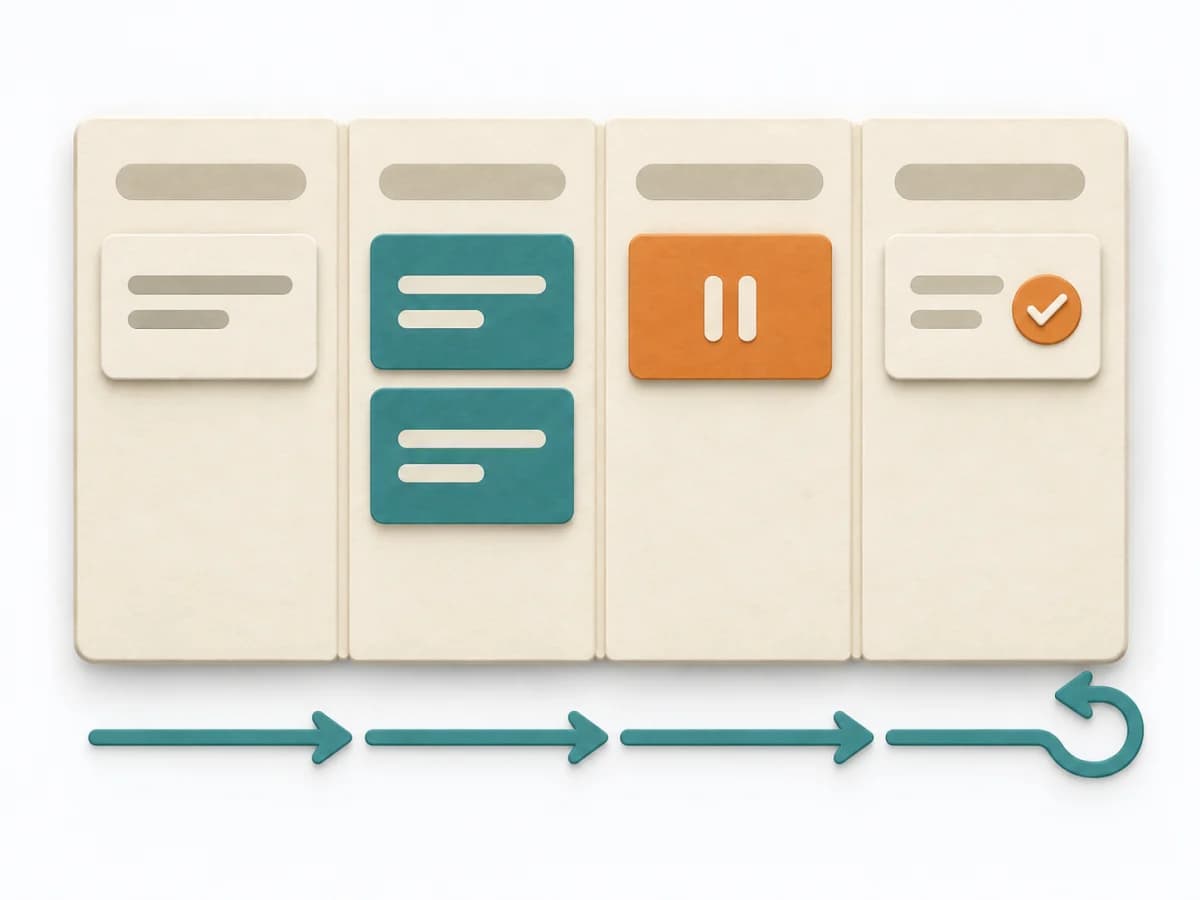 Engineering Kanban |  Systems Thinking Evaporating Cloud |  Product Strategy DIBB |
|---|---|---|---|---|
Purposedifferent | Leverage Points show exactly where interventions in a system produce a disproportionate effect. It draws relationships, patterns, and feedback loops. The result is captured as a leverage map and action strategy. | When work sits in too many parallel streams, throughput suffers and no one sees the bottlenecks. Kanban makes the flow of work visible and limits overload so a system becomes calmer and more predictable. | The method makes visible why two seemingly incompatible demands arise and which assumption must be tested to resolve the conflict. | DIBB helps clarify target groups, value, goals, and priorities by making the logic behind a decision explicit. It captures results as a DIBB document, belief list, bet list, and learning report. |
Complexitydifferent | High | Medium | Medium | Low |
Timedifferent | Half day | Ongoing | 60-120 min | 1-2 h |
Participantsdifferent | 3-12 | 2-12 | 2-8 | 2-8 |
Formatdifferent | Workshop | Workshop + async | Workshop | Workshop + async |
Outputdifferent | Leverage Map, Action Strategy | Kanban board, WIP policies, Flow metrics | Conflict Cloud, Assumption List, Breakthrough Ideas, Next Experiments | DIBB document, Belief list, Bet list, Learning report |
Tagsno overlap | Systems thinkingChangeStrategy | FlowVisual managementDelivery | Theory of ConstraintsAssumptionsSystems thinking | StrategyDecisionAssumptionsHypothesis |