View methods side by side.
Choose up to four methods. Add them using the search and share the comparison by copying its link.
Selected:Leverage PointsIntervention MappingFailure Mode and Effects AnalysisBusiness Model Stress Test
| Criterion |  Systems Thinking Leverage Points |  Systems Thinking Intervention Mapping |  Operations Failure Mode and Effects Analysis | 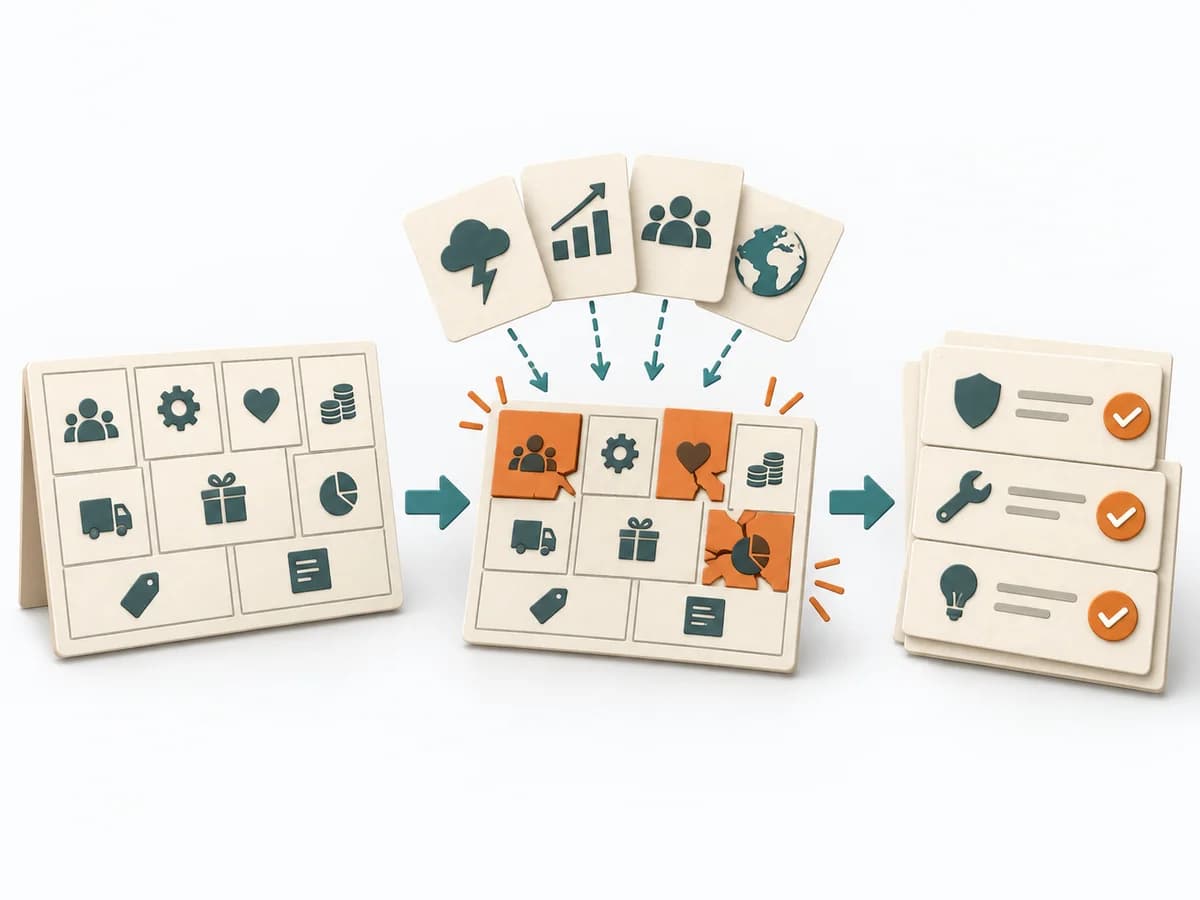 Business Strategy Business Model Stress Test |
|---|---|---|---|---|
Purposedifferent | Leverage Points show exactly where interventions in a system produce a disproportionate effect. It draws relationships, patterns, and feedback loops. The result is captured as a leverage map and action strategy. | Intervention Mapping translates a need for change into a planned, evaluable program. The method connects target group, determinants, actions, and measurement into a traceable chain. | For a process, product, or service with noticeable failure risks, the method assesses possible failure modes in advance. It directs attention to combinations of occurrence, effect, and detectability. | A Business Model Stress Test checks how well a business model holds up under pressure and headwinds. It compares strengths, risks, market logic, and courses of action. The result is captured as a stress-test report and action plan per scenario. |
Complexitysame | High | High | High | High |
Timedifferent | Half day | 1-5 Tage | 2-6 h | Half day |
Participantsdifferent | 3-12 | 4-12 | 3-10 | 3-8 |
Formatdifferent | Workshop | Workshop + async | Workshop | Workshop |
Outputdifferent | Leverage Map, Action Strategy | Logic Model, Change Objectives, Intervention Components, Evaluation Plan | FMEA Table, Risk Priority, Mitigation Actions | Stress Test Report, Action Plan per Scenario |
Tagsno overlap | Systems thinkingChangeStrategy | ChangeSystems thinkingCapability | RiskQualityOperationsRoot cause | StrategyBusiness modelRiskDiagnosis |